
The Misrepresentation of Migrant Narratives
A recent analytical paper has highlighted the troubling narratives surrounding the influx of irregular migrants heading to Ceuta at the end of July, which have been sensationalized as an "invasion." Such portrayals are deemed unfounded and politically charged, evoking unnecessary alarm and stigma. Published by the U.S. Committee for Refugees and Immigrants (USCRI), the paper argues that these narratives are part of a broader strategy to depict migrants as dangerous criminals who must be barred from entry, emphasizing the need to contextualize the events in Ceuta within a wider framework before delving into specifics.
The report attributes the surge in crossings to various factors, including a regularization program for migrants initiated by Spain in April 2026 and the potential for Morocco to open its borders in response. However, many critics question the direct correlation between the regularization process and the subsequent wave of crossings, pointing out that the program had concluded a month before the increase in attempted entries.
The immediate catalyst, according to the analysis, stems from a ruling by the Spanish Supreme Court on June 29, which mandated that migrants arriving via sea should be subjected to standard immigration procedures in Spain. This ruling was misinterpreted by social media users, who propagated the misleading message that entry by sea precluded the possibility of deportation.
The paper also noted the emergence of a slogan suggesting that "Spanish borders are open and can be crossed without papers," which spurred online gatherings on platforms like TikTok, Facebook, Instagram, X (formerly Twitter), and WhatsApp. Users shared the locations of vendors selling swimming gear and Google Maps links to areas with reduced security surveillance, painting a vivid picture of the desperate measures taken by those seeking to cross the border.
For many young Moroccans, particularly those aged 15 to 24, who face staggering unemployment rates of 29.2%, this social media campaign represented a glimmer of hope in an otherwise bleak future. The limited legal pathways for education and employment in the European Union have compelled these youth to take matters into their own hands, reminiscent of the protests by Generation Z across more than a dozen Moroccan cities in 2025, challenging the systemic inequalities they face.
The Human Cost of Border Policies
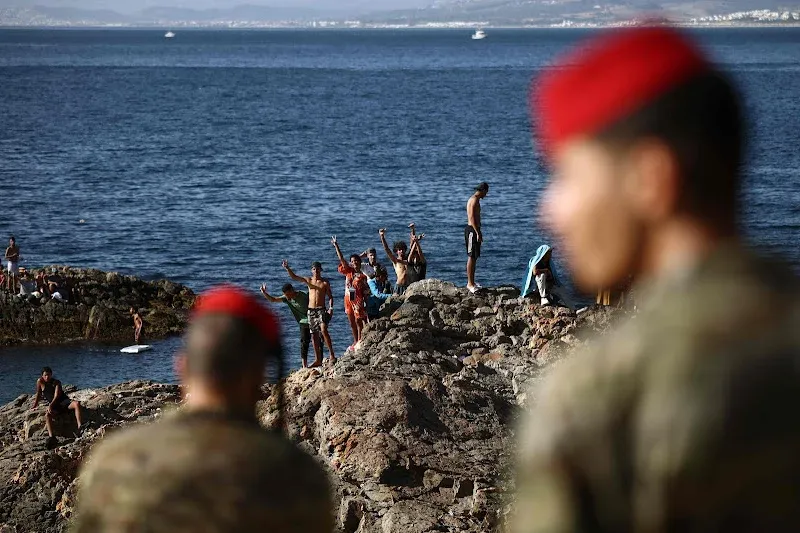
Between July 30 and 31, approximately 72,000 migrants crossed into Ceuta, including individuals from countries beyond Morocco, such as Sudan and Afghanistan. Tragically, many lost their lives during this perilous crossing, which has become increasingly deadly due to stringent border control policies. Reports indicate that some drowned, while others were crushed in stampedes while attempting to breach barriers.
The Moroccan authorities responded to this surge by deploying water cannons and tear gas to deter migrants from reaching Ceuta. Various sources report death tolls ranging from 100 to 141, with many more unaccounted for. The majority of those who entered Ceuta in late July were subsequently returned to Morocco as part of Spanish-Moroccan cooperation initiatives, leaving around a thousand unaccompanied minors among those who participated in the crossings.
According to reforms in Spanish immigration law enacted in 2025, unaccompanied minors from heavily pressured regions must be redistributed within 15 days of their case being processed, with the Spanish government allocating 25 million euros to support these minors and potentially facilitate their transfer to mainland Spain.
On July 31, Magnus Brunner, the European Commissioner for Migration, affirmed that "no one" had crossed into mainland Spain, despite some media and political narratives linking the events in Ceuta to the potential relocation of migrants to other European nations. On a humanitarian level, the implications of these crossings extend beyond the borders, with families congregating in the city of Fnideq, northern Morocco, seeking news about their relatives and their survival status. The poignant story of a farmer searching for his missing 17-year-old brother, while two of his friends returned, highlights the personal tragedies that accompany these events.
Parents displayed photographs of their children and relatives at the border fence, desperately seeking any information regarding their fates, underscoring that the individuals represented in migration statistics are, in fact, sons, daughters, brothers, and sisters whose families bear the emotional weight long after media attention wanes.
The report emphasizes that Morocco has consistently collaborated with the European Union to monitor migration toward Europe, citing a European program initiated in 2023 under the Neighbourhood, Development and International Cooperation Instrument, which allocated 152 million euros to bolster border management systems in Morocco. This cooperation reflects a broader trend of transferring parts of European border control to countries situated outside the EU's actual borders.
While EU citizens can travel to Morocco visa-free, many Moroccans and migrants from the Global South risk their lives in attempts to reach Europe, driven by the belief that they can find employment opportunities or escape persecution. In 2025, 2,185 cases of death or disappearance among migrants in the Mediterranean Sea were recorded.
Furthermore, numerous media outlets have exploited the situation and associated imagery to propagate a narrative centered on "invasion and crime," with some European leaders claiming that these migrants were en route to other European countries such as Germany and Italy. In this context, Spanish Prime Minister Pedro Sánchez condemned the "selfish, polarizing, and illegal" reactions from other European nations, particularly as countries like Italy and France tightened their border controls against arrivals from Spain.
The report concludes by stating that the border scenario, which media outlets often transform into a spectacle, is not a novel occurrence. The resulting harm and loss of human life are also not new, calling for a nuanced understanding of the events in Ceuta within their broader humanitarian and political context, rather than reducing migrants to mere statistics and narratives surrounding crossing attempts.
As reported by hespress.com.