
Deconstructing the Spanish Collective Imagination
In a profound analysis, thinker Mohamed Nour El-Din Afaya dissects the negative perceptions that have been embedded in the Spanish collective imagination regarding Moroccans over centuries. He emphasizes the importance of understanding and addressing the extent to which these notions occupy the consciousness of various social and intellectual elite circles in Spain, the northern neighbor of Morocco. Afaya argues that two institutions have significantly shaped the collective Spanish imagination: the Church and the military. He interprets recent expressions of this imagination during the events at the occupied Ceuta as not merely isolated statements or personal opinions, but as reflections of a broader historical context. He contends that the extensive modernization processes affecting Spanish society, economy, and politics have not been accompanied by a parallel reassessment of the outdated views long held about the 'Other,' particularly the Moroccan.
Afaya, the author of "The Imagined West," reveals the underlying meanings of the terms used by both moderate and extreme factions in Spanish society, as well as by Spanish officials. He notes that these terms reflect a continuity of a 'historical, illusory fear' that many harbor regarding a renewed desire among the 'Moros' and Moriscos for 'revenge.' He examines key historical milestones including Orientalism, colonialism, the Battle of Annual against occupation, the Spanish Civil War and its repercussions, and the Green March. Furthermore, he highlights the existence of a small yet notable segment of the Spanish elite that has opposed the derogatory stereotypes directed at Moroccans and Morocco. He calls for an effort beyond mere intentions and slogans of coexistence and shared interests, advocating for a direct confrontation with the "perspective" and "strong tension" present in the Spanish collective imagination against Moroccans, Arabs, and Muslims.
The Complexity of Spanish-Moroccan Relations
The historical relationship between Morocco and Spain has often manifested as a complex interplay of admiration and disdain, especially during moments of conflict, dramatic events, colonial ambitions, or declarations of subjugation and humiliation. The recent events at the end of July 2026 exemplify a chapter in this tumultuous history, where latent expressions of the Spanish collective imagination erupted, revealing long-silenced judgments that re-emerged within the political and media discourse. These relations have oscillated between confrontation and reconciliation since the arrival of Muslims in Andalusia in the eighth century. Significant historical events have been penned that illuminate the collective imaginations of both nations, weaving narratives that have been profoundly influenced by geography and history, and shaped by the dialectic of control and liberation.
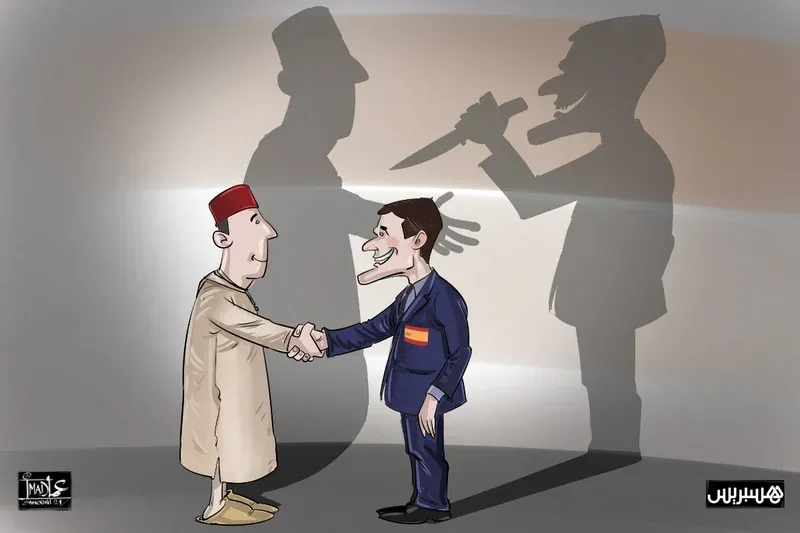
Notable episodes in this bilateral relationship include direct confrontations, such as the Battle of Tetouan in 1859-1860, the occupation of the Sahara in 1884, the Green Island Conference in 1906, and the infamous Battle of Annual in 1921. These events contributed to an enduring negative perception of Moroccans, increasingly marked by hostility and prejudice over time. This perception frames Spain as a country of civilization, progress, and freedom, contrasting it with Morocco, viewed as a land of savagery, violence, and despotism. Spanish historian Eloy Martin Corrales has dissected these components in his work "The Image of the Moroccan in the Spanish Imagination," showcasing how depictions of Moroccans as animals, akin to monkeys or dogs, have historically served as a method of dehumanization by Spanish religious, political, and cultural elites.
Amidst these confrontations, Spaniards have created a plethora of derogatory terms for Moroccans, at times labeling them as Aragenos, Arabs, Saracens, and more recently, Moros. Such derogatory terms have become entrenched within the Spanish collective imagination, particularly in light of recent events in Ceuta and Melilla. The Church and military stand as the two primary institutions that have propagated this hostile imagination. The Church has drawn from the Latin Christian perspective on Islam throughout the medieval period and the Crusades, while the military has shaped its narrative based on its historical conflicts with Moroccan forces. Therefore, it is unsurprising that recent events in Ceuta prompted fierce rhetoric from religious leaders and military officials, calling for aggressive actions against Morocco and framing it within the context of defending Spanish sovereignty. These statements should not be viewed in isolation; they reflect a broader societal mindset where modernization has not dismantled the archaic views of the 'Other.'
This entrenched perspective fosters a range of prejudices against Moroccans, prevalent traits attributed to them include intolerance, savagery, and deceit, which have been significantly influenced by medieval Christian imaginings. The Spanish Church, wielding considerable influence, continues to exploit these sentiments, especially during periods of tension between Spain and Morocco, as evidenced by calls for military action against the Moroccan capital, Rabat. As we look to the future, addressing these ingrained prejudices and fostering a more nuanced understanding of Moroccan identity is essential for the evolution of Spanish-Moroccan relations. The task is not merely one of dialogue but requires a sincere commitment to dismantling the stereotypes that have long dictated perceptions on both sides.
As reported by hespress.com.