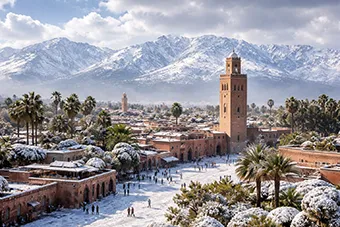

This April weekend in 2026 has brought Morocco an extraordinary weather event, with Marrakech experiencing a dramatic hailstorm while the Atlas Mountains are blanketed in snow. Since Friday, April 10, the kingdom has been affected by severe storms, a rarity for this time of year. The "Red City," as Marrakech is known, was transformed overnight as hail accumulated, creating the illusion of snow in spring. Social media erupted with videos showcasing streets covered in white, terraces littered with hailstones, and traffic grinding to a halt on slippery roads.
The General Directorate of Meteorology (DGM) clarified the situation, stating that contrary to the excitement among many internet users, what fell was indeed hail, locally referred to as "tiberouri," rather than snow. This phenomenon is attributed to a classic yet particularly intense atmospheric mechanism: an Atlantic low-pressure system containing cold air aloft met with significantly warmer surface air, resulting in strong instability and the formation of powerful thunderstorm clouds known as cumulonimbus.
While Marrakech witnessed this brief yet spectacular natural spectacle, the return of winter in the Moroccan mountains is undeniable. Snowfall is expected from Saturday, April 11, to Sunday, April 12, at elevations above 1,800 meters, with fresh accumulations ranging from 10 to 20 centimeters in the provinces of Midelt, Khénifra, Ifrane, Béni Mellal, Azilal, Al Haouz, and Tinghir. The DGM has issued an orange warning for several provinces throughout the weekend.
This unusual event is part of a broader disturbance phase, accompanied by thunderstorms bringing up to 35 mm of rainfall and a risk of hail along a corridor stretching from Marrakech to Khouribga. The weather system expanded overnight into eastern regions, including Taza, Figuig, Jerada, and Guercif, marking a shift of the phenomenon towards the northeastern part of the country.
Snow in April: Rare Yet Not Unprecedented
Is snowfall in April truly an anomaly in Morocco? The peaks of the Atlas, reaching over 4,000 meters with Jebel Toubkal, regularly receive snow into April and occasionally even in May during late cold snaps. What is surprising, however, is the intensity and vast geographical spread of this event, particularly when combined with the dramatic hail in the plains.
When questioned about a possible connection to climate change, the DGM responded cautiously, asserting that such occurrences are part of normal meteorological fluctuations during spring, a season often characterized by unstable weather patterns in Morocco.
Nevertheless, the winter of 2025-2026 has been marked by repeated snowfalls, especially along the route from Marrakech to Ouarzazate via the Tizi n’Tichka pass, which has frequently been blocked due to severe weather. This April weekend thus extends an already unpredictable season and serves as a reminder that Morocco is not solely a land of sunshine but also a region of mountains and impressive climatic contrasts.
As reported by africa-live.de.