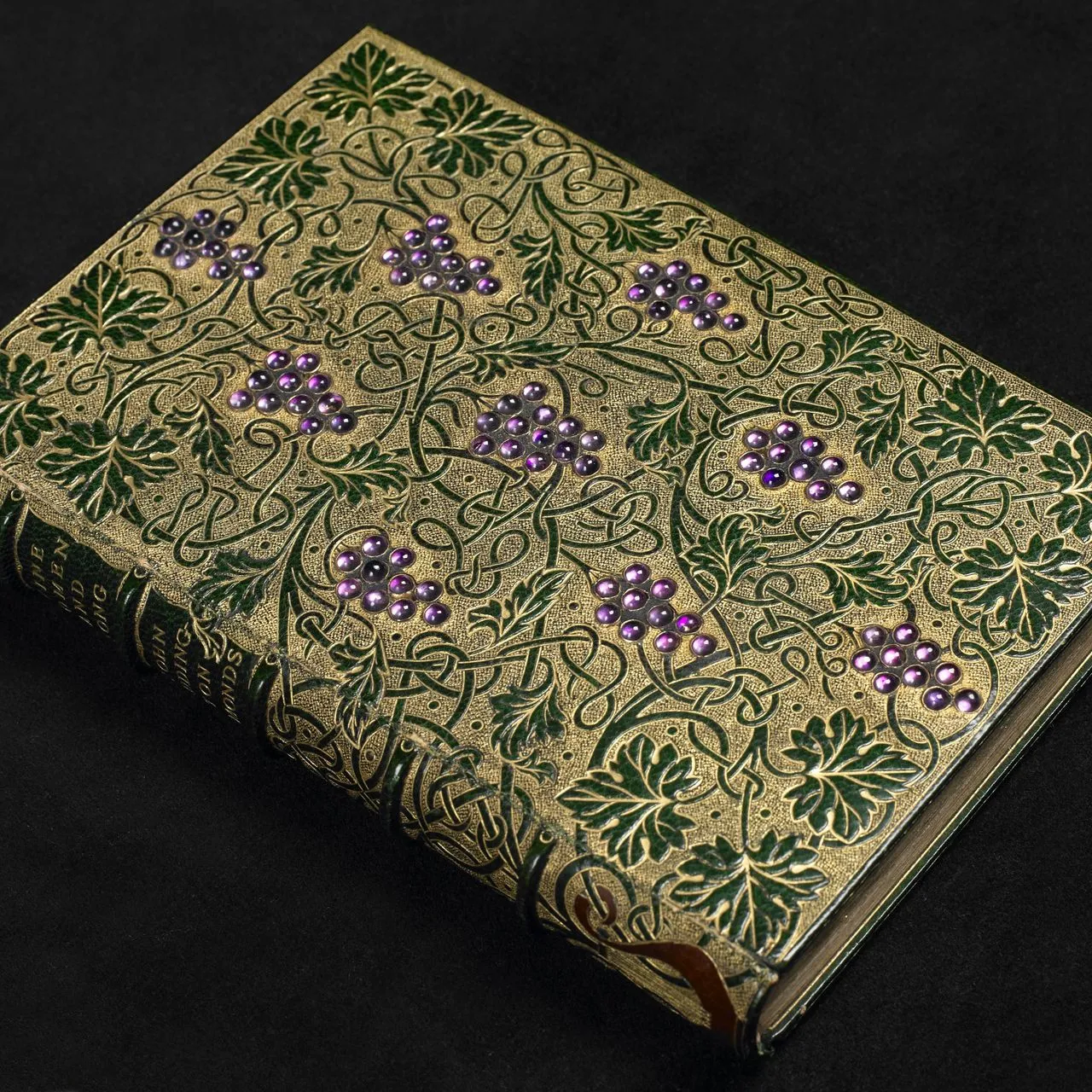

Exploring the Jewel of Bookbinding from the 19th Century
Within the hallowed halls of the Cooper Hewitt, Smithsonian Design Museum Library lies a captivating piece of literary and artistic history, a stunning book titled 'Wine, Women, and Song'. This rare volume, originally published in 1884 and translated by the esteemed John Addington Symonds, is not just notable for its text but also for its exquisite binding, which reflects the opulence and artistic trends favored by the elite at the end of the 19th century. The book's allure is amplified by its striking cover, crafted by the renowned London artisans Sangorski & Sutcliffe, whose commissions were synonymous with luxury and craftsmanship during that period.
The binding of 'Wine, Women, and Song' is a remarkable example of the jeweled bookbinding revival, showcasing a rich green Morocco leather adorned with intricate grapevine motifs set against a shimmering gold stippled background. Each bunch of grapes is meticulously formed from smooth-cut amethyst cabochons, elegantly mounted in gold, resulting in a visually arresting cover that is further embellished with a total of 190 sparkling amethysts. This binding, commissioned by John Harrison Stonehouse, the director of the historic bookshop Sotheran's in London, serves not only as a protective container for the book but also as a testament to the intricate artistry of the time.
The Cultural Significance of 'Wine, Women, and Song'
While the exterior of 'Wine, Women, and Song' dazzles with its opulent design, its contents are equally profound. The book features a collection of 60 poems translated from the Latin Carmina Burana, a medieval manuscript that provides a vibrant glimpse into the cultural and societal dynamics of 11th and 12th century Europe. The Goliards, the anonymous poets behind these works, celebrated themes of hedonism and offered satirical critiques of contemporary society and the Catholic Church, thus enriching our understanding of medieval life and its complexities.
Symonds's translation, published by the reputable London firm Chatto & Windus, counters the misconception that the Middle Ages were solely a period of gloom and despair, revealing instead a time of vibrant expression and intellectual curiosity. The provenance of this particular copy adds to its historical significance; it was once owned by Edwin C. May, a notable figure in Pittsburgh's Jewish community, who gifted it to his wife, Gertrude Brilles May, in 1925. Such connections to past owners enhance the book's narrative, intertwining themes of craftsmanship, literature, and the social tapestry of its time.
The artistry of 'Wine, Women, and Song' encapsulates the essence of a bygone era while simultaneously resonating with modern interpretations of hedonistic pursuits, mirroring the familiar refrain of 'sex, drugs, and rock and roll' in contemporary culture. This exquisite book stands as a celebration of both the tangible beauty of its physical form and the timeless nature of its literary content, inviting us to reflect on the enduring interplay between art and literature.
As reported by smithsonianmag.com.