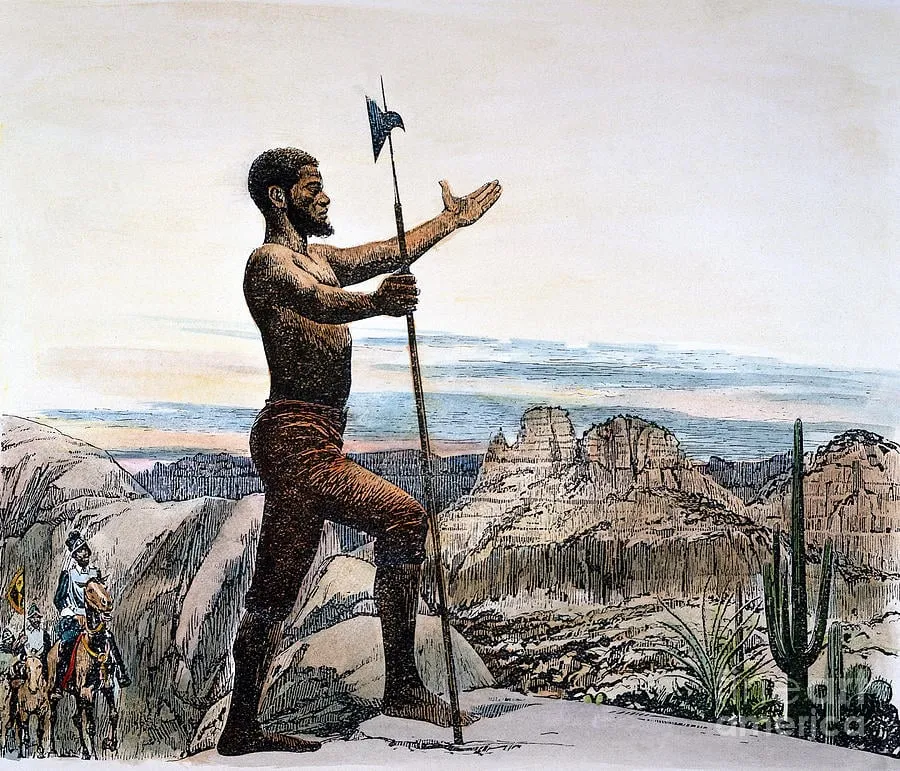

Estevanico: A Pioneering Explorer of Early America
The BBC has brought to light the remarkable journey of Mustapha Zemmouri, known in Western history as Estevanico, who stands as one of the earliest Africans and Muslims to traverse what is now the United States. This feature, published recently, meticulously outlines Zemmouri’s odyssey that commenced in Azemmour, Morocco, during the early 16th century. His life took a dramatic turn when he was enslaved by Spanish nobleman Andrés Dorantes de Carranza, leading him to partake in a Spanish expedition to the Americas.
Zemmouri’s tale is particularly captivating as it recounts the ill-fated expedition of 1527, which set sail from Spain with around 600 men aiming to conquer regions that are now known as Florida and the Gulf Coast. The expedition faced catastrophic challenges, including shipwrecks, rampant disease, starvation, and hostile encounters, ultimately leaving only four survivors, one of whom was Zemmouri himself.
The Historic Journey Across North America
Historians referenced by the BBC highlight Zemmouri's significant role in what is believed to be the first documented crossing of North America. Between the years 1528 and 1536, he undertook a monumental journey, traversing thousands of miles on foot from Florida through the American Southwest and into Mexico. This venture not only marked a significant geographical milestone but also underscored Zemmouri's invaluable contribution as a translator, scout, and intermediary among various Indigenous communities. His linguistic skills and cultural adaptability were crucial in navigating the complexities of unfamiliar territories.
Hsain Ilahiane, an academic featured in the report, described Zemmouri as “one of the most extraordinary, yet overlooked, figures in the early history of what would become the American Southwest.” In recent years, there has been a growing interest in Zemmouri’s legacy throughout the United States. Various institutions, including museums and historical tours, are increasingly acknowledging his pivotal role in shaping the early narratives of American history, especially in anticipation of the 250th anniversary of the nation.
A bronze statue commemorating Estevanico stands proudly at the Texas State Capitol, while numerous museums across the country host exhibitions dedicated to his extraordinary journey. His final expedition in 1539 was instrumental in guiding Spanish explorers deeper into territories that would eventually become Texas, Arizona, and New Mexico, thereby enhancing Spain’s understanding of the region's geography.
Despite the profound historical significance of Zemmouri’s contributions, the BBC emphasizes that he remains largely absent from mainstream narratives of early American history. Laila Lalami articulates what makes Zemmouri's story particularly compelling, noting, “What makes him so fascinating is his position: he didn’t come to the U.S. as a conqueror, and he wasn’t part of the people who were conquered. He was something in between.”
As reported by barlamantoday.com.