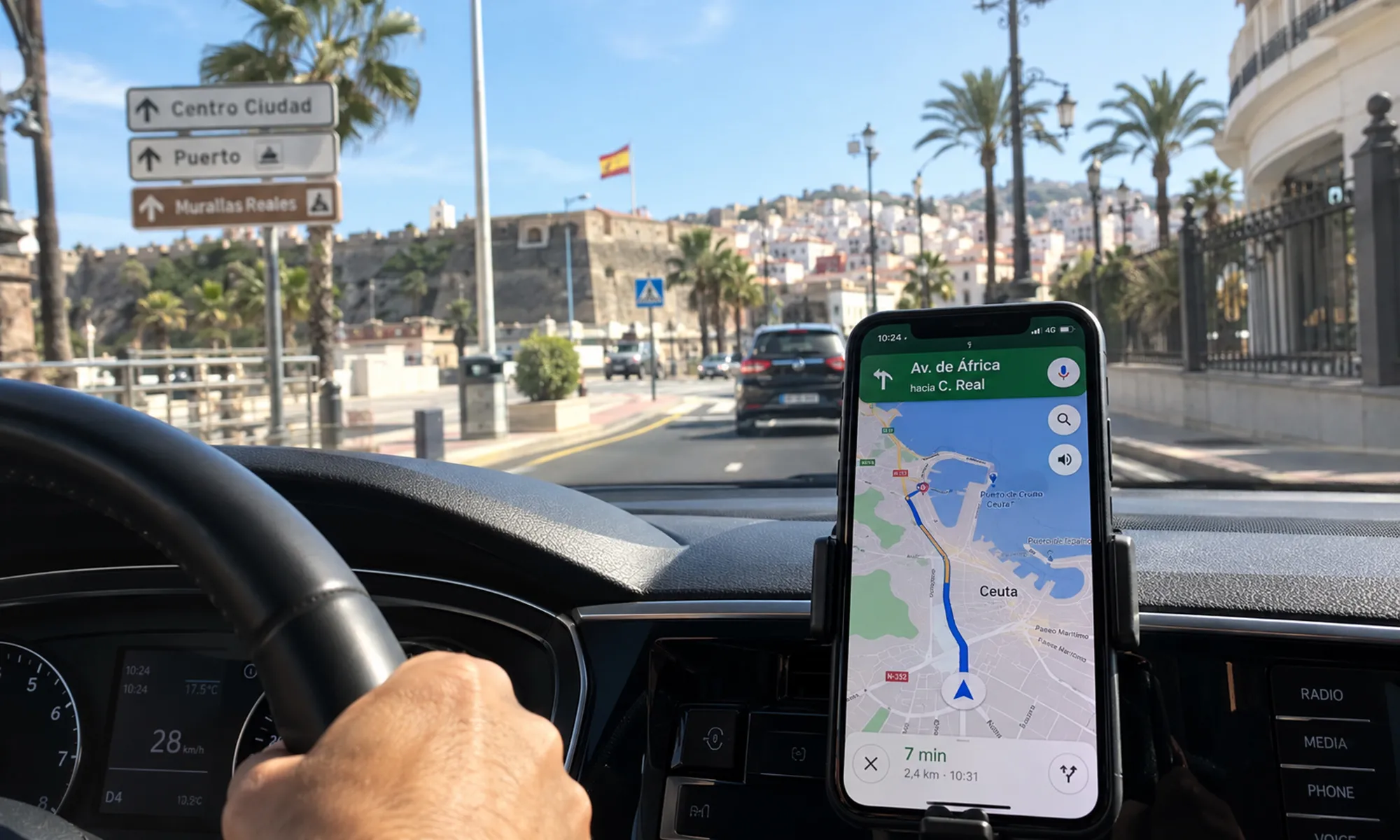
Google Maps Under Scrutiny Over Ceuta and Melilla Border Representation
The ongoing discussion around how Google Maps depicts the borders of Ceuta and Melilla in relation to Morocco has escalated to the European Parliament. The Petitions Committee has decided to proceed with an initiative that seeks to investigate whether the dashed lines used by Google could lead to the misconception that these Spanish cities are disputed territories. The next step in this process will involve examining whether this representation conflicts with the obligations of large platforms under the Digital Services Act (DSA). As of now, there are no fines or sanction procedures initiated against Google regarding this matter.
While the issue may initially seem purely cartographic, it has significant implications for a platform that millions of users rely on daily for navigation, route planning, and checking roadways and borders. The dashed lines in question do not accurately reflect the reality of the situation.
Understanding Google Maps' Disputed Border Representation
Google Maps employs distinct graphical representations for various types of international borders. Borders deemed undisputed are depicted with solid lines, whereas disputed borders are shown with dashed gray lines by Google, indicating a lack of consensus on where the boundary lies. Additionally, dashed lines may represent provisional boundaries or those resulting from treaties that are not considered definitively established.
This specific symbolism is applied to the land borders of Ceuta and Melilla with Morocco. The petition submitted to the European Parliament, recorded as 2284/2026, argues that this representation may create a misleading perception regarding the legal status of these two cities and the external borders of the European Union. It is critical to note that Ceuta and Melilla are autonomous Spanish cities and are not in dispute.
Importantly, the decision made by the Petitions Committee does not equate to launching a sanctioning procedure against Google, nor does it imply that Brussels has concluded the platform is in violation of the law. Instead, it represents a step towards further consideration of the petition to assess if the matter warrants examination under the Digital Services Act (DSA), which mandates large digital platforms to analyze and mitigate certain systemic risks associated with their services.
If the European Commission later determines a violation, the legislation permits fines of up to 6% of the global annual revenue of the implicated provider. This percentage constitutes the maximum legal penalty and is not a specific fine proposed for the current situation.
With the recent migratory crisis affecting Ceuta, Google Maps is under the scrutiny of the EU, highlighting the relevance of this issue.
The debate extends far beyond a mere line on a map. The initiative calls for Google to depict the borders of Ceuta and Melilla using solid international lines. However, for Google, the borders on their maps are not merely a visual feature; they reflect its classification of various existing political and territorial situations worldwide. Consequently, any potential change could have implications beyond this specific case, determining the extent to which European regulations on digital platforms can influence how major mapping services represent borders and territorial disputes.
At this juncture, the notable development is not that Europe is poised to fine Google Maps, but rather that the European Parliament has agreed to continue examining a petition that could compel Brussels to address whether this representation aligns with Google’s digital obligations within the EU.
As reported by hibridosyelectricos.com.