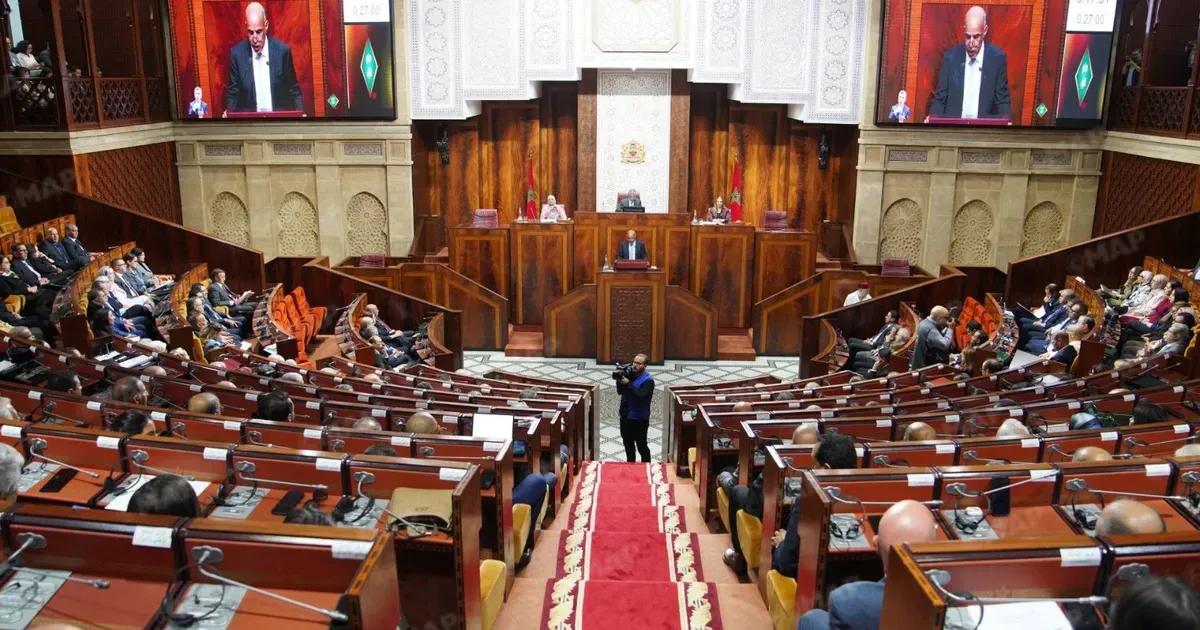
The Moroccan Parliament has officially endorsed the government program presented by Prime Minister Fatima Zahra Mansouri, securing the approval of 204 deputies while 127 opposed it. This vote signifies a crucial step for the new government as it aims to establish the foundations of a "social state" and accelerate economic growth, despite facing the daunting challenge of converting its promises into tangible results amidst strict financial constraints. The public anticipates how the government's social and economic commitments will impact their daily lives.
According to Moroccan News Agency reports, the vote granted the new government the trust of the House of Representatives as stipulated in Article 88 of the Constitution, which requires an absolute majority of council members to endorse its program for its installation. With the Parliament's approval, the new government meets the necessary constitutional requirements for its formation.
The members of the new government took the oath of office before King Mohammed VI last Friday after Fatima Zahra Mansouri was tasked with forming it in late September. The opposition parties within the Moroccan Parliament have expressed concerns that the government program lacks a clear reform vision, citing the absence of specific indicators and timelines for executing economic and social commitments, as well as a lack of practical measures and contradictions between electoral promises and the governmental composition, which they claim has overlooked strategic sectors.
Social Support and Economic Implications
The coalition government led by Fatima Mansouri has emphasized that its program aims to solidify the foundations of a "social state" and accelerate growth. Observers note that this program represents an attempt to transition from mobilizing investments and initiating reforms to evaluating their economic, social, and national effectiveness. However, the implementation faces challenges due to strict financial constraints. Moroccans are cautiously optimistic about the social promises made by the government. For example, 64-year-old former private sector employee Abdul Wahid, who receives a pension of only 1,000 dirhams (approximately $102), stated that raising the minimum pension to 3,000 dirhams would significantly help thousands of families escape vulnerability.
Fatima, a 41-year-old mother of three who benefits from a direct social support program, expressed her relative satisfaction with the government's promise to gradually increase support from 500 to 1,000 dirhams, stating that the 500 dirhams had greatly assisted her in coping with rising food prices. If this amount doubles, it would significantly alleviate the burden of ongoing price hikes.
Economic expert Rashid Sari, president of the African Center for Strategic Studies and Digitization, explained that the government initially may not have been able to bear the cost of regular social support of 500 dirhams as easily as some might think. He added that raising the amount to 1,000 dirhams for over 2.9 million beneficiaries without strict controls or clear funding sources could impose a heavy financial burden on the public treasury, potentially forcing it to borrow against investment budgets or causing structural imbalances in the overall economic balance.
Growth Targets and Tax Reforms
The macroeconomic framework of the government program highlights a significant disparity between political ambitions and economic reality, targeting an average annual growth rate of 5% from 2027 to 2031 while aiming to limit the budget deficit to 3%. However, these targets appear optimistic compared to the Bank of Morocco's expectations, which predict growth will not exceed 2.9% in 2027, with budget deficits projected at 3.4% in 2026 and 3.5% in 2027. This gap indicates that the government is relying on overly optimistic assumptions, including an anticipated exceptional agricultural yield of 7 million tons annually, while the non-agricultural sectors are not contributing sufficiently to wealth creation and job opportunities.
Another critical promise from the ruling party, the Authenticity and Modernity Party, was a reduction in income tax. Nevertheless, the government program reveals a notable retreat from these commitments, scaling back tax reform ambitions. While the electoral program proposed radical reforms to exempt gross salaries below 15,000 dirhams, the government program has raised the income tax exemption threshold to just 60,000 dirhams annually. Experts note that this reduction will result in immediate and significant tax losses for the budget, estimated at around 4.9 billion dirhams due to the decrease in the maximum tax rate.
As the government embarks on this ambitious journey, experts like Amin Sami emphasize that the greatest challenge lies in transitioning from a model focused on increasing investment inputs to one that elevates productivity, develops local suppliers, transfers technology, and enhances value addition while integrating water, energy, and climate constraints into investment decisions. The coming five years will serve as a crucial test for the government's capacity to shift from fragmented sectoral management to integrated management, ensuring accountability across all sectors and regions regarding the impact of mobilized resources.
As reported by asharq.com.