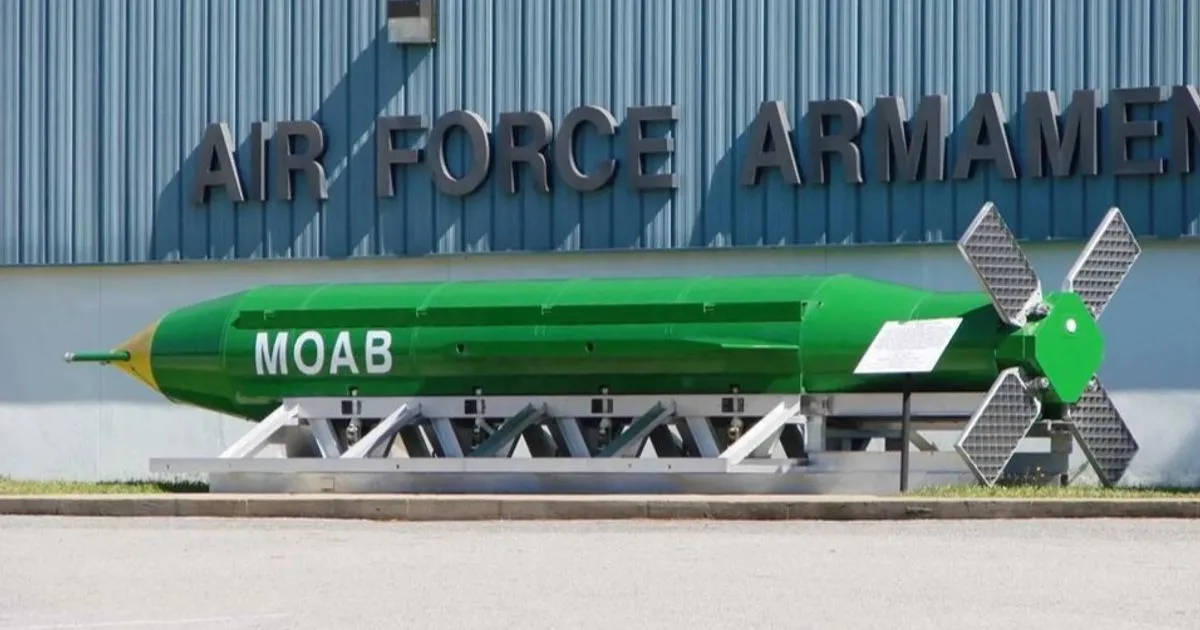
U.S. Military Considers Using the MOAB Against Iran
The United States military has devised new strike plans that include the potential use of the GBU-43/B, commonly known as the "Mother of All Bombs" (MOAB), aimed at targeting Iranian energy infrastructure and nuclear sites. This information comes from U.S. officials and was reported by CNN, highlighting a significant escalation in military strategy should President Donald Trump authorize a resumption of military operations against Iran.
The deployment of the MOAB, which is the largest non-nuclear bomb in the U.S. arsenal, represents a noteworthy increase in military action if used against Iranian targets for the first time. However, questions remain regarding its effectiveness in achieving strategic military goals or altering the course of the ongoing conflict.
Political Pressures and Additional Options
Amid increasing political pressure to conclude an unpopular war, President Trump is bracing for potential electoral backlash in the upcoming midterm elections. After more than six months of sustained American bombing, there are no indications that either side is nearing a negotiated settlement. In a recent interview with Newsmax, Trump stated, "It is not nuclear at all, it is just a very large bomb... it is like a small nuclear weapon, but it is not nuclear."
According to sources, Trump has instructed the military to prepare additional strike options against Iranian targets, which include "massive energy infrastructure" and the possibility of deploying the MOAB. The phrasing of this directive suggests that any attack might occur before the withdrawal of U.S. forces from the Central Command area of responsibility, indicating a potential strategy to execute strikes, declare victory, and quickly pull out troops.
A second source confirmed that plans specifically targeting nuclear sites, including the Kuh-e Khaas, explicitly mention the use of the MOAB. Trump has repeatedly hinted at targeting this mountain, as Washington and Tel Aviv believe it harbors components linked to Iran's nuclear program, even after large-scale combat operations were scaled back earlier in the year. A third American official noted that the military is preparing a range of options for decision-makers, varying from advanced to less costly solutions, with deeper buried targets requiring larger bombs.
The MOAB can destroy an area equivalent to nine city blocks, but it was not specifically designed to penetrate deeply fortified structures. This raises doubts about its capability to demolish facilities believed to be fortified with granite layers, such as those suspected in Kuh-e Khaas. A source familiar with the discussions told CNN that the bomb is "a distinctive weapon for clearing vast areas," but it is not designed to be a warhead capable of deep penetration. Sources indicate that its destructive impact will likely be concentrated at ground level.
The extensive blast radius raises concerns about civilian casualties, especially if infrastructure is targeted close to populated areas or non-military sites. Nevertheless, Trump may opt to use it as a psychological weapon, particularly as the Iranian regime seems entrenched in its stance and unresponsive to diplomatic overtures, according to CNN.
Developed in the early 2000s, the MOAB was unveiled during preparations for the invasion of Iraq in 2003. It is an airburst warhead that detonates before making contact with the ground, releasing a massive shockwave in all directions. Military officials stated during final testing phases in 2003 that it was primarily designed as a psychological operations weapon. Initially, it was aimed at large troop formations, equipment, and fortified surface bunkers, but its target scope has expanded to include caves and tunnels buried beneath softer surfaces.
Trump became the first U.S. president to utilize the MOAB when he authorized a strike against ISIS positions in Afghanistan during his first term in 2017. This attack targeted a fortified tunnel network and reportedly killed 36 militants, according to Afghan authorities at the time. Afghan and U.S. officials mentioned that the explosion destroyed three tunnels, weapons, and munitions without causing civilian casualties.
The MOAB is notable for containing 86.3% explosives of its total mass of 9,850 kilograms, with the aluminum casing weighing about 1,300 kilograms and around 50 kilograms allocated for other components. This makes it the largest conventional air-dropped bomb in the U.S. arsenal in terms of explosive content, as noted by Army Recognition. Its nominal explosive power is equivalent to 11 tons of TNT, translating to approximately 46 gigajoules of energy. A total of 15 bombs were manufactured at the McAlester Army Ammunition Plant in Oklahoma beginning in 2003, with a historical unit cost of $170,000, reflecting the use of existing components and internal development resources, not including the cost of reactivating production in 2026.
The deployment mechanism imposes restrictions concerning operations against Iran. The bomb was designed to be dropped from the MC-130E Combat Talon I and MC-130H Combat Talon II aircraft, both of which are currently out of service in the U.S. Air Force, although tests and operations have relied on modified transport aircraft from the C-130 family. The bomb is released from the rear opening via parachutes, then separates and reaches its target through GPS guidance, inertial navigation, and lattice fins. Due to its lack of propulsion, it does not reach the range of cruise missiles like the AGM-158 JASSM or the B-2 Spirit bombers, which necessitates that a C-130 aircraft be positioned at an appropriate launch location. This presents a significant constraint if Iranian fighters or surface-to-air missile systems remain operational near the target. Additionally, the withdrawal of original MC-130 variants raises practical concerns regarding the available aircraft and delivery arrangements capable of supporting such a mission.
The GBU-57A/B Massive Ordnance Penetrator (MOP) illustrates that explosive mass alone does not dictate effectiveness against deep facilities. Its body weighs 12,304 kilograms and contains 2,423 kilograms of explosives, roughly 3.51 times less than the MOAB's 8,500 kilograms. However, it relies on a high-strength steel body (BLU-127), an inertial and GPS guidance system (KMU-612), and an intelligent fuse that detonates it after penetrating solid materials. Its estimated penetration depth is approximately 18 meters of reinforced concrete or 60 meters of soil under specific conditions, noting that the hardness of granite and geological layers may reduce its effectiveness.
As reported by defensearabia.com.