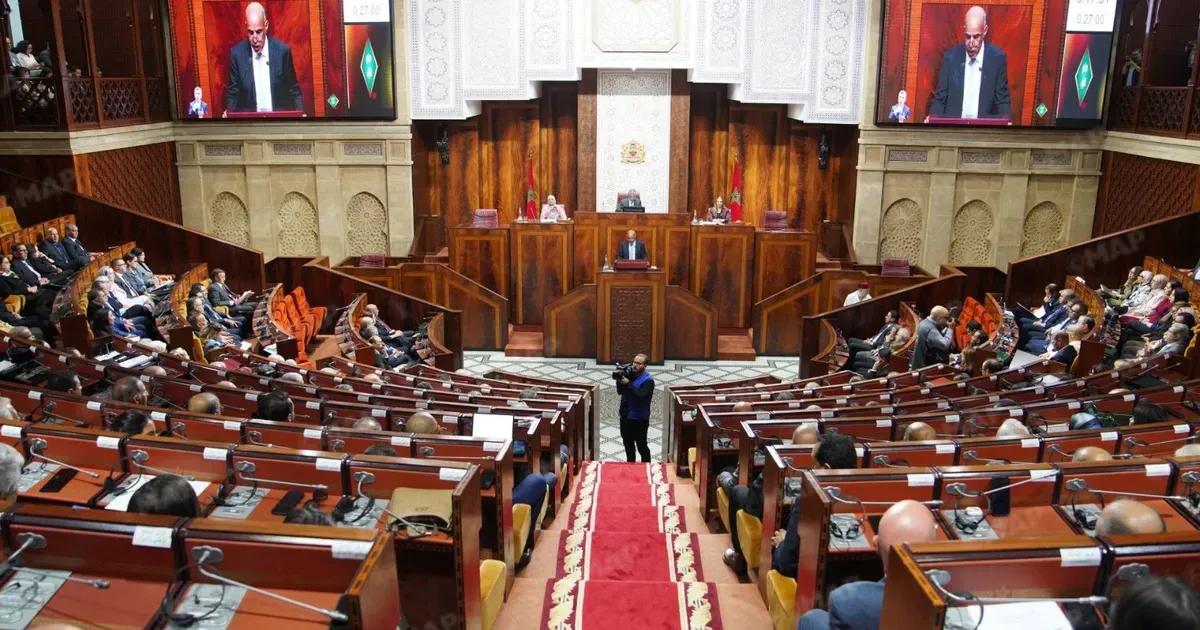
The Moroccan House of Representatives approved the government's program presented by Prime Minister Fatima Zahra Mansouri on Thursday, securing the backing of 204 deputies against 127 who opposed it. This critical vote marks a significant step in the establishment of the new government, which is now tasked with translating its ambitious social and economic promises into tangible results amidst stringent financial constraints.
The Moroccan News Agency reported that the confidence vote granted the new government the legitimacy required under Article 88 of the Constitution, which mandates an absolute majority of the council members' approval for the government program to be formally installed. Following this legislative endorsement, the new cabinet had previously taken an oath of office before King Mohammed VI last Friday, after being entrusted to form the government in late September.
Challenges Ahead for the New Government
While the coalition government led by Mansouri aims to lay the groundwork for a "social state" and accelerate economic growth, it faces the formidable challenge of fulfilling its commitments in a context marked by strict financial limitations. This situation has sparked public anticipation regarding how the government's social and economic pledges will impact the lives of citizens. Members of the opposition in the Moroccan Parliament have criticized the government program, claiming it lacks a clear reform vision and fails to provide specific indicators or timelines for implementing economic and social commitments. Furthermore, they argue that the program does not adequately address key sectors that are crucial for achieving the desired reforms.
During a general session dedicated to discussing the program, opposition members highlighted what they described as a diminishing focus on ethical governance, particularly concerning commitments to combat corruption and conflict of interests. They expressed concerns over the government's approach to these pressing issues, emphasizing the need for greater transparency and accountability.
Social Support Initiatives and Economic Projections
The coalition government, under Fatima Mansouri's leadership, asserts that its program is designed to solidify the foundations of a "social state" and accelerate growth. Observers view this program as a crucial attempt to transition from investment mobilization to a phase focused on evaluating economic and social returns. However, experts warn that the execution of these initiatives will be tested by their feasibility in light of stringent financial constraints.
Moroccans are cautiously optimistic about the social promises made by the government. For instance, a 64-year-old retiree expressed hope that raising the minimum pension to 3,000 dirhams would provide relief to vulnerable families. On the other hand, a mother of three beneficiaries of direct social support voiced her relief regarding the government's commitment to gradually increase support from 500 to 1,000 dirhams, stressing the importance of this financial assistance in coping with rising food prices.
Economic expert Rashid Sari pointed out that the government faces significant financial challenges in implementing these social support programs. He noted that increasing the support amount without strict regulations or clear funding sources could burden the public treasury heavily, potentially requiring future borrowing that may jeopardize investment budgets and lead to structural imbalances in the overall economy.
In terms of economic growth targets, the government's program aims for an annual growth rate of 5% from 2027 to 2031 while maintaining a budget deficit within 3%. However, these targets appear optimistic compared to the central bank's forecast of 2.9% growth in 2027. Analysts argue that achieving such ambitious growth rates necessitates identifying clear sectoral drivers, particularly in agriculture, which may be overly relied upon without adequate contributions from non-agricultural sectors to generate wealth and create jobs.
Despite the challenges ahead, the government is committed to advancing its agenda, and the next five years will be crucial in determining its ability to transition from fragmented sectoral management to integrated governance that effectively addresses the needs of the Moroccan people.
As reported by asharq.com.