
The Unforgettable Solar Eclipse Experience in Morocco
On the evening of August 12, 2026, Morocco experienced a remarkable astronomical event that set it apart from any ordinary summer evening. Approximately an hour and a half before sunset, observers noted that the sun began to lose its circular shape as the moon moved into position, partially obscuring the sun's light. This stunning celestial phenomenon captivated the attention of people across the nation, from north to south, transforming the partial eclipse into a moment of deep reflection and awe for all those who gazed skyward.
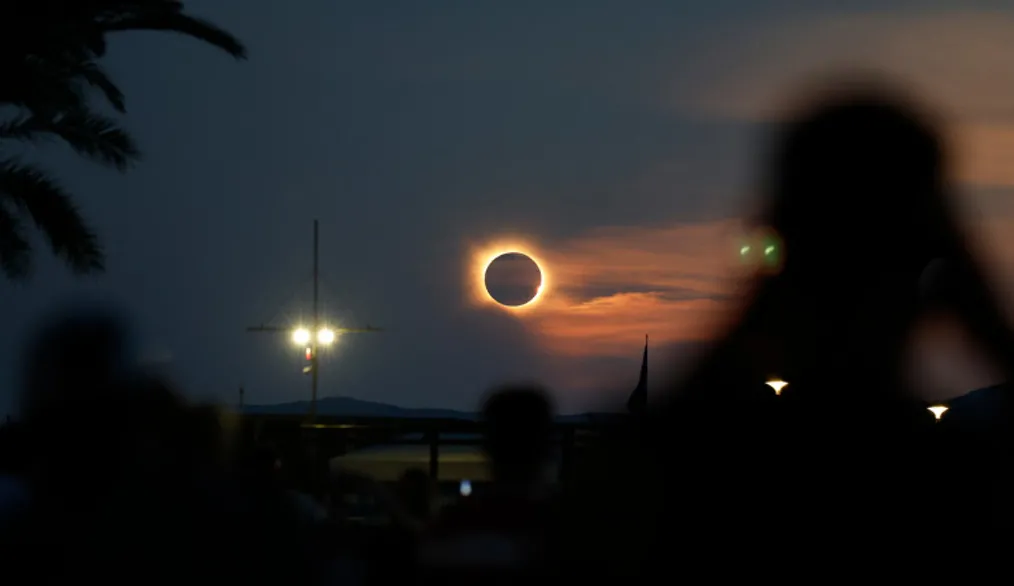
In Agadir, where astronomer Ibrahim Jabel captured breathtaking images, the scene took on a particularly poetic quality. Occasionally, clouds drifted across the sky, momentarily masking the sun before yielding once more to reveal its glowing disk, while the moon continued its gradual encroachment. By around 7:01 PM, the spectacle intensified as the moon positioned itself in front of the sun, initiating a series of occultations that peaked just as the sun descended towards the western horizon. The transition from a complete solar disk to a luminous crescent was a sight to behold, with the moon's shadow gradually overtaking the sun.
Observing the Eclipse: A Shared Experience Across the Kingdom
The solar eclipse of August 12 was visible throughout Morocco, showcasing varying degrees of obscuration depending on the region. The northern areas experienced the highest occultation rates, with Tangier witnessing approximately 91.97% coverage, followed closely by Oujda at 88.53% and Rabat at 82.53%. Meanwhile, Agadir and Marrakech recorded rates of around 79.30% and 79.20%, respectively. In contrast, Laâyoune and Dakhla saw significantly lower rates, at approximately 69.80% and 59.98%. While Moroccans enjoyed the partial eclipse, the path of totality traversed outside the kingdom, crossing the northern Atlantic before reaching northern Spain and the Balearic Islands.
Ibrahim Jabel remarked on the significance of this event, explaining that a partial solar eclipse occurs when the moon aligns between the Earth and the sun, partially blocking sunlight from reaching specific areas on Earth’s surface. He elaborated on the evolution of the sun's shape observed in his photographs, which depicted the moon’s gradual passage across the sun's disk. The first image captured the onset of the occultation, while the subsequent photographs showcased the moon transforming the sun into a crescent, culminating just before sunset, where the eclipsed sun appeared particularly striking against the horizon.
This extraordinary celestial event not only provided a visual feast but also reignited discussions about the state of astronomy in Agadir. Jabel highlighted the challenges faced by amateur astronomers, including a lack of access to telescopes and observational equipment, which hinders the growth of scientific interest among youth. He emphasized that fostering scientific curiosity through educational activities could help nurture skills in young people, providing them with opportunities to explore their interests in science.
Furthermore, Jabel pointed out the absence of dedicated spaces for astronomy enthusiasts in Agadir, such as observatories, planetariums, or museums. Establishing such venues could bridge the gap between astronomy and the public, offering children and adolescents hands-on learning experiences rather than reducing significant astronomical events to mere photographs and videos.
Jabel also reflected on the importance of educating younger generations about the contributions of Islamic civilization to the field of astronomy. He lamented that the achievements of Moroccan scholars in this domain often remain overshadowed, despite their significant roles in astronomical observation, calculations, and instrument-making. Creating a museum focused on the astronomy of the Islamic West in Agadir could serve as more than a cultural project—it could reconnect youth with their scientific heritage while inspiring them to pursue modern scientific avenues. Astronomy, beyond merely observing celestial bodies, opens doors to mathematics, physics, engineering, and technology, igniting a lifelong passion for learning.
Ultimately, the solar eclipse of August 12, 2026, marked a brief yet profound encounter between Earth, the moon, and the sun, witnessed by the Moroccan populace as they shared the same sky, albeit with varied experiences of obscuration. In Agadir, the eclipse intermingled with clouds and the Atlantic horizon, creating a rare natural tableau. As the sun slowly disappeared behind the moon, it appeared as though the sky was penning a brief chapter of a cosmic narrative that stretches back billions of years. With the sunset, the spectacle concluded in tranquility, yet the photographs remained as lasting testimonies of a night where the sun took on an extraordinary form and where the Moroccan sky became a canvas for contemplating the universe's beauty and precision.
As reported by libe.ma.