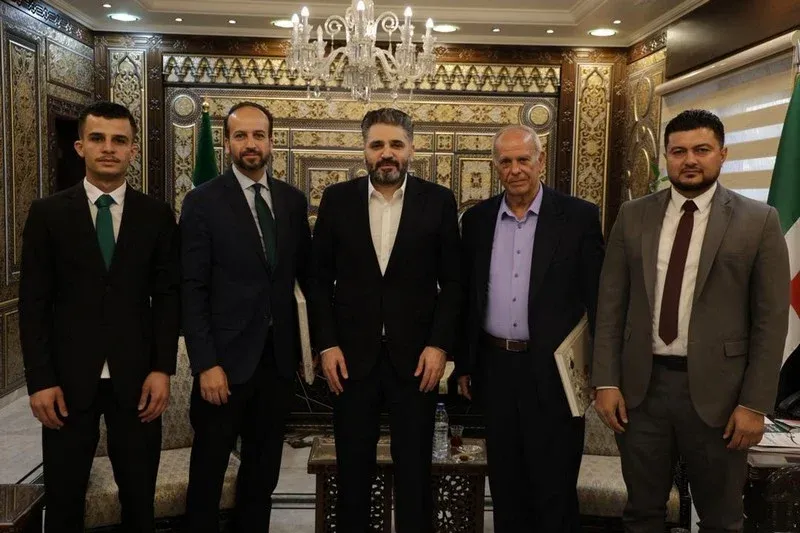

After nearly five decades of forced exile, Syrian Ali Al-Ahmad has returned to his homeland of Syria, embarking on a journey that encapsulates the story of a man who left his country as a youth. His absence extended into decades, during which he lived in voluntary exile in Morocco, a country that embraced him and opened its doors, allowing him to work, build a family, and forge human connections that transcended mere friendships formed in diaspora.
Upon his return, the poet and writer finds himself not just reclaiming a homeland that has undergone significant transformations, but also restoring a part of his life that had been suspended during his years away. Al-Ahmad's path is particularly unique as he is one of the oldest opponents of the former Syrian regime, compelled by political circumstances in the 1970s to leave his country. He arrived in Morocco on September 6, 1977, to work as an Arabic language teacher. From the city of Kenitra, another chapter began—a lengthy narrative in which his country of residence morphed into a second homeland, with Morocco becoming an integral part of his and his family's memory.
Now, as he steps foot in Syria once more, Al-Ahmad confronts a homeland that has remained vivid in his heart despite the passage of time. In an interview with Hespress, he expressed that his return comes after “five decades of exile that dictated the fate of the Syrian people,” emphasizing that this period was marked by “the devastation of freedoms and governance through iron and fire.”
The Weight of Exile
For Ali Al-Ahmad, exile was not merely a transition from one country to another; it was a profound experience that spanned from youth to old age, laden with many details he should have lived through in his homeland. While his life unfolded in Morocco, Syria remained a constant presence in his memory, entwined with the bittersweet pain of losing loved ones he could not bid farewell. In his reflections shared with Hespress, Al-Ahmad recounted the tragedy of family members who passed away during his absence, moments he was unable to share with them in their final hours. This represents one of the most severe aspects of exile, where separation from one’s country also translates into being distant from family, witnessing the departure of loved ones from afar.
Thus, his current return signifies more than just arriving in Syria; it represents a culmination of years filled with longing, anticipation, and memory. Many of those he left behind are no longer there, and the places he once knew have changed, yet he carries with him the memories of an entire life lived away from his original homeland.
From Exile to a Second Home
In stark contrast to the homeland that felt so distant, Al-Ahmad found in Morocco a space to rebuild his life. When he first arrived in Kenitra as an Arabic teacher, he could not have anticipated that his years there would stretch into decades, transforming the country from a mere stepping stone into an essential chapter of his personal and family narrative. Reflecting on this experience, Al-Ahmad remarked, “Morocco represented for me and for all expatriates a dignified place, a safe home, and a warm embrace, providing spiritual sanctuary, honorable work, and cherished companionship that evolved over time into a brotherhood I deeply value alongside all Syrians in the land of free and honorable Moroccans.”
These sentiments reveal another layer to his return; Al-Ahmad is not departing Morocco as if it is a completed chapter, but rather carrying with him gratitude for a country that provided him with the majority of his life, and for the people who alleviated the harshness of exile, enabling him to work, establish a family, and maintain relationships that endured through the decades. In his testimony to Hespress, he recounted the early years of his stay in Morocco, detailing the usual difficulties of acclimating as a newcomer, challenges that were soon dispelled by the generosity and warmth of Moroccans, leading to relationships that transcended the boundaries of work and residence, evolving into friendships and brotherhood.
Furthermore, Al-Ahmad's return is intricately connected to the memories of his children, who grew up in Morocco and experienced the life their father chose, or more aptly, one that was imposed on him by circumstances of exile. For them, Morocco is where their family was formed, where initial dreams were constructed, and where the details of their life unfolded over decades. Abdullah Al-Ahmad, Ali’s son, described this moment to Hespress, stating: “We see our father, who was absent for decades from his land and kin, reclaiming his first breaths as if a new spirit has animated his body after such prolonged exile.”
However, the joy of returning, as Abdullah notes—who works as a journalist at Medi 1 TV—does not erase the presence of Morocco in this moment; rather, it evokes it strongly. He adds, “This joy brings us back with loyalty to a land that never made us feel like strangers; Morocco was our support and refuge, a homeland that opened its arms to us with dignity and warmth, where we built our dreams and regained our dignity.” Abdullah emphasizes that the family’s bond with Morocco has been a complete human experience that left a profound impact on their hearts. Therefore, he asserts, “The beauty of the Kingdom of Morocco will remain alive in our hearts,” noting that since their father’s arrival in Syria, he has not missed an opportunity to speak of Morocco and its people.
Abdullah states that his father “in all his meetings and gatherings on Syrian soil does not miss a chance to make it a platform to talk about the merits of Morocco, its noble people, and the place it will always hold in our hearts.”
Thus, Ali Al-Ahmad’s return seems distinct from the return of an expatriate exhausted by years of distance; it is a return of a man carrying the narratives of two homelands—Syria, which his heart has clung to for decades, and Morocco, which embraced him when circumstances thwarted his return to his native land. In Syria, he today reconnects with his original roots and old memories, while in Morocco, he leaves behind a life he has lived since the late 1970s. Between these two homelands lies the narrative of a man who has spent nearly half a century carrying the question of return without losing gratitude for the place that offered him safety, work, companionship, and family.
Ultimately, this journey encapsulates the idea that exile does not erase the first homeland, but it also does not negate the impact of the homeland that embraced the expatriate. When Ali Al-Ahmad returned to Syria, he did not leave Morocco behind; he carried it within his memories, his family, and the words he often shares about a country where he claims he never felt like a stranger.
After nearly five decades, the man returned to the land he left as a youth. He returned to a country that has changed, to a person who has changed, and to faces he wished to meet that have since disappeared. Yet he also returned carrying another human story formed in Morocco, where he spent the majority of his life, thus becoming a testament to the notion that while some homelands are where one is born, others offer the chance to live, grow, and leave a part of one’s soul behind.
As reported by hespress.com.