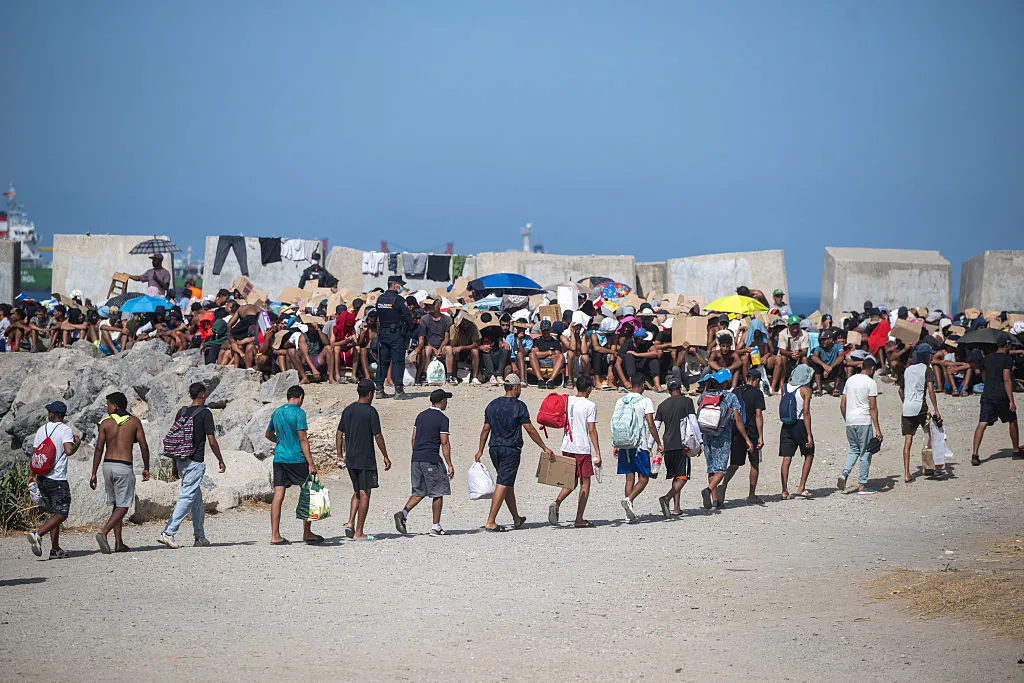

MADRID – A leaked report from the Spanish National Police has reportedly alleged that Moroccan authorities orchestrated a massive influx of migrants into Ceuta at the end of July, aiming to destabilize the Spanish border. The document from the National Center for Immigration and Borders (CENIF) indicates that Moroccan gendarmes guided thousands of migrants to the border of the small Spanish city in North Africa. This alarming information was published by the Spanish newspaper _El Español_, highlighting the serious implications of this situation.
The report details the "planning and execution" of the influx, which saw approximately 72,000 migrants crossing into Ceuta on July 30 and 31, with local authorities estimating the number to be as high as 80,000. Tragically, over 100 individuals lost their lives during this incident, which was allegedly monitored by Moroccan agents on the ground. This investigation was initiated by Spain's Supreme Criminal Court, as a judge currently conducts an inquiry into this [massive border crisis](https://www.euractiv.com/news/spain-has-no-emergency-plan-for-ceuta/) that may represent one of the most significant national security crises Spain has faced in recent history.
Government Response Amidst Political Fallout
In light of these allegations, Spanish Prime Minister Pedro Sánchez has denied any involvement by Morocco in the migrant surge, asserting that there is no evidence to support such claims. Nonetheless, the report suggests that the influx aimed to overwhelm Spanish security forces in Ceuta and is linked to Morocco's territorial claims over the Spanish cities of Ceuta and Melilla, the latter being another enclave in North Africa. Jorge Dezcallar, Spain's former ambassador to Morocco and ex-head of the National Intelligence Center (CNI), previously indicated that Morocco's territorial ambitions significantly influenced this incident. By allowing the surge, he posited, Moroccan authorities could "gauge the situation" while perceiving a "weak government in Madrid." The CENIF report concludes that Morocco sought to "violate" both the Spanish and EU borders under the guise of a migration crisis. Interestingly, it noted that around 70,000 individuals who entered Ceuta voluntarily returned within hours.
This explosive report has caused an uproar in Madrid, with the entire political spectrum questioning the Socialist Party's (PSOE) leniency towards Rabat. Although Sánchez initially condemned the influx as a "violation of Spain's territorial integrity" and acknowledged the public sovereignty claims by Moroccan ministers over Ceuta and Melilla, Madrid has yet to take concrete actions against this so-called "loyal ally." The Moroccan ambassador to Spain has not even been summoned for questioning. Both Spain and Morocco have officially attributed the crisis to criminal smuggling networks and misinformation circulating on social media, a hypothesis that has been met with skepticism by Spanish security forces and experts.
In response to the political implications of the report, Interior Minister Fernando Grande-Marlaska has instructed the Director General of Police, Francisco Pardo, to inform him as soon as possible about the report's content and its "accuracy." This urgent request underscores the growing tensions within the Spanish government as key ministers express increasing concern about the handling of this crisis. The ministry emphasized that such "essential" information should have been promptly communicated to the executive branch and the members of the National Security Council, which advises the Prime Minister during crises.
The police report is currently in the hands of Judge Maria Tardón and the public prosecutor's office, who will soon decide whether to initiate criminal proceedings regarding this matter. Following the report's emergence, Pardo informed the minister that "there is no police report attributing the planning or execution of the events of July 30 and 31 in Ceuta to Moroccan security forces," as stated in an official declaration. However, the judge had instructed investigators not to disclose any information regarding the report's creation and content to their superiors, which led to Pardo's unawareness of the situation.
As reported by euractiv.com.