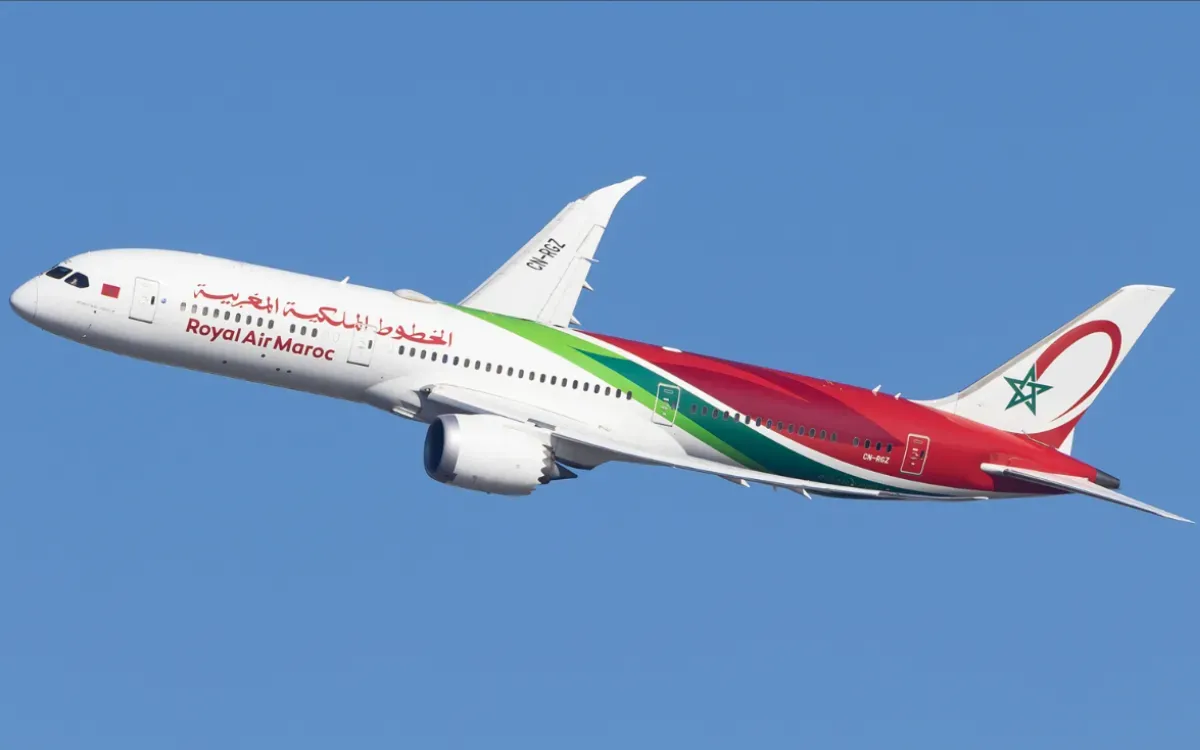

In the competitive realm of aviation, Air Algérie currently surpasses Royal Air Maroc in terms of passenger transportation. However, a deeper examination reveals that when we consider factors such as network reach across Africa, current capacity, and punctuality, the narrative shifts significantly. A recent annual report from the African Airlines Association (AFRAA) indicates that Air Algérie transported 7.857 million passengers in 2024, compared to Royal Air Maroc's 7.376 million. This translates to a difference of just under 500,000 passengers, or approximately 6.5%.
However, the composition of this traffic tells a more complex story. Air Algérie recorded 2.570 million passengers on domestic routes, more than double the 1.189 million passengers carried by Royal Air Maroc. Conversely, in regional air traffic, the tables turn dramatically; Royal Air Maroc accommodated 1.483 million travelers, while Air Algérie managed only 387,000. This means that RAM transports nearly four times as many passengers in this segment.
The disparity becomes even more pronounced when considering capacity across the entire network rather than merely passenger numbers. In 2024, Royal Air Maroc generated 22.32 billion available seat kilometers (ASK), in stark contrast to Air Algérie's 15.35 billion. This metric effectively combines the number of seats offered with the distances flown, showcasing RAM's advantage of about 45%.
Royal Air Maroc Outperforms in Network Capacity
The contrast is even starker when assessing revenue passenger kilometers (RPK), which measure the actual distance flown by paying passengers. Royal Air Maroc achieved 17.19 billion RPK compared to Air Algérie's 11.29 billion, resulting in a difference of over 52%. Thus, while Air Algérie carries 6.5% more passengers than RAM, the Moroccan airline generates 52% more passenger kilometers. These two figures alone encapsulate the divergence in operational models between the two airlines.
This trend is reflected in current flight schedules as well. Data from global aviation specialist OAG places Royal Air Maroc fourth among African airlines in capacity for August 2026, with 868,100 scheduled seats compared to Air Algérie's 825,900, which ranks fifth. Notably, Air Algérie is expanding at a faster rate year-on-year, with a growth of 16.8%, compared to RAM's 13.2%.
This difference can also be attributed to the strategic positioning of the two carriers. Royal Air Maroc operates from Casablanca as a hub connecting Africa to Europe and the Americas and is a member of the oneworld alliance. Its significant influence on regional African traffic is evident, as it transported nearly 1.5 million travelers in this segment in 2024, far exceeding Air Algérie's 387,000.
Another crucial factor impacting passengers is punctuality. A study conducted by Flightright, as reported by Le Figaro, indicated that between June 1 and July 20, 2026, 18.30% of Royal Air Maroc flights departing from France experienced delays of at least fifteen minutes, whereas Air Algérie faced a staggering 42.68% delay rate. This means that the Algerian airline's rate of delays was more than twice that of its Moroccan counterpart.
In terms of passenger numbers, both airlines are closely matched, with Air Algérie maintaining a slight edge. However, when the comparison extends to network reach, distances flown, market capacity, and punctuality observed in France, Royal Air Maroc clearly operates on a different level. It is at this juncture that the trajectories of the two airlines begin to diverge significantly, illustrating the complexities of the aviation landscape in Africa.
As reported by bladi.net.