
Morocco's Economic and Social Reforms Presented at OECD Meeting
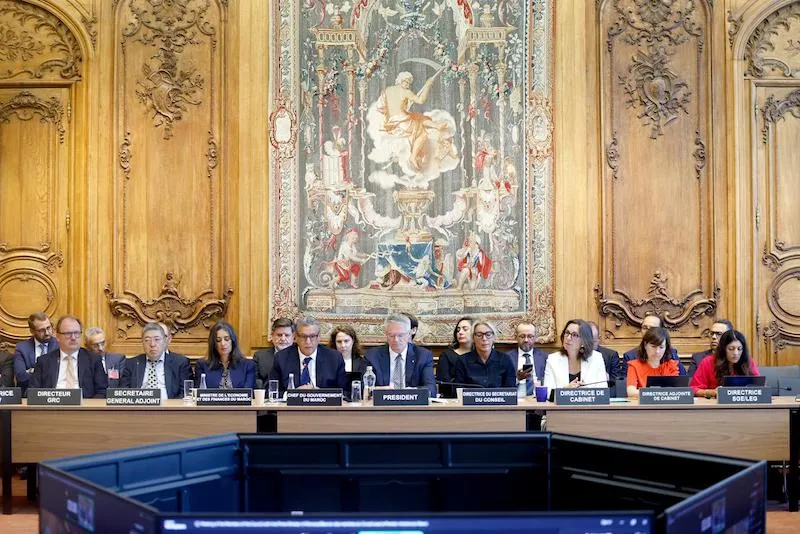
On September 7, 2026, Moroccan Prime Minister Aziz Akhannouch delivered a comprehensive overview of the nation’s economic and social reform achievements during a meeting in Paris with the Organisation for Economic Co-operation and Development (OECD). He emphasized Morocco's strategic choices in navigating the aftermath of the pandemic, geopolitical tensions, inflation, and years of drought. Akhannouch conveyed that the Moroccan government has prioritized maintaining macroeconomic stability while simultaneously expanding the social state and enhancing investment and production capabilities.
In his address, Akhannouch highlighted the success of the social protection initiative, which has enabled over 11 million individuals to benefit from mandatory health insurance. Furthermore, 3.9 million non-salaried workers and individuals capable of contributing to the system have been integrated. He noted that between December 2023 and December 2025, the state allocated approximately 51 billion dirhams in direct social support for around four million families.
Progress in Health, Education, and Economic Growth
Turning to the health and education sectors, the Prime Minister reported the rehabilitation of 1,400 primary healthcare institutions, with plans for an additional 1,600 facilities. The ratio of healthcare professionals has improved significantly, increasing from 17.4 to 25 per 10,000 people between 2021 and 2026. In the education sector, Morocco has established 4,626 pioneering primary schools, with plans to expand to 6,626 by the 2026-2027 academic year, including the introduction of middle school programs.
Economically, Akhannouch shared that Morocco's gross domestic product (GDP) grew by 4.9% in 2025, compared to 4.4% in 2024, coinciding with a reduction in inflation to 0.8% over the past year. The budget deficit stabilized at approximately 3.5% of GDP, while public debt decreased from 71.6% in 2022 to around 67% in 2025. The government aims for a growth rate of 5.3% and a budget deficit of about 3% in 2026.
In terms of investment, the Prime Minister revealed that the National Investment Commission has approved 381 projects valued at nearly 581 billion dirhams since the implementation of the new investment charter, projected to create approximately 245,000 direct and indirect jobs. Additionally, foreign direct investment reached a record 56.1 billion dirhams in 2025, with continued revenue growth observed in the first seven months of 2026.
Akhannouch also discussed advancements in the industrial and tourism sectors, noting that automotive exports rose from 87.1 billion dirhams in 2021 to 154.5 billion dirhams in 2025, with production capacity approaching one million vehicles annually. The tourism sector welcomed roughly 19.8 million visitors, generating tourism revenues of 138.1 billion dirhams, while the unemployment rate dropped to 9.5% in the second quarter of 2026, although challenges remain in youth employment and increasing female participation in the labor market.
On water and energy issues, the Prime Minister underscored the significance of water security, particularly following consecutive years of drought, outlining investments totaling 143 billion dirhams for the national water supply program, including dam projects and seawater desalination initiatives. He highlighted the Dakhla desalination plant, which has a capacity of 37 million cubic meters annually and is powered by wind energy.
Moreover, Akhannouch reported that the share of renewable energy in electricity production has risen to 46.1%, up from 37.1% in 2021, with a target of reaching 52% by 2030, alongside the launch of green hydrogen projects involving investments nearing $43 billion.
In terms of infrastructure, the Prime Minister presented the Tangier-Med port as a model for Morocco's logistical transformation, having processed over 11.1 million containers in 2025. The Nador West Mediterranean port is expected to commence operations in the last quarter of 2026, while the Atlantic Dakhla port is set for completion in 2028, further solidifying Morocco's position as a critical link between Europe, Africa, and the Atlantic region.
In conclusion, Prime Minister Akhannouch emphasized that Morocco's co-hosting of the 2030 FIFA World Cup, alongside Spain and Portugal, represents a significant opportunity to accelerate ongoing economic and social transformations, reinforcing the nation's status as a competitive economy and a hub of stability and prosperity in Africa and the Euro-Atlantic space.
As reported by hespress.com.