
Al-Qods: The Intersection of Memory, Sacredness, and Justice
During a significant meeting organized by the Al-Qods Committee at the Academy of the Kingdom of Morocco, which celebrated Rabat as the capital of Arab media for the year 2026, Abdeljelil Lahjomri articulated the profound responsibility that Al-Qods embodies on intellectual, moral, and humanitarian levels. Beyond its political implications, this holy city emerges as a universal symbol of justice, coexistence, and peace grounded in law. In a heartfelt and rational discourse, the perpetual secretary of the Academy of the Kingdom emphasized that Morocco has placed Al-Qods at the core of its fundamental values, making its defense a crucial part of a balanced vision that intertwines political responsibility, humanitarian initiatives, and the preservation of the spiritual and civilizational essence of this sacred city.
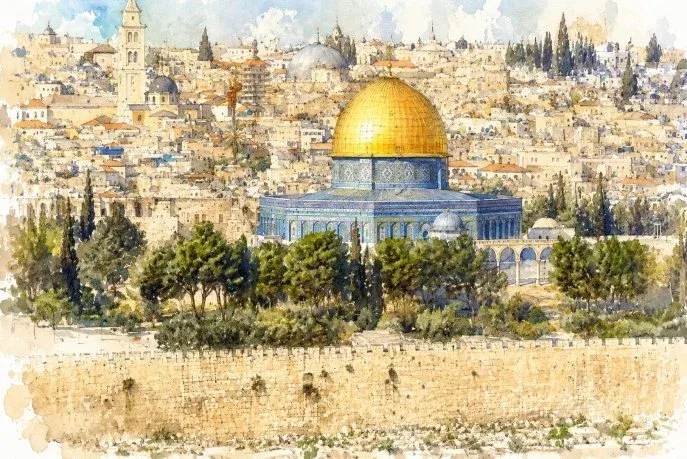
When Al-Qods enters the discourse of thought, its mention carries a weight that transcends ordinary historical narratives. Discussing the Holy City does not merely invoke a location shaped by politics, only to fade into obscurity; rather, it prompts humanity to confront an enduring question: how can we safeguard the sacred, protect dignity, and ensure that peace stems from justice rather than merely masking existing wounds? Al-Qods is far more than a collection of stones, walls, and monuments; it represents a living memory that resides in the consciousness of believers. Its streets echo with history, speaking in a subtle yet profound voice. In its sacred sites, the spiritual dimension intertwines with the call for protection, demanding a new language that transcends mere descriptions of suffering. This language must strive to restore justice to its rightful place, dignity to peace, and honor to humanity.
An Intellectual Gathering for a New Vision
The high-level meeting held at the Academy of the Kingdom of Morocco under the theme "Al-Qods: A Narrative for Universal Peace" carries unique significance as it aligns with the celebration of Rabat as the Arab media capital for 2026. This gathering not only highlights the prestige of the academic institution but also emphasizes the media's role in shaping collective consciousness and the centrality of Jerusalem within Arab and human awareness. By hosting this intellectual event, Rabat reinforces the noblest mission of the media: to serve as a responsible expression, a guardian of truth, and a bridge connecting memory with justice. Thus, the purpose of this meeting is not to contribute yet another voice to an endless stream of speeches but to construct a deeper meaning of the Holy City, presenting it as a symbol of peace rooted in justice, rather than as a mere lull devoid of justice; as a symbol of dialogue that safeguards sacred sites instead of stripping causes of their essence.
In this context, the meeting holds significant value: to craft a narrative for Al-Qods that is worthy of its history, faithful to its inhabitants, and capable of opening a horizon for the world where the Holy City stands as a shared space of dignity rather than a continuous battleground. The theme of this meeting inherently confronts us with a profound intellectual and moral responsibility. Al-Qods does not require a fleeting media discourse or emotionally detached sentiments; it needs a new narrative that honors its history, preserves its sacred character, protects its inhabitants, and provides humanity with a pathway from the logic of force to that of law, transitioning from the language of division to one of shared dignity.
From Morocco's perspective, this meeting carries exceptional significance. The Kingdom has positioned Al-Qods at the heart of its fundamental constants, integrating its defense into a balanced vision that harmonizes political responsibility, humanitarian initiatives, and the preservation of the spiritual and civilizational dimensions of the Holy City. His Majesty King Mohammed VI, may God assist him, embodies this vision as President of the Al-Qods Committee, thus embracing a historical responsibility marked by consistency in positions, wisdom in action, and fidelity to commitments.
This royal vision finds its universal expression in the "Call of Al-Qods," signed in Rabat in 2019 by His Majesty King Mohammed VI, Amir Al-Mouminine, and His Holiness Pope Francis. This call presents Jerusalem to the world as a common heritage of humanity, a land of encounter, and a symbol of peaceful coexistence among the adherents of the three monotheistic religions. It encapsulates the essence of a universal narrative of peace: Al-Qods is not a subject of religious confrontation but a space for listening, a place of mercy, and a home for the values of dialogue and mutual respect. In this context, peace does not equate to forgetting rights or abandoning the memory of peoples. True peace is grounded in justice, safeguarding sacred places and ensuring that individuals retain their right to safety and dignity.
Consequently, the defense of Al-Qods cannot be divorced from the defense of the Palestinian people and their rights to life, education, health, housing, and serenity in their land, home, and city. The humanitarian initiatives mandated by His Majesty King Mohammed VI, President of the Al-Qods Committee, exemplify this commitment in concrete terms. Morocco does not merely issue principled positions; it translates its fidelity into actions, transforming solidarity into tangible achievements and making the service of Jerusalem a natural extension of its religious, national, and humanitarian values.
As reported by quid.ma.