
In recent months, a notable discourse has emerged within diplomatic circles and analysis forums suggesting that Algeria has altered its stance regarding Western Sahara. There are indications that Algeria is participating in roundtable discussions, avoiding direct diplomatic crises, and even normalizing relations with countries that have established consulates in Laayoune or Dakhla. Some observers interpret this as a newfound pragmatism or even the beginnings of a doctrinal shift. However, while this interpretation may seem appealing, it can also be misleading.
Algeria has not changed its ultimate objective; rather, it has shifted its battlefield. What appears to be a relaxation of tensions in Western Sahara is, in fact, a strategic reallocation of diplomatic, financial, and political resources towards another front—one that is situated further south, less visible, and potentially more decisive for the regional balances of the 21st century. This new front is the Sahel and West Africa, where the stakes are not territorial but logistical, energetic, economic, and ultimately geopolitical. The fundamental question arises: who will control the routes through which the Sahel, an enclave, will connect to the world?
To understand Algeria's maneuvering, it is essential to first examine the current status of the Western Sahara issue and acknowledge a reality that many still hesitate to articulate clearly: the balance of power in this context has tilted in favor of Morocco. The U.S. recognition of Moroccan sovereignty over Western Sahara in 2020 has permanently altered the diplomatic landscape. Since then, dozens of states have opened consulates in Laayoune or Dakhla, and United Nations Security Council resolutions, which Algeria has long championed, have increasingly incorporated Morocco's autonomy plan as a realistic basis for negotiation.
In light of this evolution, Algeria has historically responded with systematic confrontation: diplomatic breaches, pressure on African states, logistical and financial support for the Polisario Front, and crises triggered by each new consulate. This strategy of obstruction has yielded results for decades, but it appears to be reaching its limits today. Algeria has not abandoned its principled position—the Sahrawi issue remains constitutionally embedded in Algerian doctrine—but the current leadership seems to have made a cold calculation: the resources mobilized on this front for diminishing returns could be redirected towards other areas where Algeria still holds significant comparative advantages.
This strategic reorientation is not an admission of defeat but rather a preservation strategy: accepting a short-term loss in the battle over Western Sahara to concentrate efforts on a broader war, the challenges of which far exceed the status of a single territory.
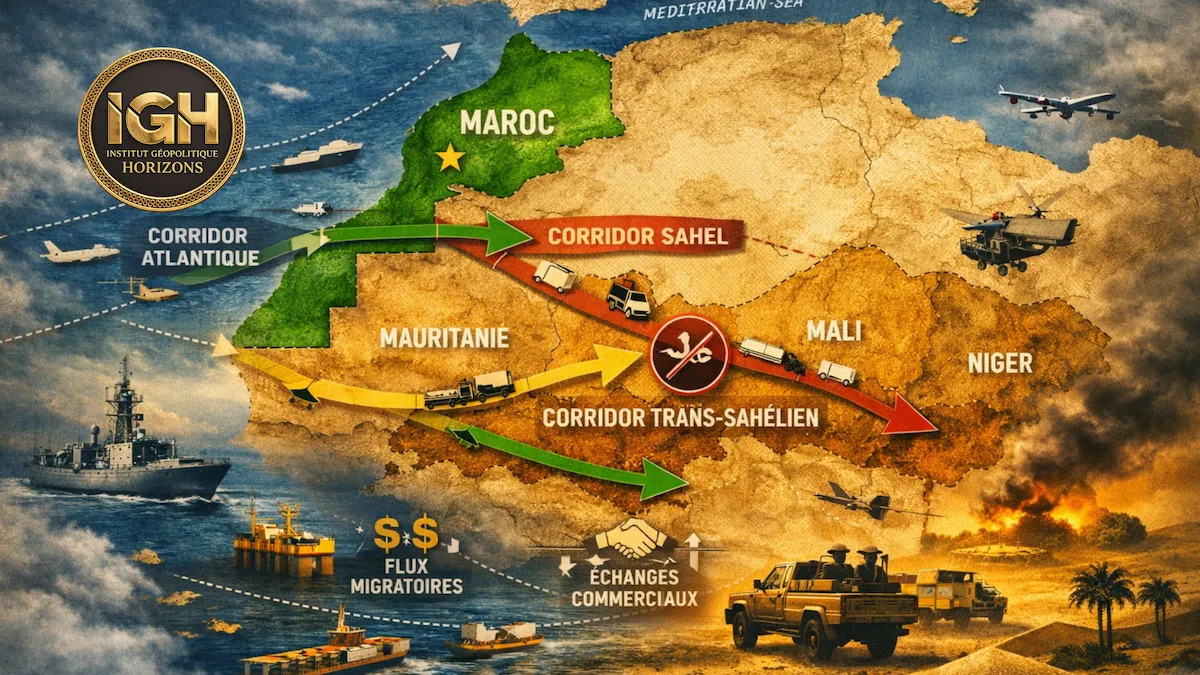
To comprehend what is at stake in the Sahel, one must understand Morocco's proposals and why they are perceived in Algeria as an existential threat. In 2023, King Mohammed VI launched what is now known as the Atlantic Initiative. The concept is deceptively simple: to offer landlocked Sahel countries—Mali, Niger, Burkina Faso, and Chad—access to the Atlantic Ocean through Moroccan ports, beginning with Dakhla and Tangier Med. This includes logistics corridors, customs agreements, and transit infrastructure, with Morocco positioning itself as the maritime gateway for the Sahel to the world.
If realized, this initiative would be geopolitically revolutionary. The landlocked Sahel has always depended on corridors controlled by neighboring countries to access global markets. Algeria has long been a central actor in this equation—due to its land routes, supply networks, and political ties with Sahelian capitals. A pivot towards Moroccan Atlantic access would render this dependence obsolete.
Adding to the structural implications is the African Atlantic Gas Pipeline (AAGP) project, which aims to connect Nigeria's gas reserves to Europe via the African Atlantic coast, passing through Morocco. Should this project succeed, it would radically alter the energy geography of West Africa and cement Morocco's status as an indispensable continental energy hub.
For Algeria, whose regional power is significantly based on gas revenues and its critical role as a transit point for Sahelian exchanges, the Moroccan Atlantic Initiative is not merely a development project; it represents a primary strategic threat. A Sahel connected by Morocco means a Sahel less dependent on Algeria. An Atlantic gas pipeline from Morocco poses a direct alternative to Algerian gas exports to Europe. Consequently, Algeria's response to these two realities could only be structural.
Algeria's response to the Atlantic Initiative is neither vocal nor overt; it is concrete, patient, and deliberately discreet. On June 3, 2026, the Algerian Prime Minister made his second visit to Niamey in just a few months to inaugurate a 40-megawatt power plant donated by Algeria to Niger. While 40 megawatts may not seem significant on paper, in a country where power outages disrupt daily life and impact every economic decision, it serves as a powerful political lever. The supplier of electricity is anything but an ordinary partner.
This gesture is part of a broader strategy. Since 2023, Algeria has multiplied agreements with states in the Sahel Alliance—Mali, Niger, and Burkina Faso—related to energy, security, and political cooperation. While Algeria cannot offer what Morocco does—access to the Atlantic—it can present something else: profound interdependencies that make a pivot towards Rabat costly.
The Algerian strategy in the Sahel is one of saturation. It does not aim to propose an alternative model of development—Algeria lacks the economic capacity for that—but rather to multiply political, security, and energy anchors to ensure that Sahelian states become sufficiently dependent on Algeria so that a shift towards Moroccan influence is perceived as a risk rather than an opportunity.
Alongside this infrastructural approach, Algeria has also activated a more unexpected lever: the religious one. In January 2026, President Tebboune officially received the general caliph of the Senegalese Fayda Tidjania. The Tijaniyya brotherhood is one of the most influential in West Africa, with networks extending across Senegal, Mali, Mauritania, and Niger. Morocco has long claimed a leadership role in this religious space, centered around the figure of the Commander of the Faithful. Algeria's activation of this lever sends a clear signal: it intends to contest Morocco even in the realm of spiritual influence.
This creates a coherent picture: a quiet Algerian corridor, built stone by stone, not to offer the Sahel a window to the world, but to ensure that, if such a window opens, it is not exclusively Moroccan. Algeria is not alone in this movement, but it also lacks formal allies. What is emerging around the Sahel-Atlantic space is something more difficult to define and, therefore, more challenging to counter: a convergence of interests among actors who do not need to coordinate to produce a common effect.
Qatar is the most documented example of this dynamic. Since April 2025, Al Jazeera has been waging what could be termed a perception war against Tangier Med—the largest container port in Africa, a visible symbol of Moroccan logistical power. Reports are proliferating, constructed around three recurring axes: the legitimacy of Moroccan claims over this port is questionable, its benefits for Africa are debatable, and its management model favors Western interests over African ones. These narratives are not fabricated; they are selected, amplified, and coherently structured through a deliberately constructed editorial architecture.
Behind this media campaign lies a concrete energy interest. Qatar is one of the world's leading exporters of liquefied natural gas. Morocco's African Atlantic Gas Pipeline project represents, if it comes to fruition, a structural alternative to gas supply to West Africa through Qatari LNG. Therefore, the interests of Doha and the weakening of Morocco's initiative converge naturally, without the need to invoke any coordination with Algeria.
Iran occupies a different position in this landscape. Its capacity for direct influence in West Africa remains limited, as the region is predominantly Sunni and Tehran lacks the historical networks it has in the Middle East. However, Iran is a background player in the information spaces: its channels disseminate narratives of African sovereignty, amplify critiques of Moroccan-Israeli normalization, and fuel anti-Western rhetoric that finds increasing resonance in the post-transition contexts of the Sahel.
There is no pact between Algeria, Doha, and Tehran. Instead, there is something more challenging to dismantle: an architecture of interests whose practical effect amounts to coordinated pressure, even though no one has had to sign anything. This configuration is analytically uncomfortable for those seeking an identifiable adversary and a coalition to name. It is also strategically effective precisely because it resists formal demonstration. One cannot denounce an alliance that does not exist; one can only observe its effects.
If one seeks a place where the competition for influence takes on a concrete and observable form, one must look to Senegal. Dakar currently possesses a set of characteristics that make it the geopolitical hub of the entire region. Senegal began gas production in January 2025 with the Grand Tortue Ahmeyim field, making it an Atlantic energy player, with all the implications this holds for competition between the Qatari gas model and the Moroccan corridor. Its Autonomous Port of Dakar serves as a logistical center for a significant portion of the Sahelian hinterland. Its brotherhood networks—Tijaniyya, Mouridiyya—are primary vectors of political influence, even for external actors. Moreover, its position as a regional power in West Africa makes it an actor whose positioning partially conditions that of its neighbors.
Adding to this is an internal political variable: the recomposition of Senegalese power since 2024, with the complex coexistence of President Diomaye Faye and Prime Minister Sonko, creates spaces of influence that external actors naturally seek to occupy. In September 2025, Sonko was received in Doha by the Emir of Qatar. Over the previous twelve months, ministerial visits between Doha and Dakar have multiplied at an unprecedented rate. Meanwhile, Algeria has strengthened its high-level diplomatic exchanges with the Senegalese capital.
Morocco is not remaining idle in the face of this penetration. In January 2026, the National Ports Agency signed a cooperation agreement with the Autonomous Port of Dakar—a direct counter-offensive in the most visible area of competition. However, the battle for Senegal will not be won with just one agreement; it will be fought over the long term, on all fronts simultaneously.
What is at stake in Dakar at this moment is a seemingly simple question: will Senegal anchor its development in the Atlantic architecture proposed by Morocco, or will it navigate between the two poles, maximizing its advantages from each side? The answer to this question will condition much of the regional dynamics leading up to 2028.
In conclusion, Algeria has not changed; it has understood that the true front has shifted. The Western Sahara dossier remains open—likely for a long time to come—but it is no longer the center of gravity in the Algerian-Moroccan rivalry. This center of gravity has moved to the Sahel and West Africa, where a much more determining question is at play: who will be the preferred partner for Sahelian countries in their integration into the global economy? Through which route, which port, and via which gas pipeline will landlocked Africa open itself to the 21st century?
Morocco has provided a clear answer to this question with the Atlantic Initiative. It is this response that Algeria seeks to neutralize—not by proposing something better, but by making the choice more complex, costly, and uncertain for those tempted to align with it. The outcome of this battle will depend less on diplomatic declarations and more on infrastructural realities: completed or uncompleted ports, finalized or blocked gas pipelines, fulfilled or abandoned logistical agreements. In this case, geopolitics is played out in the concrete realities.
What is certain is that Algeria's silence on Western Sahara should not be interpreted as a retreat. It should be seen as a concentration of efforts. Observers focusing solely on Western Sahara risk missing the essential developments occurring much further south.
As reported by atalayar.com.