
Understanding the Cultural Intertwining of Morocco and Spain
There is no denying that the metaphor used to describe Morocco's geographical location as a tree with its roots deeply embedded in African realms, its trunk directed towards the east, and its branches extending towards Europe carries profound significance. Morocco has historically served as a crossing point for bodies, cultures, goods, armies, capital, and values. Its geography has witnessed, and continues to witness, rich and diverse cultural and human amalgamations, making the quest for a 'pure origin' seem futile and fundamentally at odds with the realities of evolving relationships. This ideological blindness can be perilous for both the self and others. The same can be observed in Spain, albeit in different manifestations; the Strait of Gibraltar stands as a testament to the transfer of ideas and images, and the myriad interactions and exchanges that have occurred between Morocco and the Iberian Peninsula.
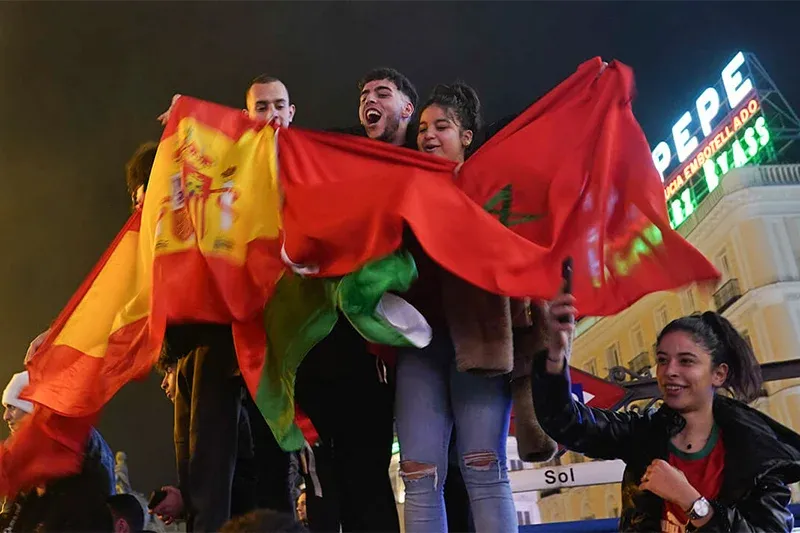
It is simply untenable to deny that Morocco is part of Spanish memory, languages, and history. To overlook the significant influence of Andalusian and Spanish lifestyles, languages, architecture, and arts on Moroccan imagination is equally erroneous. Linguistic studies reveal that there are over four thousand Spanish words with Arabic origins, illustrating the deep-rooted cultural and human extensions that showcase the awareness of this fusion. Furthermore, Spain has a continuous presence in modern and contemporary Moroccan history, whether through its colonial past or the substantial interactions that Moroccans have had with Spanish culture, including their passionate following of Spanish football teams and a growing interest in tourism in recent decades.
However, the renowned writer Juan Goytisolo pointed out, with a sense of bitterness, that Spain's perception of Morocco is often clouded by a sense of superiority, overt and covert, towards its 'poor' neighbor. Despite the shared history between the two nations, marked by past conflicts and territorial disputes, each party manages this history and charts its destiny in its unique way.
Moroccan Perspectives on Spaniards
For centuries, Morocco and its people have been subjects of interest for Spanish clergy, military personnel, artists, and researchers, whether viewed as a religious and military adversary or as a topic of contemplation by Orientalists, historians, and politicians. Often, Moroccans have been portrayed with contempt, ridicule, and attempts to dehumanize them, as evidenced by a wealth of visual productions including drawings, caricatures, photographs, and films. This subject matter has been extensively analyzed by historian E. Martin Corrales in his monumental work titled 'The Image of the Moroccan in Spain: A Historical Perspective from the 16th to the 20th Century,' published in 2002.
Upon reviewing this book at its release and recognizing its extensive research into how Moroccan images have evolved over four centuries, we noted a significant lack of studies on Spanish images in Moroccan perceptions. Consequently, in 2004, alongside Professor Idriss Krawi, we embarked on producing a work that not only revisited history but also supplemented existing texts with nationwide research aimed at exploring Moroccan views on Spaniards through a representative sample. This endeavor culminated in the publication of 'The Image of Spain in Morocco' in French in 2005, later translated into Spanish in 2006, supported by the Cidob Foundation in Barcelona, an organization focused on international relations and Mediterranean issues. At that time, Narcis Serra, a prominent figure in the Spanish Socialist Workers' Party and a former Minister of Defense, graciously attended the book's presentation at the Moroccan News Agency.
In preparing for the research, we discovered a considerable lack of documents that could shed light on Moroccan perceptions of Spain, aside from some reports crafted by diplomatic envoys or personal impressions of Spain. Notably, while there are historical works documenting battles from a 'jihad' perspective, a bibliography authored by Moroccans focusing on Spain and its society remained elusive. Researchers could find some historical analyses of battles; however, the desire to understand Spain and its cultural components from the Moroccan viewpoint was largely absent at that time. There has indeed been a growing interest among Moroccan scholars in the representations of Moriscos and Moroccans produced by Spaniards over the past two decades, yet the initiative to critically examine Spaniards from a Moroccan perspective has only recently begun to gain traction in some academic circles, particularly among those engaged in comparative literature and image studies.
Martin Corrales articulated how images of the Moors, Africans, Arabs, Muslims, and Moroccans are entrenched in Spanish collective imagination, preserved by the church for centuries and summoned whenever conflicts arise with Morocco. These images are reinterpreted according to the context and dynamics of competition within Spain and the conditions underlying disputes with Morocco. In contrast, the Moroccan viewpoint of Spaniards over the past four centuries, extending to the early 20th century, has been characterized by religious differences, with judgments formed based on the Islamic worldview that divides the world into 'Dar al-Islam' and 'Dar al-Harb.' Despite seemingly positive observations made by diplomats or ambassadors regarding European societies, one can still find derogatory terms and dismissive sentiments towards Spaniards, as reflected in the writings of figures like Ahmed Ibn Qasim Al-Hajari and Mohammed Ibn Othman Al-Miknasi.
As we moved into the 20th century, representations of Spaniards became more pronounced, becoming intertwined with the daily lives of Moroccans across various regions. Descriptions ranged from the Spanish invader, colonizer, competitor, and the vanquished (in the case of the Battle of Anwal) to the provocative, arrogant neighbor. Conversely, one could also find portrayals of the impoverished Spaniard, particularly during the 1940s and 50s when Spaniards from Andalusia traveled to Morocco to sell goods. Despite challenging circumstances, Moroccans often viewed these Spaniards as friendly and amicable individuals.
Thus, 'The Image of Spain in Morocco' aimed to comprehend Moroccan perceptions of Spaniards throughout modern history, relying on various diplomatic travels and scattered writings on the subject. However, we concluded that a thorough investigative study was necessary to gather perspectives and judgments that would illuminate the nature of Spanish presence in Moroccan identity and understanding.
As reported by hespress.com.