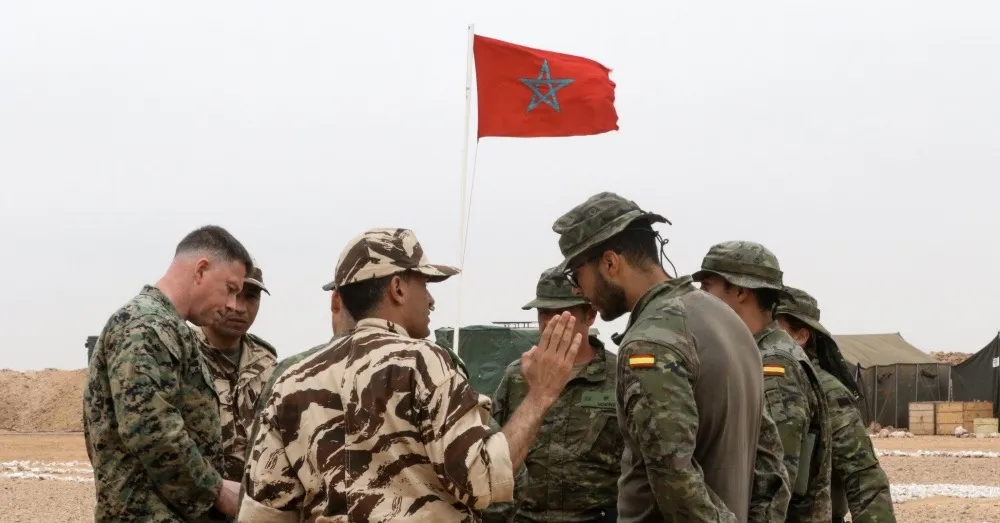

Contemplating a Hypothetical Military Confrontation
A recent Spanish report has ignited discussions surrounding a hypothetical scenario concerning a potential military confrontation between Morocco and Spain, particularly following the recent crisis in Ceuta. The report raises critical questions regarding Morocco's capability, from a military perspective, to seize control over the cities of Ceuta and Melilla, or even the Canary Islands. However, it emphasizes that any analysis of this nature cannot solely rely on a comparison of troop numbers or tanks. It necessitates a broader consideration of more complex factors, including military technology, operational capabilities, logistical support, geographical nuances, and international alliances.
Military Developments and Strategic Assessments
According to the Spanish newspaper Okdiario, Morocco has made significant strides in modernizing its armed forces over recent years, enhancing its air and naval capabilities, and strengthening its deterrent and intervention measures. This evolution has equipped the Moroccan military with advanced capabilities that must be taken into account when evaluating any hypothetical scenarios related to regional security. The assessment of the balance of power cannot be limited to mere numbers; it must also encompass the level of armament, readiness, rapid deployment capabilities, and the ability to manage operations on multiple fronts.
An academic study published by the National University of Distance Education in Spain suggests that the likelihood of an open war between Morocco and Spain remains low under current conditions. Nevertheless, it argues that examining such scenarios theoretically is valuable for understanding the elements of power and deterrence on both sides. The report outlines that any potential confrontation would hinge on critical factors, including air and naval superiority, intelligence effectiveness, and the ability to transport reinforcements and supplies, along with the political and diplomatic support that each party might secure. In modern warfare, these elements have proven to be more influential than mere numerical superiority of forces.
When considering Ceuta and Melilla, the newspaper points out that the geographical positioning of these cities grants Morocco a distinct advantage in terms of proximity and the speed of troop mobilization at the border. This proximity theoretically allows for quicker movement should a military crisis arise. However, the report also underlines that the geographical nature of the region, the narrowness of the border area, and the continuous military presence of Spain within these cities complicate any military operation. It is not merely about achieving initial gains, but also about the ability to hold positions and manage prolonged operations.
In contrast, regarding the Canary Islands, the situation differs significantly due to the maritime distance separating the archipelago from Moroccan shores. This distance complicates any hypothetical military operation logistically and operationally, necessitating substantial capabilities for troop transport, supply security, and control over both maritime and aerial domains, in addition to countering the Spanish military infrastructure present in the islands, particularly the Gando Air Base, which Madrid considers one of its strategic assets.
In its power balance analysis, the newspaper asserts that any attempt to seize control of Ceuta, Melilla, or the Canary Islands would not be solely contingent on initial military superiority, but also on the ability to secure supply lines, maintain operational continuity, and respond to military reactions from Spain, which could launch from the Iberian Peninsula and its various military bases.
Furthermore, the Spanish newspaper emphasizes that relations between Rabat and Madrid remain governed by complex issues, including the Sahara dispute, immigration, and the future of Ceuta and Melilla. It suggests that any open military confrontation would come at a significant political, economic, and military cost for both parties, making military deterrence and maintaining strategic balance the more prudent options. Both Morocco and Spain are acutely aware that the costs of resorting to force would far outweigh any potential gains.
It is noteworthy that the tension following an unprecedented wave of mass migration towards Ceuta and Melilla has propelled the issue of Moroccan-Spanish relations into the spotlight of media and political discussions. According to the Spanish narrative, the number of migrants who managed to reach Ceuta has exceeded 60,000 irregular migrants, while Moroccan data indicates that this figure is closer to 40,000. These events have tragically resulted in the death of over 70 migrants in preliminary reports.
As reported by assahifa.com.