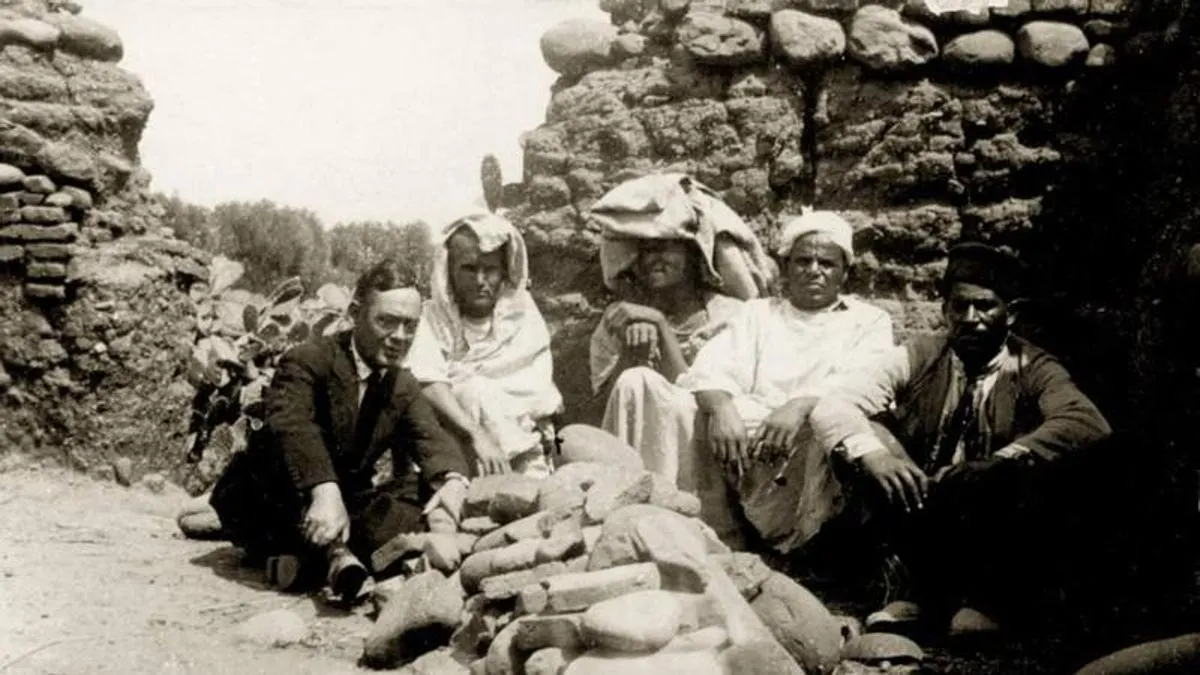

In September 1924, just over a century ago, Blas Infante, a notary residing in Isla Cristina (Huelva) and a passionate advocate for Andalusian identity, embarked on a unique journey to Morocco. This trip, made during a time of war between Spain and Morocco, took him through Lisbon and Casablanca with a singular purpose: to locate the tomb of Al Mutamid, the poet-king and last monarch of the Taifa of Seville. Infante regarded this figure as the embodiment of Andalusia’s historical pinnacle. This 'pilgrimage,' impeccably suited for the desert, has fueled a long-standing rumor that Infante converted to Islam during his travels, a narrative that has been recently amplified by far-right factions seeking to undermine his legacy and the very concept of Andalusian autonomy.
Historian Manuel Ruiz cautions against taking Infante's words out of context when criticizing him, emphasizing that while his Muslim faith remains unsubstantiated, claims of conversion are often misrepresented. Indeed, there is no documented evidence that Infante altered his name before witnesses at Al Mutamid's tomb in Agmat, a supposed conversion that he never mentions in his writings. Manuel Hijano del Río, a historian at the University of Málaga, reinforces this point, noting that Infante described his journey as a 'pilgrimage' not for religious reasons but due to the profound emotional connection he felt towards Al Mutamid. Infante identified three periods of Andalusian history as its golden ages: Tartessos, Roman Bética, and Al Ándalus, particularly during the reign of Al Mutamid (1069-1091), who sought help against the Almoravids' religious extremism.
Ruiz, who participated in a recent expedition to Agmat emulating Infante's journey, believes the far-right narrative serves to politically discredit Infante, who symbolizes autonomy and is a precursor to the Statute of Autonomy. He argues that proponents of a singular, unified Spain aim to deny Andalusia's distinct cultural identity and its rich cultural tapestry. They reject the global historical perspective in favor of a monochromatic narrative, prompting Ruiz to call for coherence and a focus on national elections. The issue of Infante’s faith, he argues, is less critical than the truth itself, as asserting he was a Muslim is both misleading and historically inaccurate.
Ruiz is currently working on a recently published book titled Peregrinaciones. The Narrative of Blas Infante's Journey to the Tomb of Al Motamid, which includes transcriptions and an introductory study based on Infante's notes from his return from Agmat. Infante had a habit of not taking notes or photographs while traveling, preferring to observe and immerse himself in the experience, which reveals no indication of any alleged conversion to Islam or religious profession.
Javier Delmás, president of the Blas Infante Foundation, asserts that Infante was deeply respectful of all religious options, yet there is no evidence to support claims of him being a Muslim. Infante married in a church, baptized his children, and even had a crucifix at the head of his table, and he was known to protect the convent of Santa María de los Reyes in Seville. His attempts to gain favor with the general Gonzalo Queipo de Llano, by having a nun intercede for him, were ultimately unsuccessful, leading to his execution on August 10-11, 1936, under charges of promoting an Andalusian nationalist party and opposing the legitimate authority.
The controversy surrounding Infante's homage to Al Mutamid further complicates his legacy. His journey to Agmat, which other Arabists labeled as a pilgrimage during the Second Republic and Franco's regime, was primarily driven by intellectual curiosity. Infante's admiration for Al Andalus led him to plan an homage to Al Mutamid in Silves, a city where the poet was educated. Although there is no evidence of the event occurring, the proposed tribute sparked significant backlash in Portugal. Ironically, today Silves celebrates the legacy of Al Mutamid, who represents the last of the Abbadid dynasty.
Infante's connection to Al Mutamid is longstanding, as he wrote a play in 1920 titled Motamid, Last King of Seville, showcasing his fascination with Andalusian heritage. His studies, influenced by Arabist Reinhart Dozy, led him to pay homage to the poet, who was said to have circled his tomb seven times, a gesture Infante mirrored. This act, while reminiscent of rituals performed by Muslims during the Hajj, has been misconstrued as evidence of his conversion to Islam.
In the late 20th century, Infante's supposed conversion was further propagated by a Pakistani professor who published a sensational book asserting Infante's Islamic faith. This narrative has since gained traction among those who believe he converted, aided by a grandson who shares articles and talks about an annotated Quran allegedly belonging to Infante.
What faith did Blas Infante truly profess? While his cultural and traditional upbringing was undoubtedly rooted in Christianity, there is no record of his regular church attendance. Delmás argues against the notion of Infante being a Freemason, while Ruiz suggests that his beliefs were eclectic and drawn from various religious traditions. Infante's rejection of dogma is evident in his advocacy for personal freedom over political or religious doctrine, emphasizing that true motivation should stem from within.
This independent thinking aligns Infante with Al Mutamid, who ruled over an idealized kingdom of freedom and culture, ultimately devastated by the intolerant Almoravids and Castilian forces. Infante’s writings reflect a visceral critique of the Christian conquest which he believed obliterated a significant cultural hub. He described the invaders' actions as imposing their faith with violence, indicating a deep-seated discontent with the historical narrative surrounding this period.
In conclusion, Blas Infante’s journey to Morocco remains a rich tapestry of cultural exploration, historical myth, and political implications. His legacy, deeply intertwined with Andalusian identity, is a testament to the complexities of cultural heritage, religious beliefs, and the quest for autonomy in the face of historical challenges. As reported by eldiario.es.