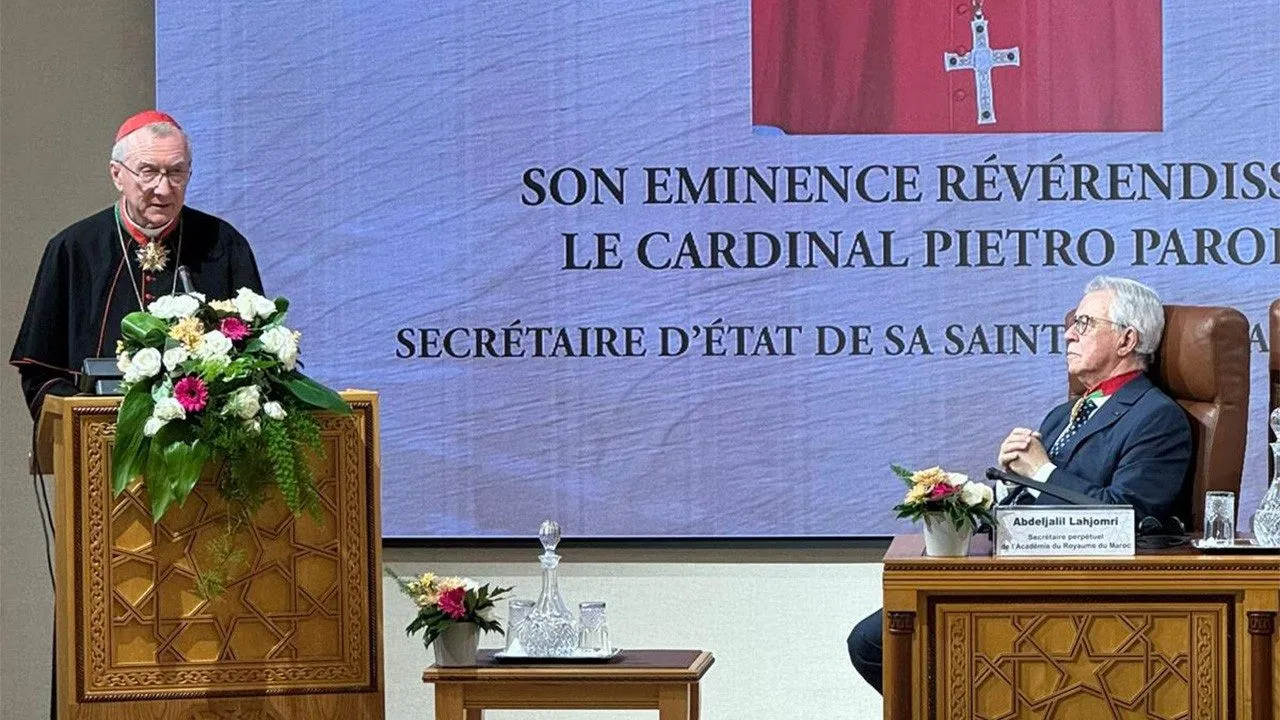

During a significant ceremony in Rabat, Cardinal Secretary of State Pietro Parolin was inaugurated as an honorary member of the Academy of the Kingdom of Morocco. In his address, he emphasized the alignment of views between the Holy See and the African nation, urging a shift from a purely utilitarian perspective of fraternity to one of genuine acceptance. This transition from mere 'tolerance' of others, who share only a 'space of rights,' to the authentic acknowledgment of 'brothers and sisters in humanity' requires a humanity deeply rooted in spirituality. Otherwise, it risks withering in favor of a purely utilitarian view. His speech, titled 'Believers and Citizens: Building Human Fraternity Together After 50 Years of Diplomatic Relations Between the Holy See and Morocco,' was delivered on June 23, marking the solemn welcome and investiture of the Cardinal as a new honorary member of this multidisciplinary institution founded in 1977 by King Hassan II.
Celebrating 50 Years of Diplomatic Relations
In conveying greetings and blessings from Pope Leo XIV, Cardinal Parolin noted that this year marks the 'Golden Jubilee' of diplomatic relations between the Kingdom of Morocco and the Holy See, established in 1976 and characterized by mutual respect and a profound convergence of viewpoints over five decades. However, these relations are merely 'a moment' in the broader context of 'our millenary institutions.' A tangible common ground is the vision of religion as a 'bulwark against extremism' rather than 'a pretext for division.' This concept has been expressed through various milestones in the relationship between the two states, beginning with King Hassan II's visit to the Vatican in 1980 and Saint John Paul II's trip to Morocco in 1985, which marked the first encounter of a Pope with Muslim youth at the initiative of a head of state. These foundations were reaffirmed during Pope Francis's apostolic visit to the country in 2019.
Faith and Citizenship Intertwined
The Cardinal specified that these meetings remain the driving force behind a shared commitment to peace, justice, and the protection of human dignity. Such commitments are encapsulated in the Document on Human Fraternity for World Peace and Living Together, signed on February 4, 2019, in Abu Dhabi. This document states that the Creator has endowed all human beings with equal dignity, urging them to coexist as brothers. This 'eternal truth' calls for active compassion from states, mutual respect, and renewed solidarity in the face of crises threatening our world. The commitment to building peace is further strengthened and legitimized in the spiritual dimension. By embodying 'service to the community' and recognizing the intrinsic dignity of every human being, faith becomes 'the foundation upon which human fraternity is built and a more just world is constructed.' Thus, believers are at the forefront of peacebuilding efforts, as articulated by Pope Francis and King Mohammed VI in 2019.
In conclusion, Cardinal Parolin reiterated that when civic consciousness and faith converge, they become architects of profound social change. The desire for a fairer world is not enough; it requires patient, concrete, and concerted commitment. True peace cannot succumb to the pragmatism of fleeting agreements; it is constructed, with perseverant patience, through a genuine culture of dialogue. It is through this peacebuilding process that we can guarantee the fundamental rights of every individual and strengthen the exercise of freedom. The ultimate hope is that Morocco and the Holy See will continue to chart the paths of the future together, providing a living, radiant, and infallible testimony of our fraternity to the concert of nations.
As reported by vaticannews.va.