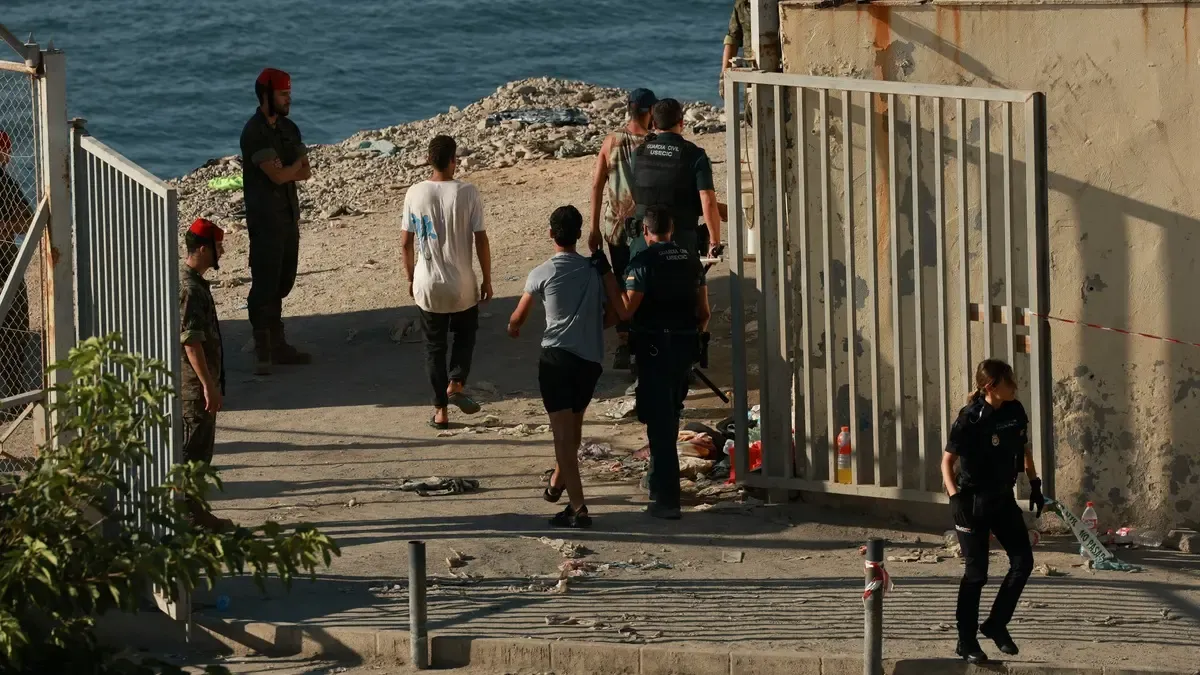
Gradually, a sense of calm is returning to the city of Ceuta, which recently experienced a tumultuous period marked by an influx of tens of thousands of migrants arriving on its shores within a short span of time across the Mediterranean Sea. However, this calm is interspersed with caution and anticipation as European Union interior ministers convene to address the ongoing crisis. Most of those who reached Ceuta, carrying their hopes and sorrows, believed that the gates to the old continent had suddenly opened for them. Unfortunately, many have returned to Morocco empty-handed, burdened only by stories of hunger, thirst, and the struggles they faced during their brief journey toward what they envisioned as a "European paradise."
Official figures regarding the number of migrants who departed or returned during this mass crossing have not been disclosed by Moroccan authorities. However, Spanish security sources have confirmed, as reported by the Spanish news agency, that approximately 69,500 irregular migrants who crossed from Morocco into the Spanish-administered city have since returned to Moroccan territory. The repatriation operations are ongoing, with Spanish authorities noting that nearly all migrants who recently surged into Ceuta have returned to Morocco. Tragically, the tally also reflects a grim reality; the sea claimed the lives of 67 migrants who drowned while attempting to swim to Ceuta.
Simultaneously, Madrid has announced the cessation of attempts to cross into Ceuta, coinciding with the Spanish police's installation of a 500-meter floating barrier off the maritime border with Morocco. This measure aims to prevent the recurrence of mass crossings. Despite the Spanish authorities' efforts to suggest that normalcy has returned to the city, the on-ground situation tells a different story. Journalists and observers report an atmosphere of anxiety, tension, and watchfulness following the shock of migrant arrivals that nearly matched the city's population.
In a report by Al Jazeera's correspondent in Spain, Ayman Al-Zubair, it appears that this sentiment dominates Ceuta, with fears that the repercussions of the crisis may extend beyond migration issues to impact security, political matters, and potentially the relations between Rabat and Madrid. For the migrants, despite the majority returning, the disappointment is as vast as the hopes they carried, as many discovered that the city they believed would serve as their gateway to Europe was merely a brief stop that ended with their return. The suffering of others continues, including mothers searching for their children, who undertook perilous journeys unknown to their families, some of which ended tragically.
In Spain, the return of migrants has not sufficed to reassure the political class or public opinion. The leader of the Spanish conservative party described the situation as an "occupation" of the disputed city with Morocco, urging the government to adopt a stricter policy for border protection. He stated, "The situation is not normal; thousands of people remain within the city, and more concerning is that some refuse to leave. If the Interior Minister believes this is a normal situation, then clearly, we disagree on the reality of the situation." Meanwhile, the residents of Ceuta remain unconvinced by the government's reassurances. While shops that had closed during the crisis are gradually resuming operations, feelings of anxiety persist, with many locals agreeing that the wounds inflicted during those turbulent days will not heal quickly.
The repercussions of the Ceuta crisis extend beyond the city and the Spanish landscape, quickly reaching the European Union level, where the wave of mass crossings has propelled migration and border security back to the forefront of the European agenda. In this context, 22 European countries called for stricter monitoring of the EU's external borders and more stringent measures to prevent irregular mass crossings. The list of signatory nations includes Italy, Denmark, Belgium, the Netherlands, Germany, Finland, the Czech Republic, Poland, Lithuania, Slovenia, Slovakia, Croatia, Bulgaria, Romania, Latvia, Estonia, Hungary, Sweden, Greece, Cyprus, Malta, and Austria.
Simultaneously, Irish Prime Minister Micheál Martin announced that EU interior ministers will hold an emergency meeting next Tuesday to discuss the implications of the crisis and explore ways to address recent developments at the Spanish border. Martin clarified on X platform that Ireland, currently holding the rotating presidency of the EU Council, would call for a meeting of the Justice and Home Affairs Council in an effort to coordinate a unified European stance regarding the crisis that has raised questions about the EU's ability to protect its external borders and manage sudden waves of migration. Ceuta holds particular significance in this context, situated at the northernmost point of Morocco in a strategic location on the southern shore of the Mediterranean Sea, surrounded on three sides by water, and a mere 26 kilometers from the Spanish coast across the Gibraltar Strait. This makes it one of the most sensitive crossing points between Africa and Europe, with implications that extend beyond geographical dimensions to include political and security aspects related to Moroccan-Spanish relations and EU policies on migration and external borders.
As reported by aljazeera.net.