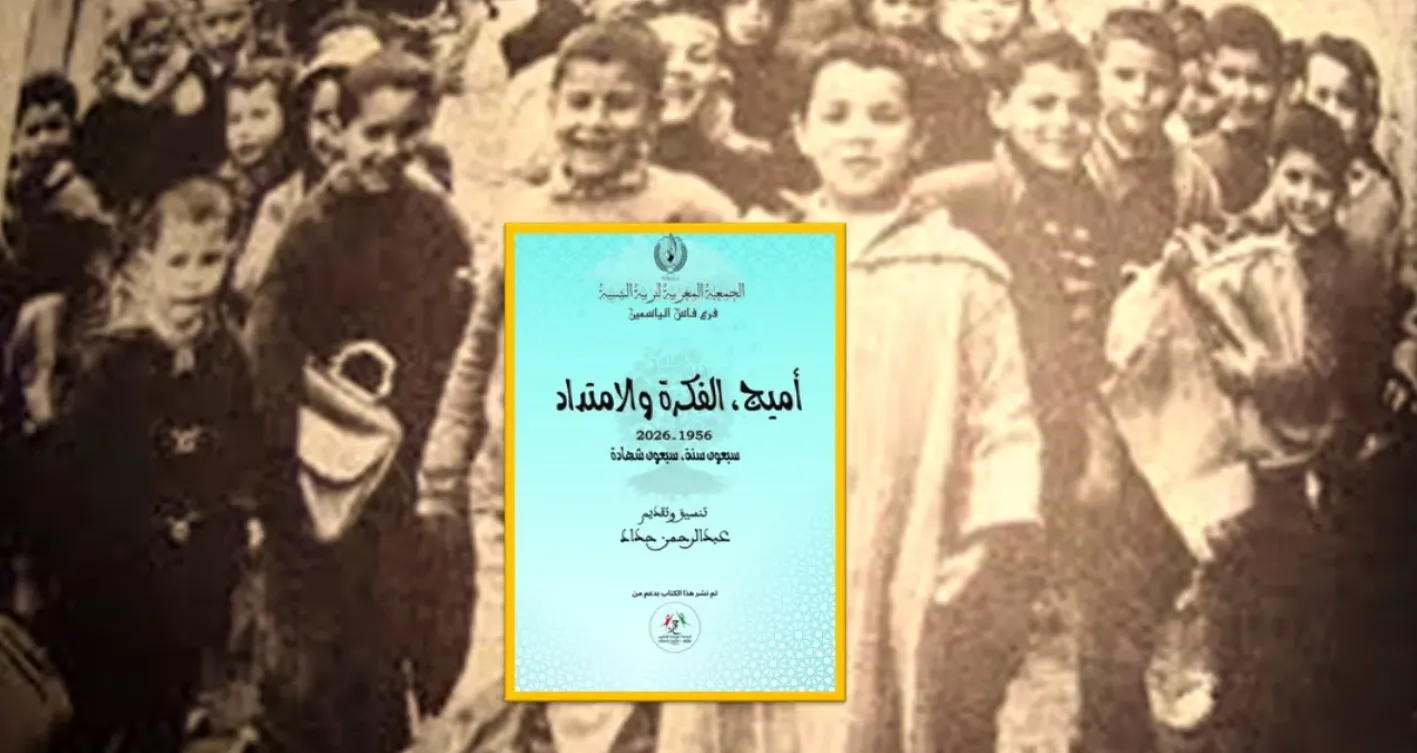

The Moroccan Association for Youth Education (AMEJ) has significantly enhanced its cultural initiative by releasing a new publication titled “AMEJ: Idea and Extension 1956 – 2026.” This new release chronicles the journey of the AMEJ association over seven decades of active involvement in community service and volunteer work. The cultural project serves as an important documentary and humanistic record, reflecting on seventy years of the association's history, which stands as one of the most prominent educational organizations in Morocco, deeply embedded in the collective memory of generations of children, youth, and community leaders.
The new publication was introduced in the city of Fez during an intellectual seminar on “Community Work in Morocco: What Transformations? What Prospects?” organized by the Jasmine branch of the association last Saturday in the scientific capital, Fez. This event showcased dozens of testimonials and experiences, painting a vivid picture of a national and educational journey intertwined with Morocco's modern history and its political, social, and cultural transformations since the years of independence. The publication is not merely an archive of the history of an organization founded in 1956 but includes a variety of testimonials from founders, activists, and leaders who have held responsibilities within the association. It highlights how AMEJ emerged in a specific national context marked by an urgent need to cultivate the Moroccan human capital following the end of colonialism, not only through formal education but also through informal educational spaces and cultural and volunteer frameworks. Consequently, the establishment of the association is linked with prominent figures from the national movement, such as Mehdi Ben Barka, Mohamed El Hayahi, and Mohamed Bensaid, who viewed education as a gateway to creating a new citizen imbued with values of freedom, commitment, and responsibility.
The book, prepared by university professor Abdel Rahman Haddad, delves into the transformations experienced by community work in Morocco and the challenges faced by the association at various stages, including camping, training, funding, and the relationship between associations and official institutions. Despite these challenges, the testimonials reveal the association's resilience and ability to innovate by developing management mechanisms and adopting more modern approaches to governance and training while remaining open to national and international partnerships, all while preserving its original spirit rooted in independence and volunteerism.
Notably, the book also emphasizes the value-driven aspect that characterized the association's experience. Most testimonials recall how AMEJ has contributed to instilling values of volunteerism, integrity, solidarity, and commitment. For its members, AMEJ has become akin to a “shared identity” that transcends mere organizational affiliation. Consequently, many participants openly express nostalgia for the era when educational and community activities served as a space for cultivating hope and collective dreams, free from narrow calculations and individual interests.
As reported by ahdath.info.