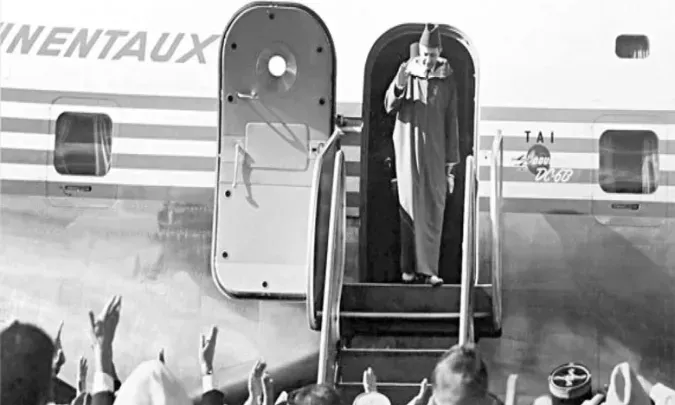

Historical Significance of the King and People's Revolution
The commemoration of the 73rd anniversary of the King and People's Revolution on Thursday serves as a poignant reminder of the historical significance and deep symbolism of this illustrious national saga, which is firmly etched in the collective memory of Moroccans. This event, celebrated on August 20, 1953, stands as a decisive milestone in the ongoing struggle for freedom, independence, and territorial integrity within Morocco. It embodies the noble values of patriotism, sacrifice, loyalty, and the enduring bond between the Throne and the people.
On that fateful day in 1953, colonial authorities exiled the revered hero of liberation and independence, the late King Mohammed V, in a futile attempt to sever the centuries-old connection between the monarchy and the Moroccan populace. Instead of quashing the national spirit, this egregious act only fortified the resolve of the Moroccan people, igniting an unprecedented wave of popular mobilization across various regions of the Kingdom. The Moroccan populace rose with courage and selflessness, fervently demanding the return of their legitimate Sovereign and expressing their readiness to make the ultimate sacrifices to defend their sovereignty, dignity, and the sacred values of their nation.
The Legacy of Resistance and National Unity
The exile of the Father of the Nation signaled the beginning of the end for colonial domination and provided a renewed impetus for national resistance. Numerous resistance movements and clandestine organizations emerged, intensifying their operations against the symbols and interests of colonial rule. A broad wave of solidarity and mobilization swept across cities, countryside, and villages, reinforcing the collective consciousness of the Moroccan people. The Revolution of the King and the People was, indeed, the culmination of a long-standing resistance against foreign occupation, characterized by heroic battles and episodes, including the confrontations at Elhri in the Middle Atlas in 1914, Anoual in the Rif from 1921 to 1926, and Bougafer in Ouarzazate and Jbel Baddou in Errachidia in 1933.
In parallel with armed resistance, national political action gained momentum through significant events, from mobilizing against the so-called Berber Dahir in 1930 to the presentation of the Independence Manifesto on January 11, 1944, which enshrined the aspirations of the Moroccan people for freedom, sovereignty, and national unity. A pivotal moment in this struggle occurred on April 9, 1947, when the late King Mohammed V made his historic visit to Tangier and delivered a speech affirming Morocco's aspirations for independence and national unity, further strengthening the bond between the Throne and the national movement.
Neither the oppressive campaigns nor the relentless persecution by colonial authorities could diminish the determination of the Moroccan people. On the contrary, the exile of their legitimate Sovereign transformed the national struggle into a true popular revolution, hastening events that ultimately led to the capitulation of colonial power. Thus, on November 16, 1955, King Mohammed V made his triumphant return to Morocco, bringing the joyous news of the end of the protectorate regime and paving the way for independence and a new chapter in the Kingdom's history—one focused on nation-building and the completion of territorial integrity.
The liberation journey continued with the recovery of Tarfaya on April 15, 1958, and Sidi Ifni on June 30, 1969. Under the leadership of the late King Hassan II, an essential turning point was reached with the glorious Green March in 1975, exemplifying peaceful and civilized mobilization for the recovery of the Kingdom's legitimate rights. More than seven decades after the events of August 20, 1953, the Revolution of the King and the People remains a significant reference point in the Kingdom's history and a beacon of patriotism from which successive generations draw values of loyalty, sacrifice, mobilization, and commitment to national unity.
Under the enlightened leadership of King Mohammed VI, this historical legacy endures today through ongoing mobilization for development, modernization of the Kingdom, and the consolidation of its achievements, all while fostering the same spirit of communion between the Throne and the people that has shaped the pivotal moments of national history.
As reported by maroc.ma.