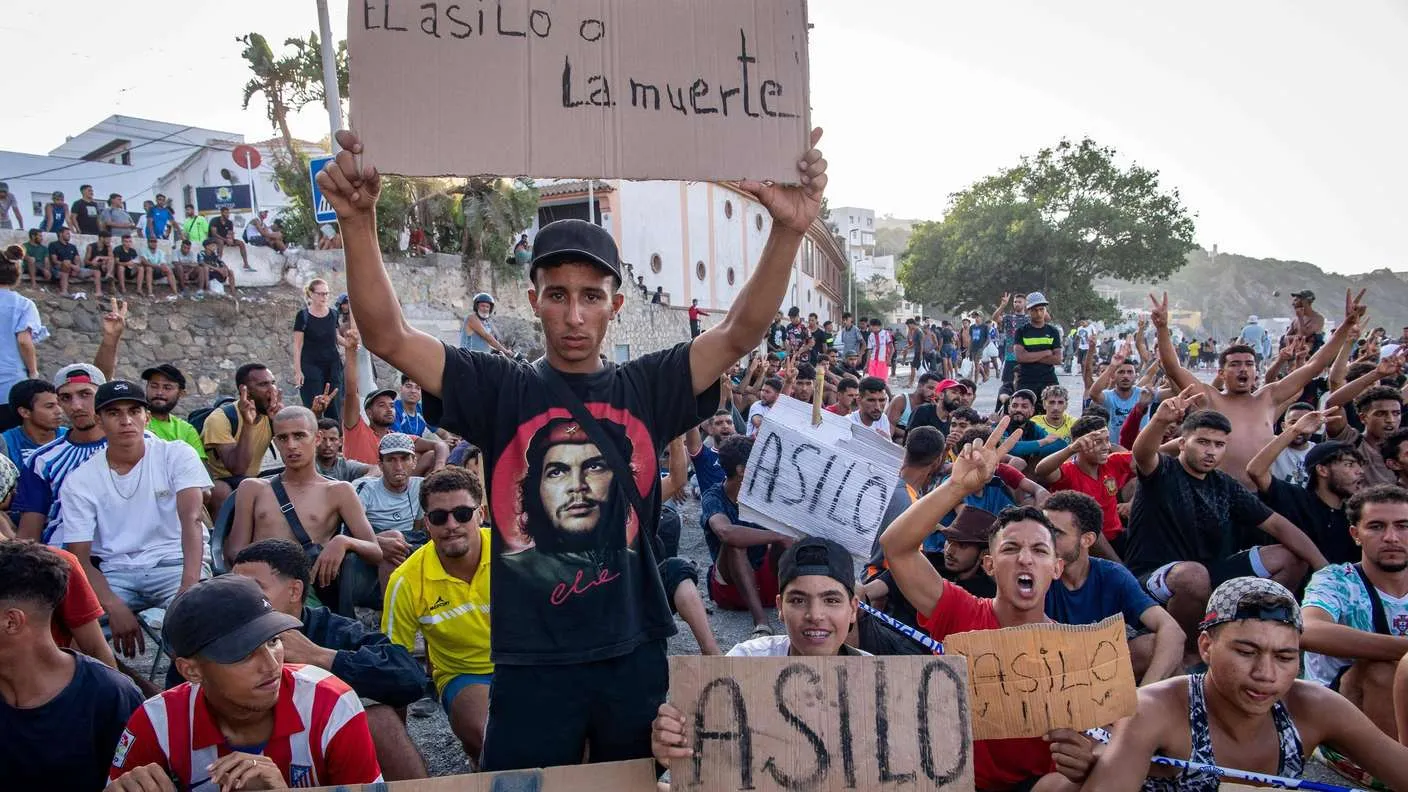

Humanitarian Situation in Ceuta
Nearly three weeks after a significant influx of refugees into the Spanish enclave of Ceuta, thousands are still stranded, many without stable shelter. The situation is dire as over 5,000 individuals, according to the Spanish government, or up to 10,000 as claimed by the local government of Ceuta, remain in precarious conditions following the surge on July 30. Among them, those fleeing from war or persecution have a chance to remain in Spain, alongside the 2,168 minors identified by the Ministry of the Interior. However, the rest face uncertain futures.
At Playa del Trampolín, makeshift accommodations are set up using bamboo, straw, and blankets. An imaginary mosque, outlined by empty milk cartons and a broken plastic pipe serving as a minaret, marks the area. A Sudanese barber offers his services, while groups of men engage in football nearby. Just across the sea lies the Rock of Gibraltar, a stark reminder of Europe’s geographical proximity.
Growing Tensions and Government Response
The tension in Ceuta is palpable. Local PSOE representative Melchor León expressed concerns about the growing anxiety among the people, stating that it is natural for them to feel increasingly abandoned by the government. This sentiment is echoed by Abdellah Mustafa, the head of the neighborhood association in the predominantly Muslim district of Sidi Embarek, who warns of the potential for social unrest if conditions do not improve. The local government has decided to establish tent camps capable of housing 1,500 individuals as a temporary solution, utilizing spaces such as a parking lot and a former cavalry barracks sports field. Meanwhile, the Red Cross is distributing around 4,000 meals daily to those in need.
Despite its manageable size—84,000 residents spread over approximately 20 square kilometers—authorities have struggled to account for the refugees moving surreptitiously throughout the city. Many Moroccans who remain in Ceuta tend to stay in Muslim neighborhoods, and locals report feeling overwhelmed, with as many as 20 people knocking on their doors each day seeking basic necessities such as showers, phone charging, or food. While the establishment of 1,500 tent spaces offers a glimmer of hope, the overall situation remains frustrating, compounded by the lack of clarity regarding the total number of refugees.
Recently, the President of Ceuta visited the area, assuring residents that every possible effort would be made to alleviate the crisis. As Abdellah Mustafa noted, the community remains hopeful yet skeptical about the government's commitment to improving conditions.
As reported by fr.de.