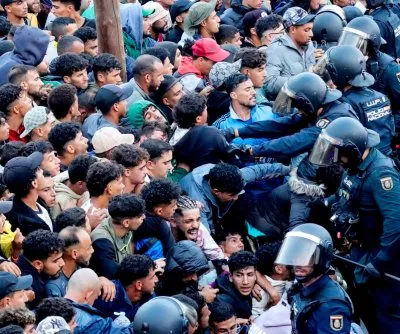
On August 3, 2026, a significant humanitarian crisis unfolded in Ceuta, Spain's North African exclave, as hundreds of migrants established makeshift camps on the region's beaches. Local authorities are grappling with the consequences of a recent surge in migrant arrivals, a situation exacerbated by a massive border rush that occurred just last week. Despite Spain's efforts to manage the influx, an estimated 69,500 migrants have returned to Morocco over a span of four days, a figure that far exceeds initial expectations of around 50,000 arrivals in Ceuta. Tragically, the official death toll now stands at 72 on the Spanish side of the border, with an additional 11 fatalities reported in Morocco.
The dire circumstances prompting these migrations are multifaceted, with many migrants citing food shortages due to shop closures, hostility from local residents, and the inability to travel onward to the Spanish mainland as driving factors behind their desperate situation. Ceuta, along with Spain's other exclave, Melilla, is strategically situated on Morocco's Mediterranean coast and frequently encounters attempts by migrants seeking a passage into Europe.
Recent footage captured by Reuters shows numerous migrants, predominantly from sub-Saharan Africa, resting on El Trampolin beach. Wrapped in towels to shield themselves from the chilly winds, they are monitored by police and military vehicles, highlighting the tense atmosphere surrounding this ongoing crisis. According to Ceuta's local leader, Juan Jesus Vivas, estimates suggest that between 3,000 and 5,000 migrants currently remain in the exclave. He lamented that the region's two migrant reception centers—one for adults and another for minors—are overwhelmed and on the brink of collapse.
Local authorities are also processing a significant number of migrant minors, currently numbering around 862, who benefit from specific legal protections against deportation. The situation has ignited a wave of anti-immigration sentiment across Europe and has strained diplomatic relations within the European Union, as Spain has accused several member states of offering unconstructive and divisive responses to the crisis. Foreign Minister Jose Manuel Albares emphasized Spain's historical support for other EU countries during past migration crises and expressed a desire for reciprocal assistance in this challenging moment.
In response to the escalating situation, the European Union has convened an emergency video conference of interior ministers to deliberate on effective strategies moving forward. Albares took the opportunity to criticize the Italian government's role in perpetuating misinformation, further complicating the crisis. He noted that Morocco had readily extended police support without imposing conditions, facilitating the swift return of many migrants who had crossed the border.
Nonetheless, Vivas expressed skepticism regarding Morocco's reliability in managing the situation, suggesting that the Moroccan authorities may have either allowed or even orchestrated the crisis. His remarks reflect a growing concern in Ceuta that the Moroccan government is not a trustworthy partner in addressing migration issues. The Moroccan Interior Ministry, for its part, has attributed the recent surge in crossings to misinformation circulating on social media, human trafficking networks, and a misinterpretation of a Spanish court ruling concerning the immediate return of intercepted migrants at sea.
Reports from El Pais and Cadena SER radio indicate that while Spanish intelligence agencies have concluded that Morocco did not premeditate the mass crossing, they did allow it to unfold. Tensions have emerged within Spain's government as Interior Minister Fernando Grande-Marlaska disclosed that the foreign intelligence agency, CNI, failed to alert him regarding the anticipated surge in migrants. This revelation has reportedly created friction between the Interior Ministry and the Defense Ministry, although an Interior Ministry spokesperson attempted to downplay the significance of these tensions. Defense Minister Margarita Robles refrained from confirming whether the CNI had prior knowledge of the situation, commending the exceptional work of Spanish security personnel in managing the crisis.
As reported by nbcnews.com.