
Rising Tensions at the Ceuta-Morocco Border
The situation in Ceuta has escalated to a critical point, as reports indicate that another wave of migrants may attempt to cross the border soon. Social media platforms are buzzing with claims that a mass movement is planned for March 23, coinciding with a parliamentary election in Morocco. This imminent challenge raises alarms regarding the already strained resources and border security measures in the Spanish exclave, located at the Strait of Gibraltar.
Manfred Weber, the chairman of the European People's Party (EVP), recently visited Ceuta, flying in from Málaga. From the helicopter, he noticed disarray at the maritime border, where several red fragments of an inflatable barrier designed to deter irregular migration were adrift. The Spanish government had deployed this barrier, which extends one meter below the water's surface, following a massive influx of approximately 80,000 migrants in late July. However, rough seas over the weekend had rendered it ineffective, leaving the border vulnerable once again.
Local Reactions and Political Implications
Weber's visit coincided with a growing sense of urgency among local officials, including Alberto Núñez Feijóo, the leader of the Spanish People's Party, who has made multiple visits since August. The conservative party has been vocal about its criticism of the socialist government's handling of migration issues, viewing Ceuta as emblematic of a failed policy, particularly as elections approach next year. The local populace, numbering around 84,000 within a mere twenty square kilometers, shares this sentiment, with many residents feeling the pressure of increasing tensions and the potential for unrest.
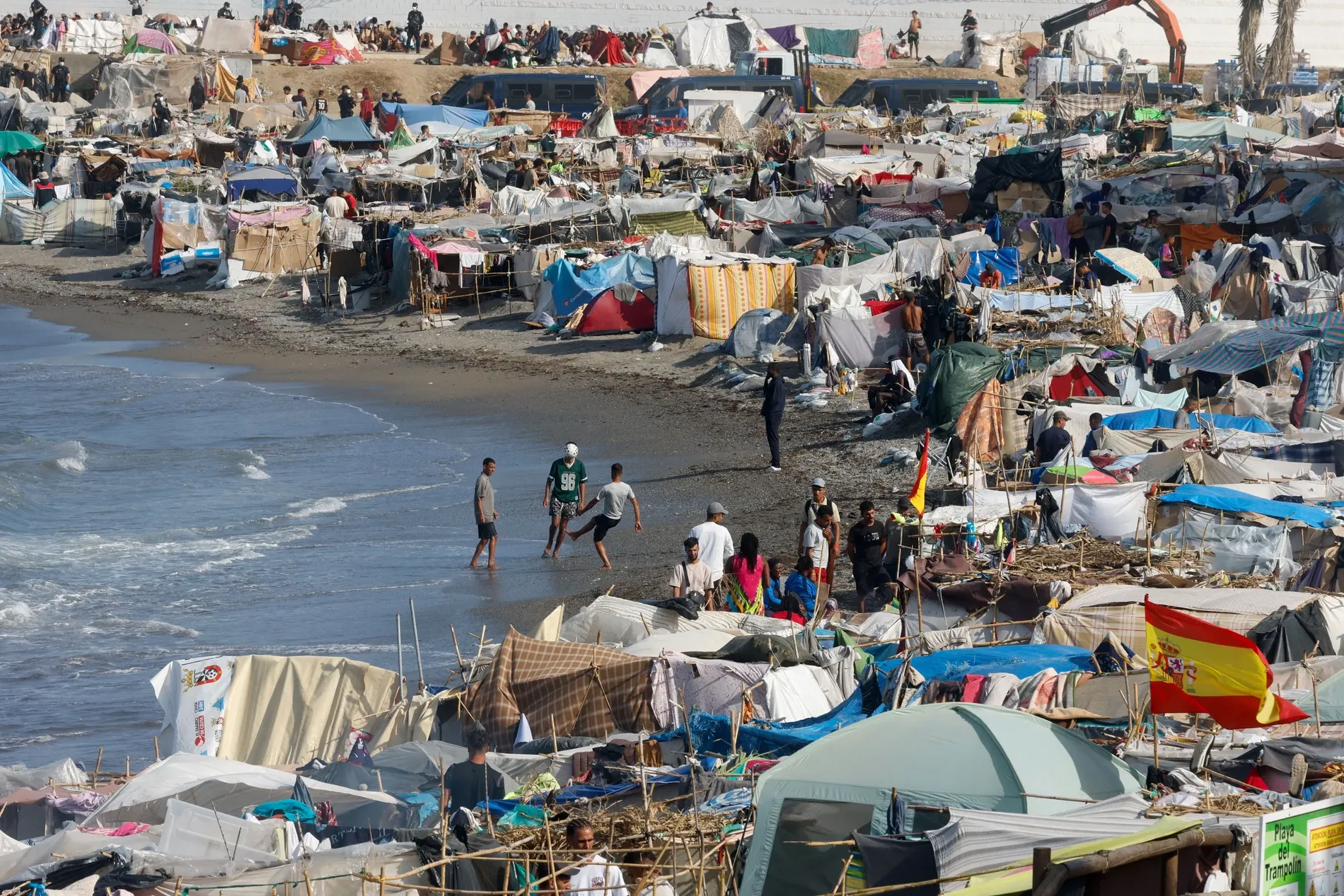
As Weber toured the area, he encountered makeshift camps along the coast, where migrants had established an informal market, selling goods to one another. Despite the chaotic appearance, the scene revealed a community struggling to survive. Khalid, a twenty-year-old migrant who had arrived weeks earlier, expressed his desperation for a better life, asserting that they were not invaders but rather individuals seeking opportunities. His story is echoed by many others who remain in Ceuta, having either exhausted their resources or lacking viable alternatives in their home countries.
In response to the ongoing crisis, the Spanish government has increased the presence of security personnel at the border, while local leaders call for stronger measures, including a reinforced physical barrier. The current situation is compounded by misinformation circulating on social media, leading many to believe that entry into Ceuta is now more accessible than before. This misunderstanding has further fueled the urgency for migrants and raised concerns among local authorities about the potential for renewed crossings.
Weber emphasizes the need for a robust response from the European Union, advocating for a stronger commitment to border security and infrastructure investments. He argues that the protection of external borders is a shared European responsibility, calling for the European Border and Coast Guard Agency (Frontex) to take a leading role in these efforts. As the political landscape in Spain shifts with an eye towards upcoming elections, the residents of Ceuta await a resolution that addresses both their immediate concerns and the broader implications of migration policy in Europe.
As reported by faz.net.