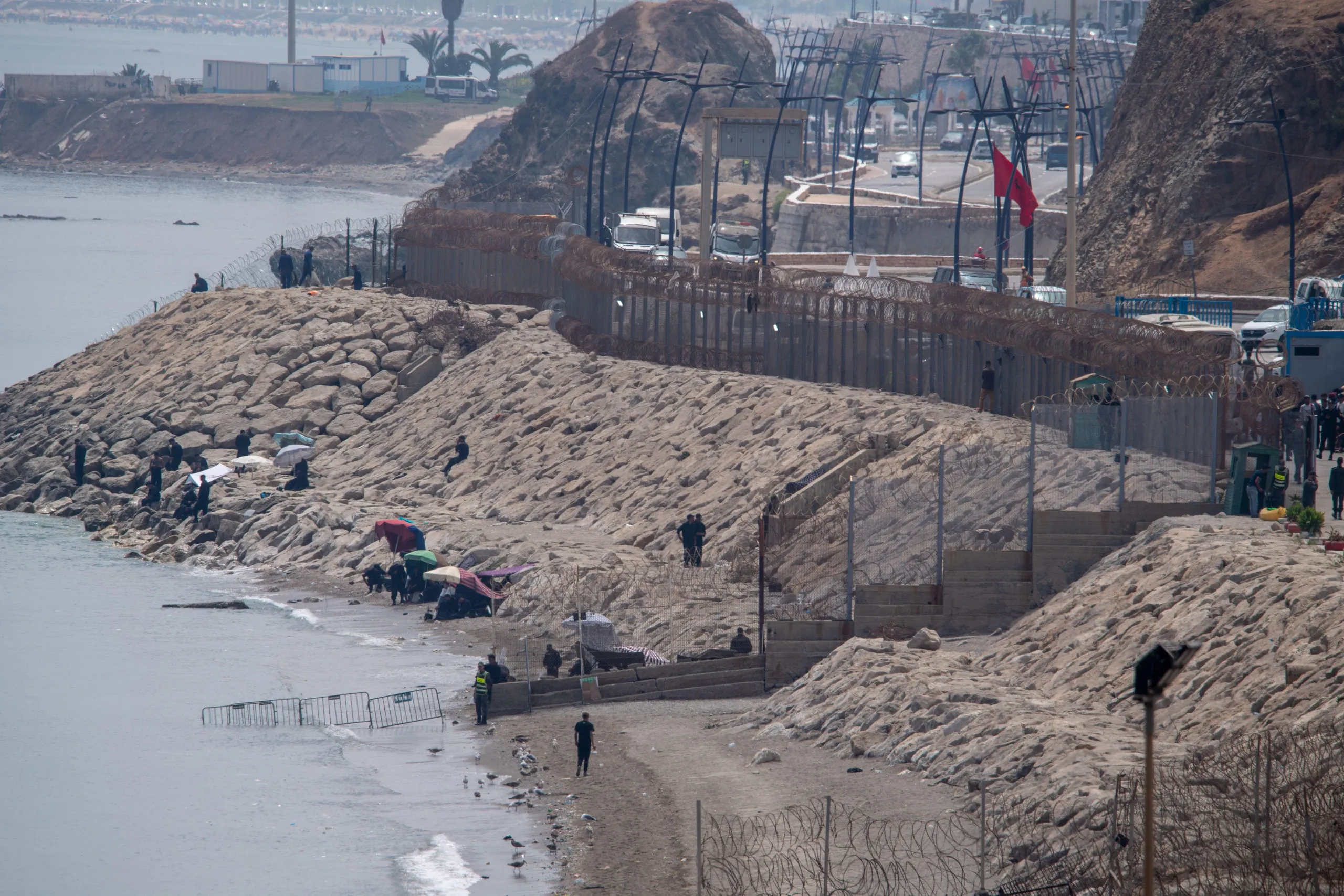

Increased Security at the Ceuta-Morocco Border
In the wake of a mass crossing event, Morocco has significantly reinforced security along its border with the Spanish exclave of Ceuta, leading many refugees and local residents to express skepticism about the likelihood of another attempt at crossing this weekend, despite calls circulating on social media. The Moroccan government has deployed additional security forces to the border area, establishing police checkpoints along the road leading to the crossing and utilizing water cannons as a deterrent. Numerous police vehicles are stationed at the control point, and officers patrol the hills to prevent a repeat of the alarming scenes witnessed two weeks ago, when approximately 70,000 individuals fled from Morocco to Ceuta.
The heightened concern over a potential new wave of migration stems from social media posts encouraging people to attempt the crossing this weekend. In response, the European Commission has urged platforms like Meta to remove such posts. Refugees in Ceuta have reported receiving messages that incite further attempts to cross the border. The previous surge in migration led to heightened tensions between Spain and Morocco, with both nations blaming each other for the situation. The precise reasons behind this sudden influx of migrants remain unclear, but both countries appear determined to avert a recurrence.
Current Conditions for Refugees in Ceuta
Within Ceuta, thousands of refugees still remain, including many minors and women. A spokesperson for the Spanish Interior Ministry has assured that all preventive measures have been taken to secure the border and prevent illegal entries. Following prior reports, additional military personnel have also been dispatched to the exclave. Morocco has established a comprehensive security perimeter deep within its territory; in the town of Fnideq, located approximately four kilometers from the border, police presence is markedly high, with multiple police buses and officers in protective gear stationed around. Meanwhile, the streets are bustling with activity, featuring vendors selling Moroccan street food and imitation football jerseys.
On the Spanish side of the border, security measures appear less pronounced, with soldiers and police present primarily in front of larger supermarkets and at the beach. A border gate near the beach remains open, allowing Moroccan citizens who wish to return voluntarily to cross back into their homeland without questioning. Reports indicate that around 600 individuals have returned voluntarily in recent days. However, many remain, with refugees camping along the beach, having arrived mainly from Sub-Saharan Africa, living in makeshift shelters or under the open sky. The Red Cross is providing assistance with water and food supplies at Playa del Trampolin. A taxi driver mentioned that the majority of migrants are men and boys, although he has also observed women and girls attempting to cross.
In the Tarajal industrial area, a warehouse serves as temporary accommodation for unaccompanied minors. Eyewitnesses noted that even before the recent events, this facility was overcrowded, resulting in families and unaccompanied minors sleeping outside. Mohammed, a 17-year-old boy, shared his experience of sleeping on cardboard with a few others, using metal barriers to shield themselves from the sun. They receive food just once daily, and the youngest in their group, a 14-year-old named Oussama, expressed a shared sentiment of hopelessness regarding their situation. Most of them originated from the same neighborhood in Tetouan, around 40 kilometers away, and many crossed the border on July 30, with some doing so earlier. Reports indicate that the number of crossings began to rise days prior to the mass event.
Mohammed recounted that he learned about the open border through Instagram posts from friends, who confirmed the information. They then took a taxi towards the border but were stopped by military personnel three kilometers away, who instructed them to walk to the beach. The boys described how panic ensued during the sea crossing, causing many to be pushed underwater. In the following days, many sought refuge in a nearby forest. Return to Morocco is not an option for them, as they cite a lack of jobs and poor educational opportunities as their primary motivations for leaving. Salim, an 18-year-old from Fes, echoed similar sentiments, explaining that he had also seen posts on Instagram regarding the open border. He has long desired to leave Morocco, burdened by the responsibility of supporting his four younger brothers and parents.
Current estimates regarding the number of refugees still in Ceuta remain uncertain. The Spanish Interior Ministry updated their estimate to approximately 5,000 adult irregular migrants, in addition to 1,989 minors registered by the National Police. Previously, the Spanish government had estimated the total number of refugees in Ceuta to be between 2,500 and 3,000, while the mayor of the exclave suggested that the number might be closer to 9,000. Local residents speculate that the actual figure could be even higher. This situation reflects the ongoing complexities surrounding migration and border security in the region.
As reported by correctiv.org.