
Overwhelming Influx of Migrants and Government Response
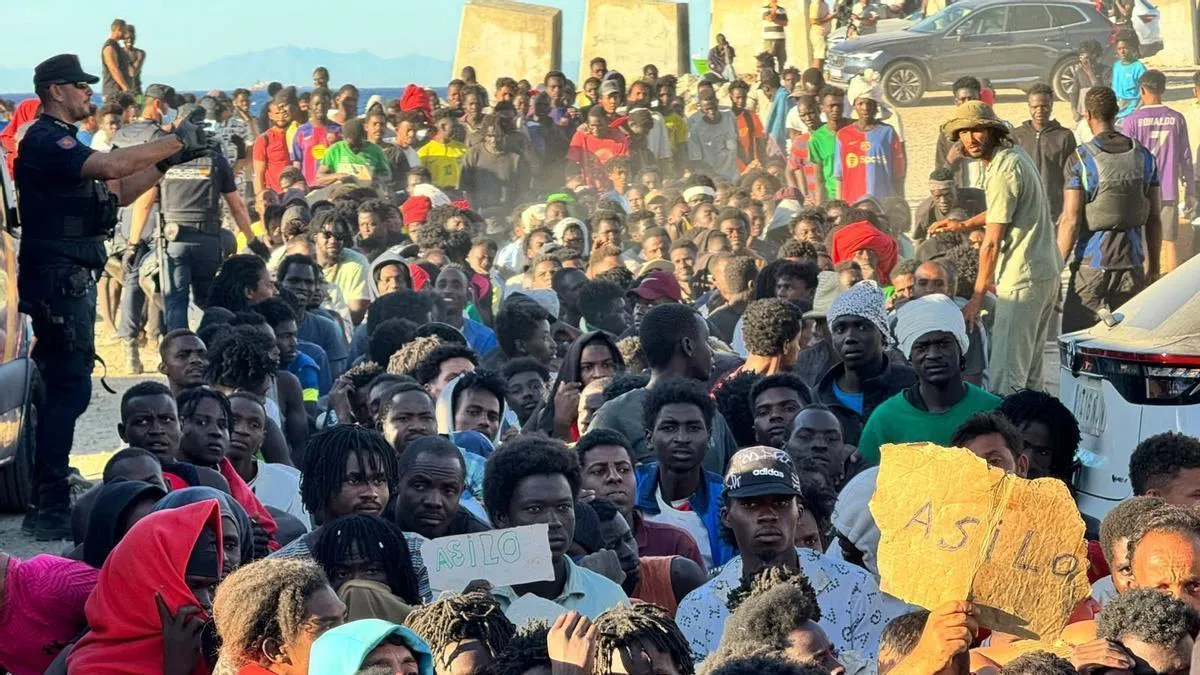
On July 30, more than 70,000 migrants entered Ceuta, either by swimming or walking around the border breakwater with Morocco, leading to a tragic loss of over one hundred lives during this perilous journey. This overwhelming situation has stretched emergency resources to their limits and reignited discussions on the management of the border between Spain and Morocco, with fears that such episodes could recur, potentially orchestrated through social media platforms.
In light of this crisis, Spain's Minister of Health, Mónica García, stated on Thursday that her department's primary focus is to "prevent, attend to, and monitor any public health issues that may arise" from the influx of migrants. She emphasized that, thus far, there has been no increase in appointment delays or cancellations. García reported that healthcare services managed to assist a total of 275 patients on the previous day, including 108 emergency room visits, 33 patient admissions, and 123 healthcare consultations across various health centers.
The Civil Guard has issued a message via their social media channels in Spanish, French, and Arabic, aiming to dissuade individuals from attempting to enter Spain irregularly. They have made it clear that those who do will be returned to their home countries, stating, "Don't be deceived. Everything they promise you is a lie." This message comes just two weeks after the massive influx of 72,000 people into the autonomous city of Ceuta, amidst concerns that another wave of mass entries could occur around August 15.
Local Leaders Demand Action and Address Underlying Issues
Juan Jesús Vivas, the President of Ceuta, has described the situation in the autonomous city as one of "maximum risk" for both coexistence and safety. He has urged the central government to dismiss asylum applications and to immediately return all migrants who crossed the border during the recent crisis. Vivas firmly stated, "Return to Morocco... no regularization, no asylum. That message must be absolutely clear," indicating his frustration over the lack of response from Interior Minister Fernando Grande-Marlaska regarding these requests during a press conference.
The Moroccan Economic, Social, and Environmental Council has reported that nearly 1.5 million Moroccan youths aged between 15 and 24 are outside of the educational system, vocational training, and the labor market. Despite Morocco's significant investments in infrastructure projects over recent decades, including ports, highways, high-speed rail lines, and modern sports facilities, the economic benefits have not reached the majority of the population. The Moroccan royal family, led by King Mohammed VI, possesses an estimated fortune ranging from $5.7 billion to over $8 billion, making it the wealthiest monarchy in Africa and one of the ten richest in the world. This wealth is concentrated through substantial business power that directly influences key sectors within the country.
Furthermore, the European Commission has stated that its 'ad hoc' cooperation mechanism with Meta, TikTok, and data verification organizations to combat misinformation related to migration crossings into Ceuta is "yielding results." Community spokesperson Balazs Ujvari noted that this collaboration includes data verifiers who analyze content and enforce policies against smuggling, violence, and hate speech, with some operating around the clock.
In a recent press briefing, Vivas reiterated to Minister Grande-Marlaska that the city is currently experiencing an "unsustainable situation" following the mass assault of approximately 72,000 irregular migrants at the end of July. He called for their swift return to Morocco, highlighting the urgent need for effective measures.
As reported by the International Organization for Migration (IOM), the deaths and disappearances of migrants have more than doubled along the Central Mediterranean Route and tripled on the Eastern Mediterranean Route during the first four months of 2026 compared to the same period in 2025, despite a decrease in arrivals. These alarming statistics reflect how extreme weather conditions, conflicts, economic pressures, and changes in migration policies have reshaped migratory pathways across various regions.
Estimates from local social organizations indicate that approximately 4,000 minors remain outside the protection system in Ceuta, awaiting identification and referral to social services, two weeks after the irregular entry of over 70,000 individuals across the Moroccan border. Save The Children has clarified that this figure is merely an estimate due to the challenges in locating all minors who are scattered throughout the city without safe sleeping arrangements or adequate access to basic services. Currently, around 1,500 minors are reported to be within the protection system, while thousands remain on the streets.
In Italy, authorities have detained three individuals and returned 21 others to Spain since the implementation of passenger controls at Spanish ports and airports due to the migration crisis in Ceuta. Italian Interior Minister Matteo Piantedosi confirmed these figures during a parliamentary session on Thursday, attempting to justify his government’s decision, which has led to tensions in bilateral relations and reciprocal measures from Spain.
The Melilla government has expressed concerns that the floating barrier being installed by the Ministry of Interior, similar to the one recently set up in Ceuta, is "insufficient," demanding that the national government devise a "defense strategy" in both autonomous cities to prevent a recurrence of this migration crisis. In response to journalists' inquiries, Melilla's First Vice President, Miguel Marín, insisted that the central government must have "immediate resources prepared" as part of this defensive strategy, asserting, "The image that Spain is projecting to the world is one of not having the capacity to defend its borders." He added that Morocco does not take President Sánchez or Spain seriously, which he deems unacceptable, advocating for strong relations between the two countries that are based on equality and mutual loyalty, which he believes is currently lacking.
As reported by elperiodico.com.