
Current Migration Challenges in Ceuta
Despite calls for illegal border crossings, a significant surge towards the Spanish exclave of Ceuta did not materialize over the weekend. However, the situation for migrants, who are inadequately sheltered in Ceuta, remains dire. On Saturday, individuals without valid documentation found themselves unable to cross into Ceuta. In response to renewed social media calls for mass migration, the Spanish exclave fortified its defenses with approximately 1,600 police officers and 2,000 soldiers deployed. Military tanks were stationed at the El Tarajal border post, while boats from the military and the Guardia Civil patrolled the coastline, ensuring that the border remained secure.
Morocco also took decisive action by sealing its border and dispatching security forces to the border area. These forces monitored access roads and the mountainous border terrain, intercepting hundreds of migrants from Sub-Saharan countries attempting to reach the Spanish border during the night leading into Saturday. According to reports from Reuters, Moroccan authorities apprehended 111 individuals. Notably, not a single irregular migrant managed to set foot on European soil via Ceuta this time, contrasting sharply with late July when over 70,000 migrants successfully entered the exclave. The absence of an official explanation for this drastic change raises questions about the underlying dynamics of the migration flow.
Ongoing Humanitarian Concerns and Government Response
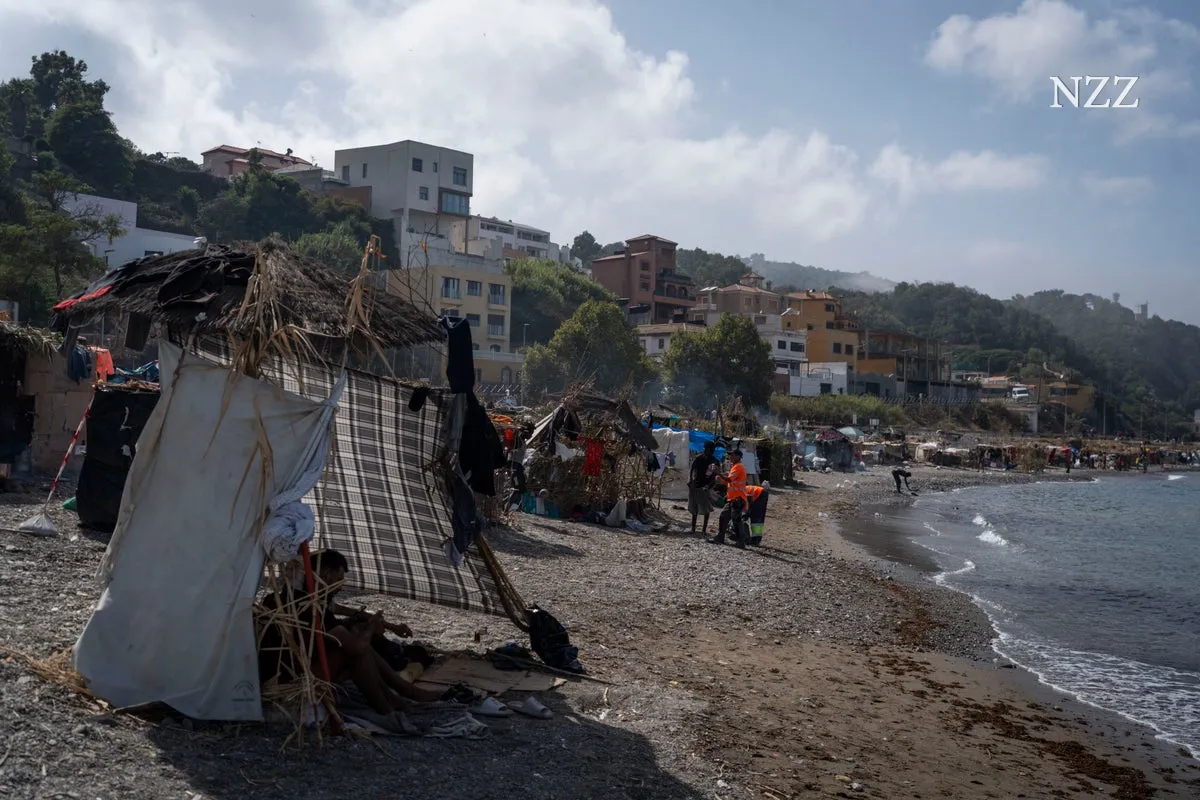
In the wake of the July influx, a state of emergency continues to prevail in the city of Ceuta, which has a population of 83,000. The Spanish government estimates that around 8,000 irregular migrants remain in the city, while the regional government of Ceuta suggests the number could be as high as 11,000. The conditions are described as untenable by Juan Jesús Vivas, the regional president from the conservative Partido Popular (PP). A poignant symbol of the dire situation is El Trampolín beach, where nearly a hundred makeshift shelters constructed from palm fronds, driftwood, tarpaulins, and discarded clothing stand. Most adult migrants in this improvised camp come from countries south of the Sahara, although exact numbers are difficult to ascertain. The Red Cross provides approximately 4,000 plastic bags containing milk, juice, water, fruit, and pastries daily, suggesting a pressing need for humanitarian assistance.
Sanitary conditions are reportedly alarming, not only in El Trampolín but across the camps. Raúl Barnaiz from Save the Children highlights that many children and adolescents are among the migrants, with some as young as ten or eleven years old. Under the UN Convention on the Rights of the Child and Spanish law, minors can only be returned after a thorough case-by-case assessment, which includes consideration of appropriate care conditions and often requires the consent of both the families and the children themselves. If such consent is not given, it falls to Spain to provide care until they reach adulthood. To date, the police have registered around 1,800 children and adolescents, who by law must be housed and cared for in state facilities. Unfortunately, these reception centers are chronically overcrowded, and even makeshift shelters set up in two primary schools are at capacity. The mandated redistribution of minors to centers on the Spanish mainland is stalled due to political reasons, as regions governed by the PP and the far-right Vox party refuse to accept them.
Reports indicate that not all underage migrants have been accounted for, with many sleeping in extreme poverty in abandoned factories, garages, or even in ditches. In the impoverished El Príncipe neighborhood, a community association has transformed a soccer field into an emergency shelter, which currently accommodates only girls and young women, some carrying babies or toddlers. Ahmed Enfedal, the president of the neighborhood association, emphasizes the heightened risks faced by women and girls, urging local residents to take action in light of the slow response from authorities. The Spanish government has allocated €25 million for the care of these children and adolescents, and ministers for health and youth recently visited the exclave. However, available facilities remain limited, and the bureaucratic processes of Spanish immigration law are lengthy. The leftist coalition government in Madrid has adopted a tougher stance, with Foreign Minister José Manuel Albares stating that every last migrant will be deported back to Morocco. Meanwhile, the Spanish police are using messages in Arabic and French to deter migrants from attempting to cross the border, while Moroccan authorities detained 61 individuals on Saturday for calls to illegal border crossing.
Social media is already buzzing with new calls for migration, scheduled for September 23, coinciding with elections in Morocco, which may draw police and officials away from border security, potentially increasing the chances of successful crossings.
As reported by nzz.ch.