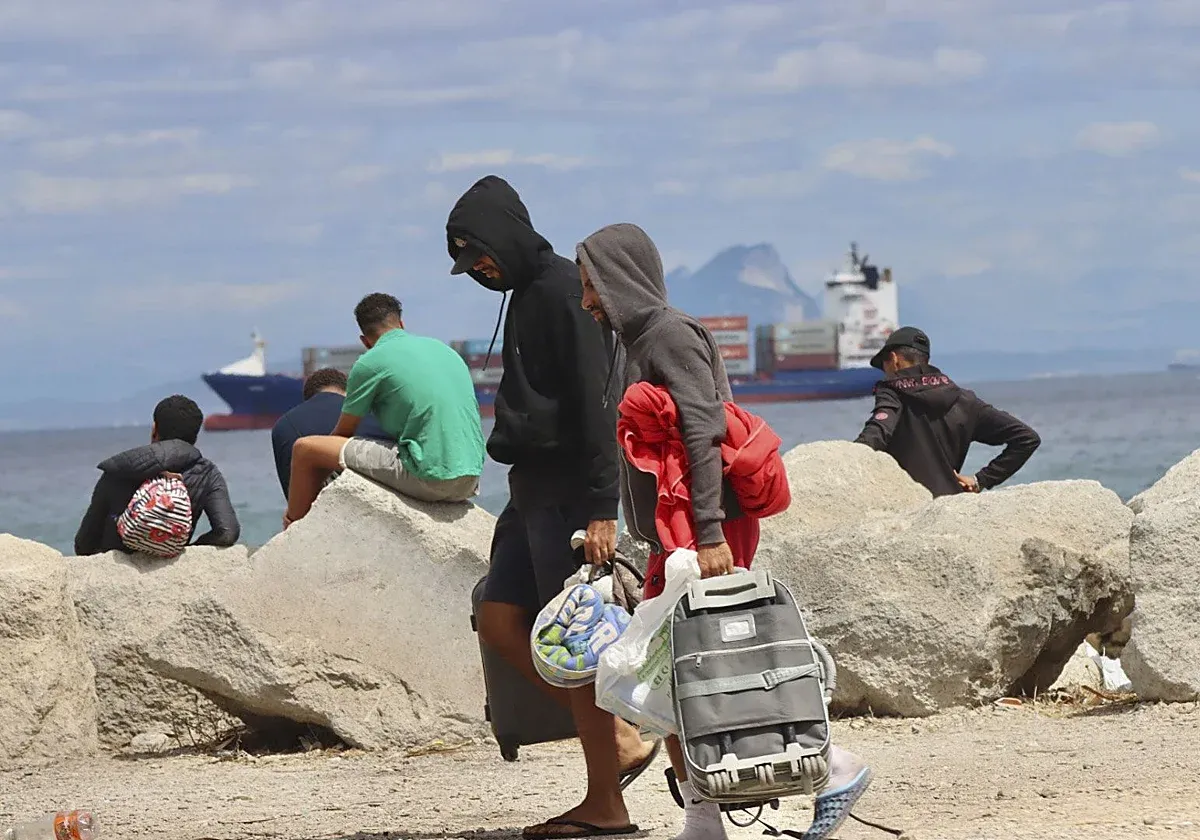

For over three weeks, the autonomous city of Ceuta has been grappling with an emergency situation triggered by the influx of tens of thousands of individuals crossing the border from Morocco irregularly. This massive surge occurred within a matter of hours, yet it was predicated on parameters that numerous studies and official reports had long anticipated. Despite these warnings, the Spanish government remained passive, seemingly unprepared for the consequences that have since unfolded.
The utilization of migration as a tool for political and diplomatic pressure has been a topic of scholarly investigation for decades. However, it was the crisis in Ceuta in 2021 that reignited alarms in Spain regarding this issue. At that time, around 8,000 individuals managed to enter Spain illegally, a stark contrast to the current estimate of 80,000 put forth by the local government. The earlier crisis was directly linked to the deterioration of relations between Morocco and Spain, stemming from the hospitalization of the Polisario Front leader, Brahim Ghali, in a Spanish facility. This incident marked the beginning of a series of analyses that warned about the use of migration at Europe’s southern borders as a coercive measure.
In this context, the government has not only ignored expert and military studies but has also failed to heed its own reports and recommendations. Merely a week after the 2021 crisis, Iván Redondo, then chief of staff for Prime Minister Pedro Sánchez, announced in Congress that a comprehensive security plan for Ceuta and Melilla would be drafted. He characterized the Moroccan crisis as “another tool used within the framework of hybrid strategies.” This specific plan for the two autonomous cities was included in the National Security Strategy published that same year, which remains in effect. The strategy recognized that Ceuta and Melilla, due to their geographic situation and unique border conditions, “require special attention to ensure the safety and well-being of their citizens.” However, this plan has yet to be implemented, remaining dormant and unfulfilled.
Despite the inaction, concerns surrounding the risks associated with hybrid strategies and migratory flows have continued to be addressed in various annual reports published by the National Security Department. In 2021, one official document acknowledged that the “instrumentalization of migratory flows for political gain” was a phenomenon that had escalated in recent months, affecting Spain directly. It emphasized the urgent need for both national and community-level instruments to counteract such actions swiftly.
Nevertheless, the necessary measures have not been forthcoming, and reports have consistently pointed in the same direction. For instance, in 2022, National Security identified the return of irregular migrants as the “most effective” approach to deter attempts at illegal crossings. It also recognized the necessity of ensuring the proper and effective implementation of existing return agreements with Morocco, Mauritania, Algeria, and Senegal. The analysis of hybrid threats persisted, and that same year, although linked to the invasion of Ukraine, the official body warned that the employment of these strategies allows middle powers to contemplate confrontation in the gray zone with the conviction of achieving their political objectives without escalating into armed conflict, albeit with the risk of triggering an uncontrollable escalation.
Numerous experts agree that one of the significant risks Spain, along with the European Union, has undertaken is placing its trust in Morocco for border control. In fact, the most recent National Security report, pertaining to 2025 yet approved just months ago, confirms an increase in illegal entries via Ceuta and Melilla, primarily involving individuals attempting to circumvent the border by sea. Regarding the fence separating the autonomous cities from Morocco, it acknowledges that a “rigorous control” of mass crossing attempts was made possible due to the “extensive perimeter deployment” of the Moroccan gendarmerie and its Armed Forces, thus confirming that control resides with the neighboring country.
However, these are not the only analyses addressing the phenomenon in recent years, as numerous university or Ministry of Defense studies yield similar conclusions. “Experience has shown that migration can be instrumentalized by various actors, such as criminal networks seeking profit or states using migratory flows as a tool for political pressure,” states Army Commander Joaquín Peral in an article published by the Higher School of the Armed Forces. These documents reflect only the opinions of their authors and not the official stance of the organization, yet many studies have pointed towards the crisis currently unfolding in Ceuta this summer.
Another analysis by Commander Emilio José Arias Otero examines deterrence as a fundamental element in conflict prevention and the protection of national interests. “Following a meticulous study of Spain's behavior on the diplomatic front, we can conclude that there has been no consistent national diplomatic stance against Morocco's claims over Ceuta and Melilla. This undermines the effectiveness of deterrence and inevitably affects its credibility and willingness to confront this threat,” he concludes. In a critical review of the situation, he warns that yielding to certain demands without demanding anything in return is a dangerous way of engaging with disputing states. He also cautions against placing all security reliance on international organizations: “Spain must not fall into the error of feeling that national interests are shared with our partners. Therefore, parallel efforts must be maintained in deterrence and, simultaneously, in our own capacity to deter threats of a purely national character.”
In this context, the Spanish Institute of Strategic Studies (IEEE), considered the 'think tank' of the Ministry of Defense, published one of its strategic notebooks in March this year, dedicated to the state ports and national defense. In this document, high-ranking military officials and civilians agree on the maritime importance of Ceuta and Melilla and the pressures from Morocco. One of its conclusions urges the implementation of “a differentiated state policy” for the ports of both cities, “whose unique isolation requires a specific strategy for singular border enclaves.”
The alerts have been echoed by various institutions, such as the Ceuta and Melilla Observatory, affiliated with the Institute of Security and Culture and a vigilant observer of the situation in these two autonomous cities. As early as November 2021, one of its publications warned of Morocco’s use of hybrid strategies to influence the political future of both autonomous cities. These actions fall within the so-called 'gray zone' and involve multiple procedures that the agency categorizes into four levels of escalation: “environment configuration, interference, destabilization, and limited and direct use of force.”
Among the numerous articles analyzing the phenomenon, both journalistic and academic, Captain Augusto Conte de los Ríos notes in the journal Ejércitos that Ceuta and Melilla are perceived by Rabat as “geostrategic anomalies” and are therefore targeted by a hybrid pressure strategy that combines economic, political, and security instruments, including the instrumental use of migration.
Now, with the massive assault on the border having occurred, resulting in thousands of individuals in illegal situations remaining in Spain, reports are once again following the same path as they did five years ago, with minimal consequences. “While the authorities focused on responding to and managing the situation, a significant number of questions remain unanswered: Why did this happen? Who ultimately benefited from this situation?” questions Rut Bermejo, a researcher at the Real Instituto Elcano.
As reported by abc.es.