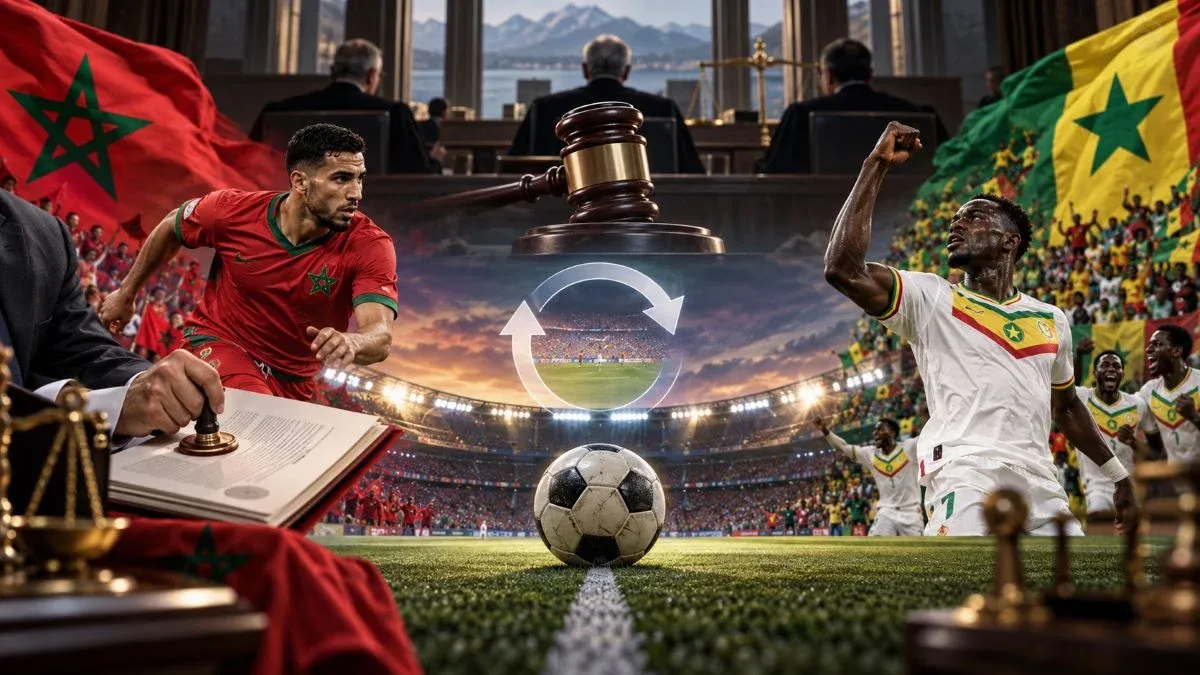

The Ongoing Dispute Over the African Cup Title
On October 8, 2023, the Court of Arbitration for Sport (CAS) convened in Lausanne to deliberate on the appeal filed by the Senegalese Football Federation against the title awarded to Morocco in a controversial administrative decision. The debate surrounding the final match, with its contrasting outcomes of a 3-0 forfeit and a 1-0 victory on the pitch, has sparked fervent discussions among supporters from both nations, leading to a persistent call for a rematch. Notably, the rules of sports do not prohibit such a scenario; however, the circumstances necessary for a rematch are far from being met.
The closed hearing concluded around 3:30 PM, presided over by French judge Gérald Simon, alongside Italian Luigi Fumagalli, nominated by the Royal Moroccan Football Federation (FRMF), and German Ulrich Haas, appointed by the Senegalese Football Federation (FSF). A timeline for the verdict remains uncertain, and until then, Morocco is officially recognized as the African champion, while Senegal retains the trophy.
Potential Outcomes and Historical Precedents
The final match on January 18 in Rabat saw Senegal leave the pitch after a controversial penalty was awarded to Morocco during stoppage time, shortly after a goal by Senegal was disallowed. Senegal later returned to the field and managed to win 1-0 in extra time. However, on March 17, the Appeals Jury of the Confederation of African Football (CAF) ruled Senegal as forfeiting the match under articles 82 and 84 of the CAN regulations, which penalize a team for leaving the field before the match concludes, thereby awarding Morocco a 3-0 victory.
According to CAS regulations, the court has the authority to reassess the facts and can either issue a ruling that supersedes the CAF's decision or annul it and refer the case back to the appropriate body. In theory, this opens the door for a rematch following the proceedings. However, the limitations arise from the requests made by the parties involved; a tribunal cannot grant more than what has been requested, as any such overreach could lead to the annulment of its ruling by the Swiss Federal Court. While the FSF demands the title, the FRMF defends the 3-0 victory, which means neither side has publicly requested a new match. Consequently, a rematch could only emerge from a referral, in which case the CAS would need to annul the March 17 decision without making its own ruling, sending the case back to Cairo, where the CAF would hold the power to schedule a new encounter.
The CAF has previously navigated similar situations without fully seeing them through. In 2019, the CAF Executive Committee ordered a neutral venue rematch for the Champions League final between Espérance de Tunis and Wydad Casablanca, which had been interrupted due to Moroccan players refusing to continue. The CAS annulled this decision citing lack of jurisdiction, sending the case back to the CAF, and ultimately, the match was never replayed.
The situation in Rabat is distinct, as the final resumed and concluded through extra time. The crux of the matter before the CAS revolves around whether a temporary exit from the field falls under the purview of articles 82 and 84. Depending on the court's answer, Morocco could retain the title by default, or the score could revert to the field's result, rendering Senegal the victor.
There have been instances historically where matches were replayed due to specific errors. For example, in 2005, FIFA annulled a 1-0 victory for Uzbekistan over Bahrain in a World Cup qualifying playoff due to a referee's misapplication of rules regarding a penalty. Uzbekistan sought a 3-0 victory, but FIFA mandated a replay, which ended in a draw, ultimately allowing Bahrain to qualify.
Replaying the match in Rabat would require addressing a misapplied rule; however, the penalty awarded in Rabat, confirmed by VAR, as well as Senegal's disallowed goal, are matters of referee judgment, a domain the CAS traditionally refrains from intervening in. For the final to be replayed, the CAS would need to forgo making its own ruling, and the CAF would have to prefer this course of action over any other, more than nine months after the events. Patrice Motsepe indicated that the CAF awaits the definitive decision from the CAS to finalize the title dispute. It is important to note that the tribunal has stated that only its official communications will be deemed authoritative, a clarification that comes after the circulation of a false document in July announcing a Senegalese victory, which was denied by the FRMF.
As reported by afrik.com.