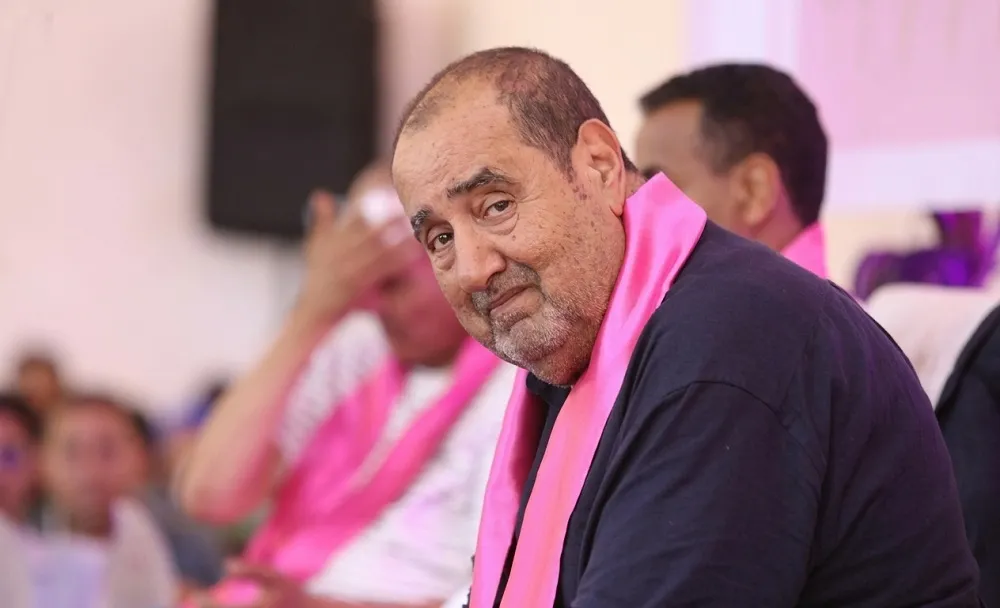

The Socialist Union of Popular Forces finds itself at a critical juncture as it embarks on the election campaign for the parliamentary elections scheduled for September 23. This period is marked not only by the electoral stakes at hand but also by the performance and outcomes resulting from the preparations leading up to these elections. Prior to this pivotal moment, the party has witnessed a series of resignations, departures, and political shifts among several of its leaders and prominent members. Notably, individuals with leftist backgrounds have chosen to migrate to other political parties, signaling a significant decline in the 'rose' party's ability to maintain its position as a leader of the Moroccan left and attract influential figures within its political and historical landscape.
Despite the party leadership presenting a list of candidates as a manifestation of renewal and openness to competencies, an examination of the names included alongside those of notable figures who have left the party or opted to pursue the upcoming elections under different banners reveals a more complex picture. The Socialist Union, which has been one of the most significant political representations of the Moroccan left for decades, now appears less capable of retaining some of the experienced names that have accumulated organizational and activist expertise within it. Meanwhile, a portion of leftist figures is seeking political spaces elsewhere, either within the New Left Alliance or competing parties.
The case of Abdelhadi Khairat stands out as one of the most indicative examples of this transformation. A historic leader and one of the most recognized figures associated with the party's memory, youth, and media, Khairat chose to join the Progress and Socialism Party last February after a long-standing estrangement from the Socialist Union, culminating in a point of no return with the party's first secretary, Idriss Lachgar. In a statement to the national channel at that time, Khairat indicated that his decision to join the 'book' party followed political meetings and consultations, expressing his conviction that continuing within the Socialist Union was no longer viable, thus underscoring the depth of the rupture that characterized his relationship with the party over recent years.
The indicators of this exodus are not confined to historical symbols; recent weeks have seen a wave of resignations linked, to varying degrees, to the management of candidacies and electoral lists. The political bureau of the Socialist Union accepted the resignation of Rjae Al-Bqali Al-Tahiri and announced Meryam Jamal Al-Idrisi's departure from the party amidst the controversy surrounding the results of the selection process for regional list candidates. While the party insists that the process adhered to its statutes and internal regulations, with the political bureau unanimously approving the results, the individuals involved presented different interpretations regarding the implementation of those rules and criteria.
The situation was further complicated by the resignation of Salwa Al-Demanati, a former member of the political bureau and current parliamentarian, who announced on August 31 her departure from the party and its organizational structures, following criticisms she directed at the management methodology and organizational and political choices. In a similar vein, the departure of Ammar Hamza, the former regional secretary of the Socialist Union in Wazan, to the Authenticity and Modernity Party, along with several other members, was officially announced at the end of August. This move is significant given Hamza's previous organizational standing within the rose party and occurred at a time when parties were preparing to reshape their local bases ahead of the electoral challenges.
Has the Moroccan Left Surpassed the Socialist Union?
The challenges facing the Socialist Union extend beyond simply losing a few names; they raise deeper questions about the party's position within the broader landscape of the Moroccan left itself. A striking paradox in the upcoming 2026 elections is that part of the discourse surrounding the future of the left no longer revolves around the Socialist Union's ability to lead this current but rather on the potential emergence of new centers of attraction that could compete with it for skilled and leftist individuals. In this context, the establishment of the 'Left Alliance' between the Unified Socialist Party and the Democratic Left Federation on June 3 serves as a new political framework that explicitly states its intention to unify part of the fragmented left and to contest the parliamentary elections with a joint political project. The two parties have confirmed that this is not merely a temporary electoral coordination but a political alliance aimed at building a democratic and progressive alternative and overcoming the fragmentation that has characterized the left over the past years.
Conversely, the Socialist Union has struggled to fully realize its announced 'project' for an alliance with the Progress and Socialism Party established in 2023, as the initiative quickly stalled despite the historical common ground shared by the two parties. Both are part of the 'Democratic Bloc', collectively securing 56 seats in the 2021 elections, with 34 for the Socialists and 22 for their counterparts under Nabil Benabdallah. Now, the Socialist Union's candidate list presents itself in a different manner; while it is geographically extensive and includes a large number of constituencies, the names that are most likely to attract national attention appear relatively limited. Among these are Abdul Karim Benatiq, a former minister and familiar face within the party, and Hassan Lachkar, the party's candidate for the Rabat-Shallah constituency, who stands out primarily as the son of the first secretary.
The Shift in Candidate Selection and Challenges Ahead
The debate surrounding the nature of this candidate list has intensified, particularly given that the Socialist Union has relied, in several regions, on attracting individuals with previous political trajectories outside the party. For instance, in the Marrakech-Safi region, several names presented had previously belonged to other parties before joining the Socialist Union, reflecting a strategy of attracting 'political nomads'. Among the notable names emerging in this landscape are Ahmed Al-Toumi, Hamid Al-Akrud, Abdul Samad Akkdash, and Abdul Ghani Kamel. This paradox raises an intriguing political question: Has the Socialist Union, historically a training ground for activists and leaders, increasingly depended on attracting ready-made names from outside its organizational structure, while some of its own members and leaders seek opportunities in other parties?
While Idriss Lachgar asserts that 77% of local list candidates represent new faces and that the party is banking on youth, women, and competencies, this narrative faces scrutiny regarding the essence of renewal, which appears to be less about internal rejuvenation and more about compensating for organizational deficiencies. Lachgar faces sharp criticisms for allegedly sidelining actual 'Socialists' in favor of electoral figures in pursuit of parliamentary seats, thereby neglecting the imperative of rebuilding the party, reminiscent of events in 2021 with the former regional secretary for the Socialist Union in the Tangier-Assilah province, Ahmed Yahya. The latter opposed Lachgar's bypassing of local organizations in candidate selection, prompting Lachgar to dissolve the regional office to complete the process, leading both into a judicial conflict.
This aspect is central to understanding the transformation that has occurred within the Socialist Union. The party no longer possesses the same depth of leadership and activist resources that previously constituted its organizational, union, and intellectual extension. Additionally, a portion of the figures historically associated with the Socialist line has either left the party or drifted away from decision-making centers within it, making membership in the Socialist Union appear less of an obvious choice for many new leftist figures, especially as other frameworks present themselves as spaces for rebuilding the left on more unified foundations.
As reported by assahifa.com.