
Celebrating Art and Culture in Casablanca
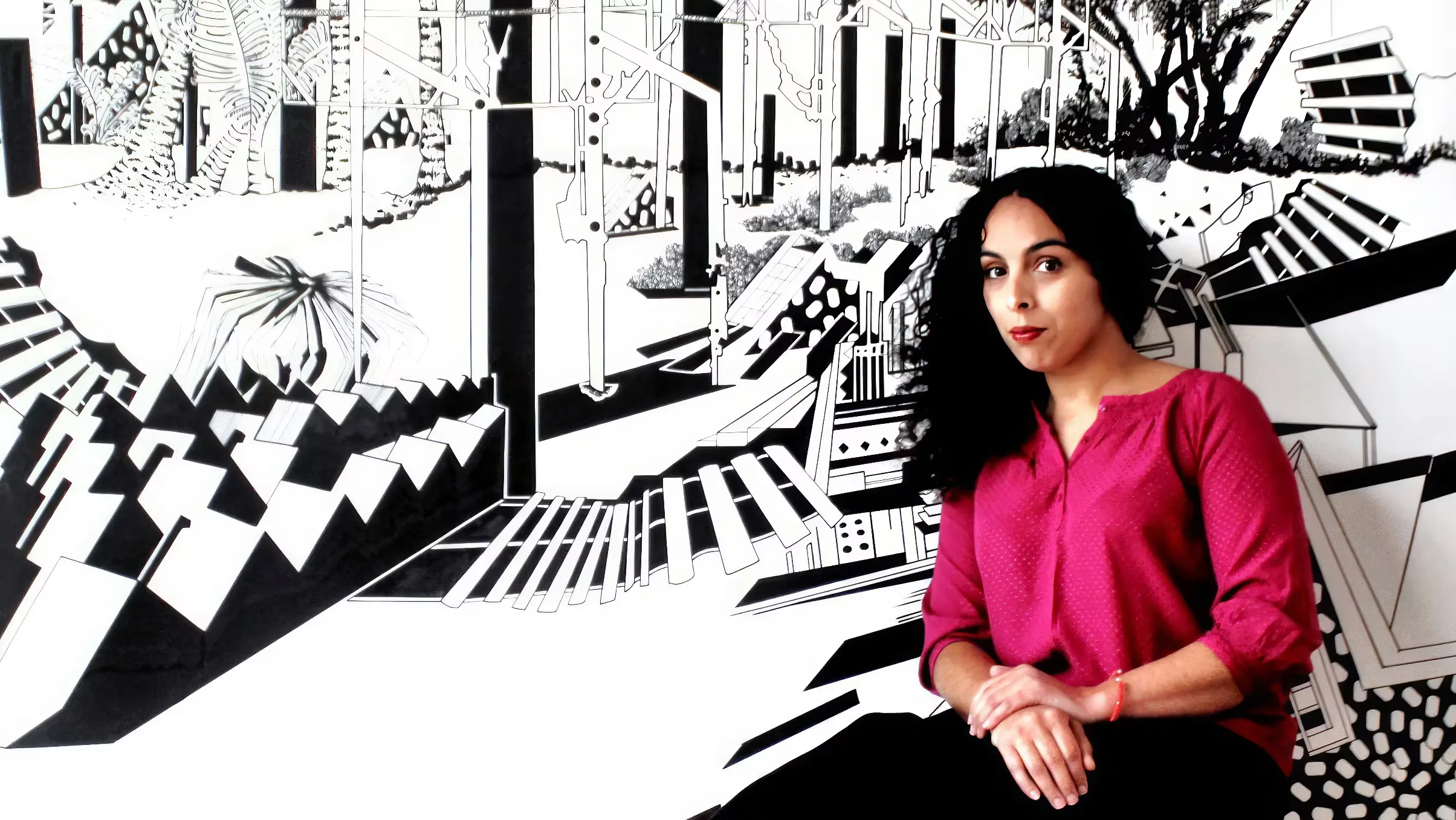
The cultural magazine hosted by Ali Baddou kicked off its second season on Sunday, October 11, featuring an unexpected lineup: Philippe Katerine, who serves as the season's patron advocating for his concept of "cuteness," and Chourouk Hriech, introduced by the host as "an extraordinary artist from Morocco" who takes us on a journey through landscapes rendered in black and white. For approximately ten minutes, the audience was captivated as her illustrations graced the screen, leaving the studio in silence to absorb the visual feast.
Hriech's artistic journey began in her childhood, as she recalls, "I was probably seven years old." She has always engaged in drawing, producing quirky artistic expressions. The tools she employs have remained relatively unchanged over the years: "I have a rather classical practice of drawing, using ink, gouache, on paper, wood, and canvas." What has evolved is the scale of her work—her drawings now manifest as monumental wallpapers adorning facades, balconies, lanterns, and even tram cars. "This is a task requiring extreme precision," she notes.
Casablanca: A Global City
Among her symbolic cities are Byblos, Rio de Janeiro, Bangkok, and Riyadh, with Casablanca holding a special place in her heart. She did not select it for its postcard-perfect imagery. As Ali Baddou reminds the audience, this is not a city defined by medinas or palm trees. Hriech agrees, stating, "Casa is like a little New York of Africa, as some call it. It is a global city with a very unique history." It is a city of migrations, where individuals from various regions of Morocco and Africa have converged throughout the 20th century. She is fascinated by this constant movement: "A street can take on ten or fifteen different faces within twenty-four hours. This human mobility and the evolution of spatial practices ignite my passion."
Her creative process begins far from the drawing board. "I enjoy learning about each city first," she explains. This involves reading about them, understanding how their imaginations are constructed, influenced by stories, texts, and even rumors. In Casablanca, she adds, “Much happens in the interstices of doors.” A single conversation might inspire a drawing, even if the building itself no longer exists.
Journalist Fabrice Bousteau points out a distinctive feature of Hriech's artwork: within her architectural vistas populated by birds and greenery, humans are notably absent. Hriech offers a playful admission: "I cannot draw humans," before elaborating that twenty-five years ago, her drawings were filled with characters and hybrid animals. "That became exhausting for me. Humanity is brutal, violent, and challenging." Now, she prefers a composition where, in her lines, “things are laid out.” Musician Charly Voodoo, who improvised on the piano while drawing inspiration from her works, noted that her illustrations represent nature reclaiming its place in deserted cities.
Despite the demanding nature of her art, Hriech emphasizes that it should not be reserved for the elite. Referring to the Nantes tramway adorned with her cityscapes, she advocates for accessible art: "If we create something too elitist, we are criticized. If we create something too popular, the same happens." For Nantes, she aimed to “draw the city for the locals,” producing works that are always figurative and recognizable at any age, allowing everyone to find an entry point. However, scaling her drawings from paper to monumental formats presents its own challenges: "An enlarged drawing may not translate well. It involves numerous trials, attempts, and corrections, and that’s what is truly exhilarating."
Hriech's appearance on the show unveiled her major upcoming event: from December 6, 2026, to April 18, 2027, she will take over the 1,000 square meters of the Paul-Valéry Museum in Sète, a city she holds dear where she first exhibited in 2002. The title, "The Song of Thresholds," reflects her artistic approach. "I embrace the term decor," she explains, noting that each space is conceived as a backdrop with multiple entry points and fields of interpretation, blending drawings, videos, materials, and even a violinist.
"The song comes from the studio," she shares. "When I draw, I often sing a lot. It adds rhythm to the drawing process, especially during hours spent in repetitive micro-movements. It also helps in finding my breath." Interestingly, Philippe Katerine admits he never sings while drawing.
Before her Sète exhibition, Hriech will participate in the Bamako Encounters in Mali starting in November. The Moroccan audience can look forward to seeing her again in May 2027 at L’Atelier 21 in Casablanca, which represents her in Morocco. This will be a return to the global city she has never ceased to illustrate.
As reported by fr.le360.ma.