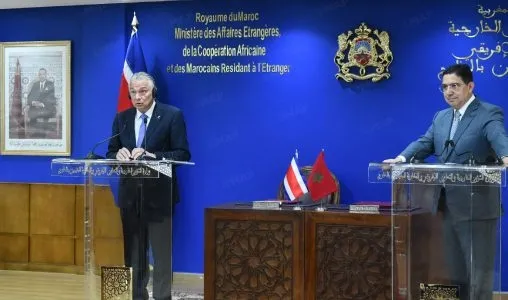

Costa Rica has lauded Morocco’s proposed Autonomy plan for the Sahara, asserting that it serves as "the most serious, credible, and realistic basis for achieving a lasting political solution" to the protracted territorial dispute. This endorsement emerges from a joint statement issued in Rabat, following discussions on Friday between Costa Rican Foreign Minister Arnoldo André Tinoco, who is visiting Morocco, and his Moroccan counterpart Nasser Bourita. During this meeting, the Costa Rican diplomat emphasized that the Autonomy plan, which operates under Moroccan sovereignty, is the most viable pathway to resolving the decades-old conflict in the Sahara region. He confirmed that Costa Rica is prepared to support this initiative across various avenues, including political, diplomatic, economic, and consular efforts.
In this context, Costa Rica recognized the historic UN Security Council resolution 2797, which endorsed Morocco's Autonomy Proposal as a means to secure a definitive political resolution to the Sahara issue. The country expressed its commitment to the growing international acknowledgment of Morocco's sovereignty over its entire Saharan territory. Both nations' officials reiterated their backing for the UN Sahara Envoy and his initiatives aimed at propelling the political process toward a sustainable resolution of this regional disagreement.
Furthermore, the discussions reinforced a mutual commitment to revitalizing bilateral relations through structured political dialogue and enhanced cooperation. The joint statement highlighted a shared vision of robust collaboration, founded on respect for each country's unique characteristics. The officials also emphasized their dedication to strengthening diplomatic ties, with a focus on fostering productive cooperation based on principles such as transparency, mutual respect, sustainable development, environmental stewardship, and human rights.
Minister Tinoco took this opportunity to praise Morocco's advancements across various sectors, underscoring the Kingdom's ongoing efforts to promote regional stability, development, South-South cooperation, and the fight against transnational threats. This affirmation reflects the increasing recognition of Morocco's proactive role, especially under the leadership of King Mohammed VI, on both regional and international fronts.
On a sectoral level, the two parties agreed to enhance their collaboration in areas of mutual interest, such as agriculture, clean energy, scientific research, sustainable tourism, and environmental protection, along with commitments to technical exchanges and investments. They also concurred on organizing an initial political consultation meeting in the near future, illustrating a shared desire to strengthen their partnership through regular and structured political dialogue.
This constructive dialogue coincides with the recent increase in women's representation within the Moroccan House of Representatives, where the percentage of female members has risen to 21% following the October 7 general elections, up from 17% in 2011. Currently, 81 out of the 395 parliamentary seats are held by women.
In related news, Italian authorities recently expelled a Moroccan cleric, Houssam Din Rouzak, due to concerns over radical interpretations of the Quran and aggressive behavior. Rouzak was flown from Milan to Casablanca as part of security measures outlined by the Italian interior ministry.
Moreover, the French publication 'Jeune Afrique' has drawn attention to the diplomatic momentum surrounding the establishment of consulates by several nations in Morocco's southern provinces, highlighting the recent inauguration of Chad's consulate general in Dakhla on August 14. This event marks Chad as the latest addition to a growing roster of countries recognizing Morocco's territorial integrity.
Lastly, the American think tank, the Middle East Forum, has called for the dismantling of the Polisario Front Camps in Tindouf, especially in light of the UN Security Council's endorsement of Morocco’s Autonomy Plan. This statement reflects a broader historical context, noting the origins of the Polisario Front during the Cold War as a proxy initiative of Algeria and Cuba, which showed little regard for the people affected.
As reported by northafricapost.com.