
Impacts of the Jabaroot Data Leak on Moroccan Security
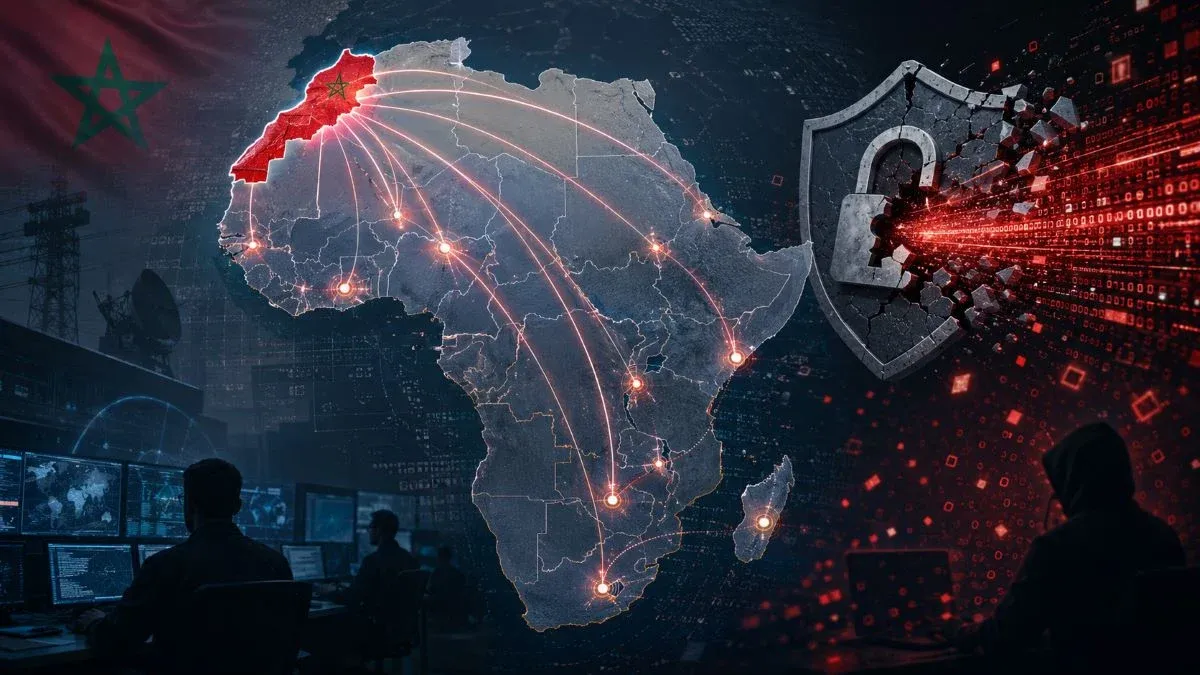
On August 24, the hacking group Jabaroot made headlines by releasing purported data on over 70,000 members of Morocco's police and security services. This significant breach not only complicates Morocco's relationship with Madrid but also threatens the reputation that the kingdom has spent a decade building across Africa—a reputation for having a reliable security apparatus with which numerous African states currently share intelligence. The leaked data, shared via Telegram, claims to contain the personal information of 70,381 individuals associated with the General Directorate of Territorial Surveillance (DGST) and the General Directorate of National Security (DGSN). The files reportedly include names, birth dates, national identity card numbers, and administrative information, with some entries also containing ranks or banking details.
While some Spanish media outlets have referred to these individuals as "70,000 spies," this characterization is likely an exaggeration; the DGSN is a vast police administration, and not all names listed correspond to intelligence agents. The authenticity of the leaked data remains to be fully verified. However, El Confidencial cites former members of Moroccan security services who have deemed at least part of the documents credible, albeit without independent technical validation. The two agencies in question have been under the direction of Abdellatif Hammouchi for the past decade, who has become the face of Morocco's security cooperation abroad, regularly engaging with Paris, Madrid, and Washington. Under his leadership, Morocco has developed an extensive intelligence network across Africa.
Morocco's Role in International Security and the Consequences of the Data Leak
Morocco has effectively transformed its security services into a diplomatic tool, as demonstrated by their mediation in December 2024, which facilitated the release of four agents from France's external security agency who had been detained in Burkina Faso for a year on espionage charges. A plane chartered by Moroccan authorities was sent to retrieve them, and French President Emmanuel Macron personally thanked King Mohammed VI shortly thereafter. The General Directorate of Studies and Documentation (DGED), responsible for external intelligence, also managed to secure the release of German humanitarian Jörg Lange in Mali in 2022 and Romanian Iulian Ghergut in August 2023 after eight years in captivity in the Sahel. These operations have positioned Rabat as a key interlocutor when traditional diplomatic channels fail.
In addition to its mediation efforts, Morocco has long been engaged in less visible foundational work. The Royal Military Academy in Meknes has trained Sahelian and West African officers for decades, while the Central Bureau of Judicial Investigations regularly hosts sessions for officials from Mali, Burkina Faso, and Mauritania focused on dismantling cells and preemptive intelligence. Such training fosters interpersonal relationships that endure beyond regime changes, explaining why Morocco can maintain open channels with governments that are otherwise hostile to its Western partners. On December 18, 2025, Morocco inaugurated the African Center for Police Cooperation in Salé, the first of its kind on the continent, designed to coordinate security for major sporting events with the support of Interpol as part of the Stadia project. Hammouchi presided over the ceremony alongside Foreign Minister Nasser Bourita and DGED chief Yassine Mansouri.
The center unites representatives from Moroccan security services and liaison officers from the twenty-three countries qualifying for the African Cup of Nations hosted in Morocco. Rabat presents this initiative as a stepping stone toward the 2030 World Cup, which it will co-host with Spain and Portugal. In May 2026, a security memorandum of understanding was signed with Liberia regarding intelligence sharing. Such structures are operational because partner services agree to attach personnel and share information, trusting in the host's confidentiality. However, the circulation of a database containing tens of thousands of identities severely undermines this trust.
The immediate risk is not that all 70,000 names are actionable but rather that an opposing service could sift through the data, cross-reference it with passenger lists, conference registries, or training enrollments, thereby reconstructing the actual hierarchy of personnel involved in external cooperation. For a West African service that has assigned a liaison officer to Salé or sent officials for training in Morocco, the pressing question is whether past exchanges are now compromised and if future cooperation should be suspended. To date, no partner state has publicly disclosed its position, and it would be unexpected for a government to announce such a decision since adjustments of this nature typically occur quietly, manifesting as slowed exchanges rather than outright cessation.
Jabaroot also claims to possess a list of agents involved in managing the migration crisis at Ceuta on July 30 and 31, as well as copies of mission orders related to movements in Fnideq. Should such documents be authenticated, they could potentially reveal not only identities but also operational methodologies. Following the hacking of the National Social Security Fund on April 8, 2025, which exposed the data of nearly two million affiliates, Jabaroot has claimed or disseminated elements touching on land conservation, the notarial system, and royal palaces. El Confidencial reported that in September, General Mostafa Rabil, formerly head of the General Directorate of Information Systems Security, was dismissed and replaced by General Abdellah Boutrig.
Despite these breaches, the kingdom boasts a cybersecurity score of 97.5 out of 100 according to the International Telecommunication Union, while being noted as one of the most exposed countries to cyber threats in its region according to a report by Allianz published in June 2025. At the GITEX Africa event in Marrakech in April, General Boutrig himself acknowledged that the challenges now extend beyond technical issues to questions of sovereignty. Two prevalent hypotheses are circulating, though neither has been definitively established. One suggests that the leaked files could identify the organizers of a planned operation against Ceuta, although Spanish services reported a gradual laissez-faire at the border rather than a fully orchestrated operation. The second theory posits that Jabaroot serves as an instrument in an internal conflict among Moroccan services, amidst rivalry between the DGST and DGED and uncertainty surrounding the succession of Mohammed VI. Le Monde referenced this possibility as early as December 2025, suggesting that former agents may have absconded with sensitive information, though no technical evidence has substantiated this claim.
For Morocco's African partners, the distinction between external hacking and internal betrayal is of lesser importance than it might seem. Whether the leak originates from a foreign entity or internal infighting, it documents a persistent permeability within the apparatus to which they entrust their information. The true cost of this incident will ultimately be measured not in accusations exchanged between Rabat, Madrid, and Algiers, but in the trust that has been irrevocably damaged.
As reported by afrik.com.