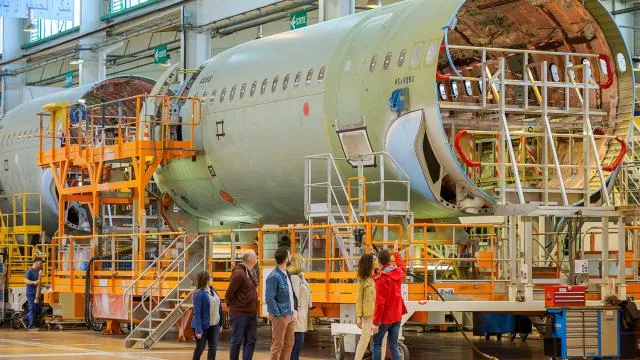

The French group Daher, a prominent player in the European aviation industry, is preparing to relocate a portion of its industrial activities related to the production of Airbus components from its Tarbes facility in France to Morocco. This strategic move not only solidifies Morocco's position within global aviation supply chains but also underscores the country's ongoing attractiveness to major international manufacturers.
According to reports from French sources, this operation is part of an internal initiative launched by Daher under the name "Edge," aimed at reorganizing its industrial activities and enhancing competitiveness by redistributing production to more cost-efficient locations. One of the primary sites targeted for this transition is the company's facility in Tangier, Morocco.
The relocation process will encompass parts and components intended for several of Airbus's most renowned aircraft, including the A320, A330, and A350 models. Daher plans to gradually shift a portion of its manufacturing and assembly operations to Tangier while also utilizing subcontractors in low-cost production countries.
Daher has clarified that this decision is not aimed at directly reducing the activities of its Tarbes facility. Instead, it seeks to alleviate the pressure on the site, which is currently experiencing a high volume of orders, and to redirect some of its capabilities toward future programs related to the defense sector and the upcoming aircraft model that will succeed the Airbus A320.
This decision by Daher occurs within a broader dynamic that Morocco has been witnessing in recent years. The country has increasingly attracted numerous industrial investments focused on the production and assembly of Airbus components, with key locations including Casablanca, Nouasseur, and Tangier. This trend aligns with an international strategy to restructure supply chains within the aviation sector.
In this context, a significant new strategic project has emerged from the French group Safran, which has initiated the construction of a massive factory for producing aircraft landing systems in Nouasseur, primarily for the Airbus A320. This investment exceeds 280 million euros and was presented to King Mohammed VI in February 2026. The new site is expected to become one of Safran's largest global centers for landing system manufacturing, providing approximately 500 direct jobs and relying entirely on carbon-free energy.
Officials from the French group emphasized that the Moroccan factory would not only fulfill current production needs but would also play a crucial role in supporting the anticipated ramp-up in Airbus A320 production and in preparing for the next generation of short- to medium-range aircraft.
New investments in Morocco have not been limited to French companies. In 2025, the German group Masterflex announced its decision to establish a new factory in Morocco dedicated to producing hoses and rubber components for the aviation industry within the Medpark area near Casablanca. The German group justified its choice by highlighting the rapid growth of the global aviation sector, asserting that Morocco offers a unique blend of advantages that are hard to find in other markets, including quality training, industrial expertise, adherence to quality standards, proximity to Europe, and competitive costs.
Moreover, in recent years, major American players have also entered the Moroccan aviation sector. For instance, an American industrial alliance announced in 2024 its decision to set up an industrial platform in Morocco specializing in converting Boeing 777-300ER aircraft into cargo planes in Casablanca, with an anticipated production capacity of eight cargo aircraft annually.
In a similar vein, the American company Pratt & Whitney has chosen to establish an industrial branch in Morocco focusing on the production of static mechanical parts and detailed structures for aircraft engines, capitalizing on what the company has described as Morocco's growing status as a regional hub for aviation manufacturing.
This industrial momentum is accompanied by a rapid expansion of the Moroccan aviation sector as a whole. In April, Transport and Logistics Minister Abdel Samad Guhiouh revealed that the kingdom currently hosts approximately 150 companies operating in the aviation industry, providing more than 25,000 direct jobs, with the sector's annual turnover reaching around 26 billion dirhams.
As reported by assahifa.com.