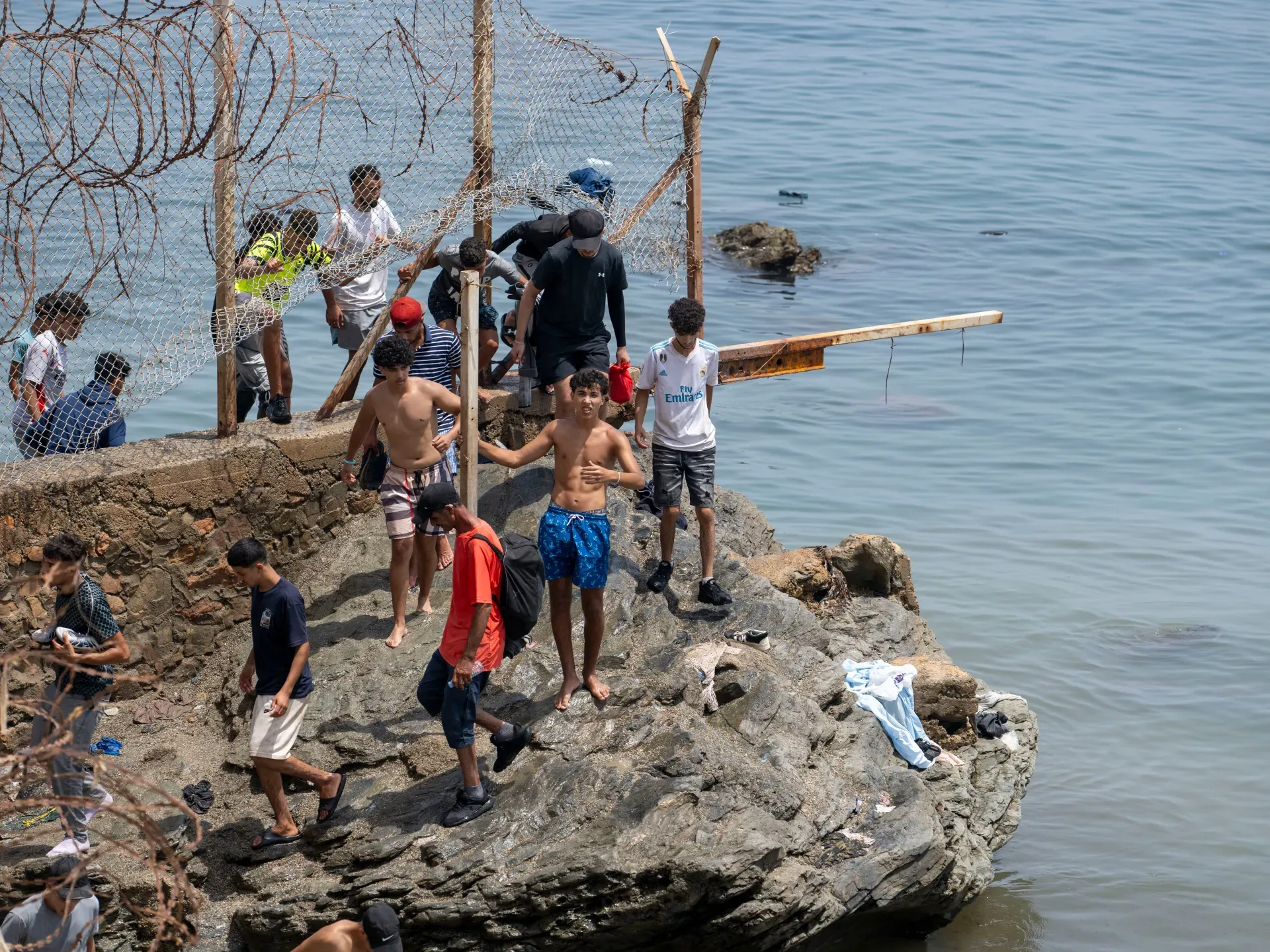

Recent revelations from declassified documents have illuminated the forewarning received by both Madrid and Morocco regarding the impending migrant crisis that unfolded in Ceuta in late July. According to these documents, Spain’s National Intelligence Center (CNI) had proactively alerted the Spanish government about the likelihood of mass crossings into Ceuta, a Spanish enclave located on the North African coast. This alarming communication came just one day before more than 72,000 migrants began entering Ceuta from Morocco, highlighting a significant lapse in preparedness for a situation that was not only anticipated but also documented.
The release of this significant cache of 40 documents coincided with ongoing protests in Ceuta, where public discontent has surged over the government's handling of the crisis, as well as the role of Moroccan authorities during these events. Among the crucial insights from the documents, a WhatsApp alert sent on July 29 warned of social media calls for a concerted effort to breach the border fence and enter Ceuta by sea. The message detailed the scale of the mobilization, mentioning that two social media groups had amassed a combined following of 180,000 users, thus indicating the extensive organization behind the planned crossings.
Additionally, on the same day, the CNI communicated with Moroccan intelligence agencies, emphasizing that migrants were likely to attempt crossing the border either by scaling the fence or swimming around it, particularly taking advantage of Morocco's national Throne Day celebrations scheduled for July 30. This intelligence suggested a certain level of awareness on both sides regarding the potential for significant migrant movements.
In response to the fallout from these revelations, Spanish Prime Minister Pedro Sanchez publicly dismissed the notion that the documents indicated a clear warning of the magnitude of the crisis that transpired between July 30 and 31. He clarified that while the situation was indeed monitored by various institutions, it did not constitute a definitive indicator of the scale or nature of the events that ultimately unfolded. There was no immediate response from Moroccan officials regarding these claims, despite previous assertions from Sanchez that no evidence linked Morocco to a deliberate orchestration of the border crisis.
Further scrutiny of the documents revealed that while Moroccan authorities were deemed not to be actively promoting the influx of migrants, they had responded with a negligent and passive approach to the situation. Reports noted that as many as several hundred migrants successfully crossed into Ceuta on the night of July 29, despite the presence of Moroccan police, who were unable to control the burgeoning crowd. The aftermath of this mass crossing has left approximately 5,000 migrants and asylum seekers, including around 1,200 minors, still residing in Ceuta, with local estimates suggesting the number could be as high as 10,000.
The Spanish government has committed $357 million in aid to address the ongoing humanitarian needs of those affected, as many remain without shelter in the small enclave, which has a population of about 84,000 residents. Critics, particularly from the opposition, have accused the government of negligence, asserting that the administration had prior knowledge of the impending crisis yet failed to take appropriate action to mitigate the potential consequences. Ester Munoz, a spokesperson for the right-wing Popular Party, emphasized that the government is directly responsible for what she termed an 'invasion' of Ceuta, given the information they had at their disposal.
As reported by aljazeera.com.