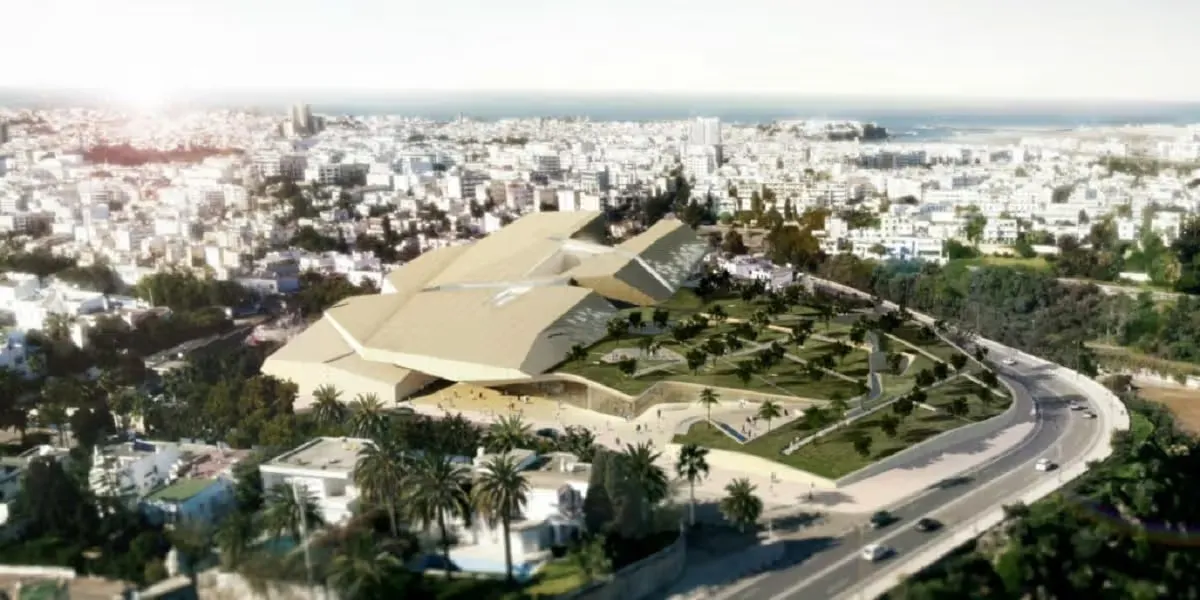
Construction on the Grand Museum of Archeology and Earth Sciences in Rabat has been at a standstill for over six months, particularly on the site of the former U.S. embassy. The project, which aims for an opening before 2030, is currently awaiting contractual clarification and a new tender process. However, the timeline for completion is slipping, and the final cost is projected to exceed one billion dirhams.
Key Highlights:
- The halt in construction is due to a financial dispute related to excavation work.
- The project’s resumption hinges on contractual clarifications and the initiation of a new tender to engage firms for the continuation of work.
- Originally set for completion by 2028, the timeline is no longer feasible, although the goal of opening before 2030 is still upheld.
- The initial estimated cost of 900 million dirhams is now expected to significantly exceed one billion dirhams.
The Grand Museum of Archeology and Earth Sciences in Rabat is touted as one of the most ambitious cultural projects in the region, with a planned completion timeline of no more than 36 months. However, after more than six months of total construction stoppage, sources close to the project disclosed the reasons behind this interruption and the likelihood of meeting the original budget and 2030 deadline.
According to insiders, the construction halt is not attributed to a lack of funding or a reconsideration of the project itself, but rather stems from a financial dispute concerning the excavation work. Reports indicate a disagreement regarding overcharging by the Italian company responsible for excavation, which has submitted claims deemed excessive by the project owner, Rabat Aménagement. Consequently, the resumption of construction cannot commence until there is a contractual clarification.
In essence, the restart of this extensive project, which previously employed workers around the clock, is now contingent upon launching and successfully concluding a new tender to select companies that will continue the work. This situation inevitably has financial implications.
The project is overseen by the National Museums Foundation (FNM), which is responsible for the scientific, cultural, and museological aspects, and is managed by the local development company (SDL) Rabat Aménagement, which oversees the operational aspects of public contracts related to preliminary studies and works integrated into the capital's cultural development programs.
With several months lost and the prolonged halt making adherence to the initial schedule impossible, a mechanical delay in the final delivery date is anticipated. Despite the initial plan for work to commence in early 2025 after awarding a tender related to the first construction lot, the project’s completion is now in doubt. However, it remains aligned with the authorities' goal of opening before the 2030 World Cup, jointly hosted by Morocco, Spain, and Portugal.
The financial implications of the project are set to increase as well. If the necessary funding remains intact, and no decisions are made regarding abandonment or scope reduction, it is likely that the state will need to allocate additional credits to complete the project. The interruption and subsequent resumption of construction after the tendering process are expected to incur significant additional costs. Given the delays since the project’s announcement in 2025 and the technical adjustments that will arise upon resuming work, combined with global inflation exacerbated by the Middle East conflict, an increase in the initial investment of 900 million dirhams is now unavoidable.
While an updated budget has not been publicly disclosed, sources suggest that based on previous tender amounts awarded in 2024 related to excavation, stabilization, technical controls, and studies, the final cost could exceed one billion dirhams substantially. Despite these unforeseen challenges, there is an optimistic outlook that once the tender processes are complete and companies remobilized, the construction will resume its normal pace, with the unchanged objective of establishing the Grand Museum of Archeology and Earth Sciences as one of Morocco's major cultural showcases before the 2030 deadline.
As reported by medias24.com.