
Analysis of the Events at Ceuta
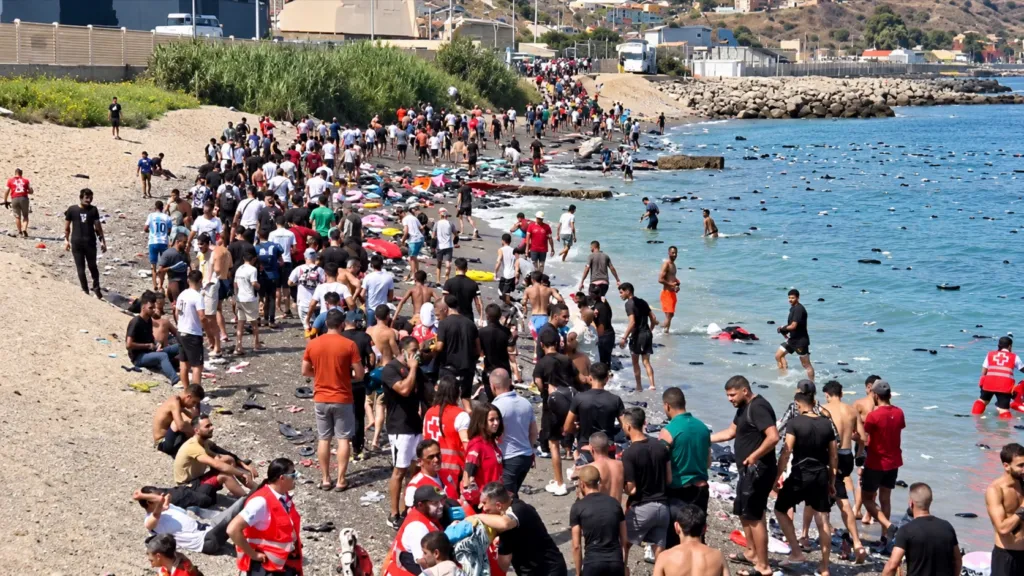
On July 30 and 31, a significant gathering of thousands of people occurred at the Spanish enclave of Ceuta, with many attempting to cross into Spanish territory from Morocco. Initially perceived as a spontaneous surge of migration, a recent report by the Spanish National Center for Immigration and Borders (CENIF) casts serious doubt on this notion, suggesting that the influx was part of a meticulously orchestrated campaign involving technical automation, strategic social media manipulation, and operational coordination. The report highlights that multiple indicators trace back to Morocco, suggesting a level of premeditation that warrants further investigation.
Evidence of Coordination and Planning
The investigators concluded that the mobilization efforts did not merely begin at the border; rather, they were systematically organized and prepared in social media networks days in advance. The report details how sophisticated automation tools and the involvement of experts allowed for targeted content dissemination, amplifying its reach significantly. CENIF's assessment is strikingly clear: the events were neither spontaneous nor random. The scale of technical and organizational effort observed exceeds what is typically associated with known criminal structures operating in the region.
Through their analysis, the investigators identified a communication pattern reminiscent of the SPREAD model, developed by David Dubois, which outlines the characteristics necessary for content to proliferate rapidly across social media platforms. The factors of provocation, emotional appeal, simplicity of sharing, ambiguity, and adaptability for various platforms and audiences were all present in the mobilization preceding the events at Ceuta. Initially, general calls for action circulated openly, which then transitioned to more specific messaging in closed groups as the date approached, ultimately evolving into operational coordination.
During the critical period from July 24 to 28, calls to action spread primarily through platforms like Facebook, Instagram, and TikTok. However, as the dates of July 30 and 31 drew closer, communication shifted to closed WhatsApp groups where discussions involved tactical movements and strategies for smaller groups, including warnings about monitored channels. The volume of messages skyrocketed, with the number of communications skyrocketing from 344 on July 28 to an astonishing 1,974 by July 30, marking a staggering 3,363.1 percent increase compared to the highest daily count prior to July 28.
Notably, approximately 90.8 percent of the analyzed phone numbers had a Moroccan prefix, although this does not necessarily indicate state involvement as many of these numbers could not be traced back to identifiable individuals. Yet, the political implications of the report extend beyond digital mobilization; it raises critical questions about the actions of Moroccan authorities during the border events. CENIF reported a 'low presence' of Moroccan security forces on the days in question, and more troublingly, there are allegations of 'active steering' of migrants towards specific border points, suggesting possible collusion or at least negligence on the part of Moroccan authorities.
In a contrasting scenario just weeks later, on August 15, another call to cross into Ceuta was met with a robust response from Moroccan security forces, successfully preventing crossings. This discrepancy raises questions about the operational readiness of Moroccan border security and whether the prior events were allowed to unfold deliberately. CENIF speculates that the second call was 'artificially more recognizable,' allowing Moroccan authorities to frame their subsequent actions in a more favorable light, leading to what they term a possible 'whitewashing' of their earlier inaction.
In conclusion, CENIF presents a picture of a campaign characterized by high technical planning, significant social media influence, and coordination among various structures, challenging the narrative of a spontaneous migration movement. While the report does not conclusively identify the Moroccan government as the orchestrator nor does it point to specific individuals responsible, it documents a structure and level of professionalism that contradicts the idea of a haphazard development, raising many suspicions towards Morocco. The overarching question remains: if the events at Ceuta were indeed premeditated, who possessed the capabilities to execute such an operation? The Spanish police have yet to provide a definitive answer, though their findings suggest that the spotlight is increasingly falling on Moroccan involvement.
As reported by spanienpress.com.