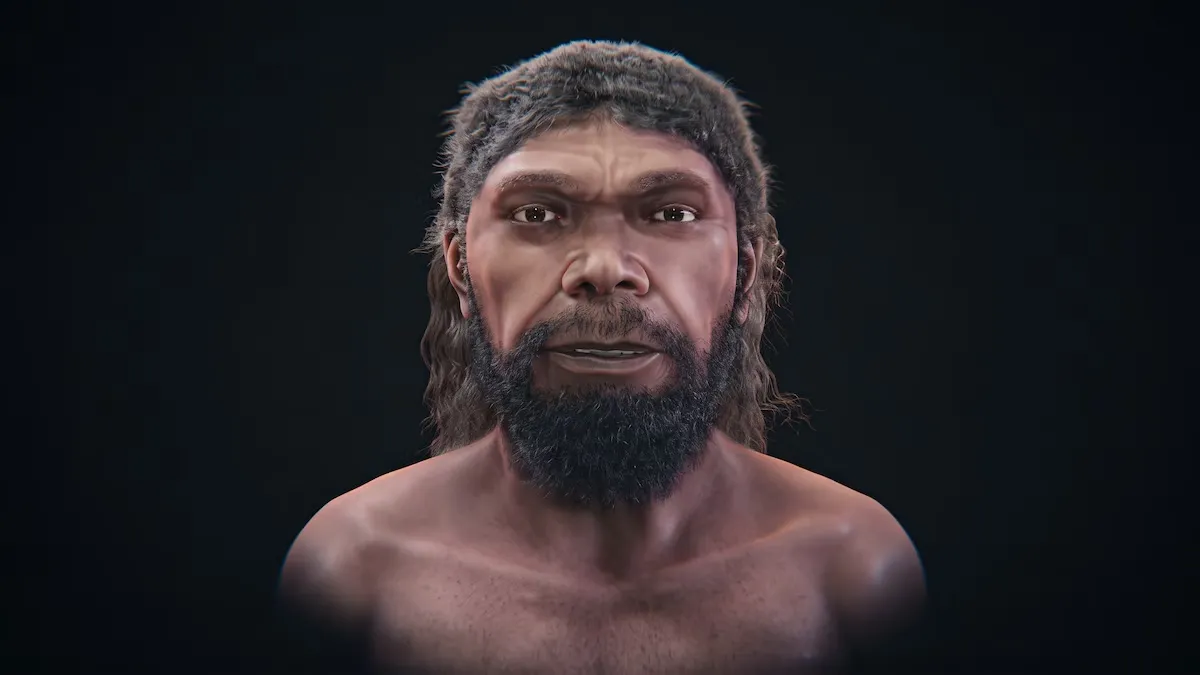

Unveiling the Ancient Face of Homo Sapiens
In a groundbreaking study, an international team of researchers has successfully digitally reconstructed the face of the oldest known Homo sapiens, based on fossils discovered in Jebel Irhoud, Morocco, dating back approximately 315,000 years. This remarkable achievement employed advanced three-dimensional modeling techniques and forensic facial analysis, traditionally used to identify individuals from skulls. The findings were published in the scientific journal Heritage.
Reconstructing a Prehistoric Ancestor
The fossils from Jebel Irhoud were accidentally uncovered during mineral extraction activities in the 1960s. Initially, the first skull found, known as Irhoud 1, was believed to be an African variant of Neanderthals, dated at around 40,000 years old. However, more precise dating methods have updated this estimate significantly, with studies in 2017 conclusively classifying the remains as Homo sapiens and establishing their age at approximately 315,000 years.
The reconstruction utilized a composite skull created from fragments of several individuals excavated from the same stratigraphic layer, with much of the structure derived from Irhoud 1, which provided the cranial vault and upper facial region. The mandible came from specimen Irhoud 11, while the maxillary region was completed with contributions from Irhoud 10, along with additional dental fragments from Irhoud 21 and 22.
To create the 3D model, the researchers started with digital images published by the Max Planck Institute for Evolutionary Anthropology in 2017. They employed photogrammetry—a technique that generates three-dimensional objects from photographs taken from various angles—to construct the model. The key technique in this process was controlled anatomical deformation, where a digital skull of a contemporary, anonymous adult was molded to fit the fossil's shape. This ensured that the adjustments remained true to the fossil's anatomical structure, preventing the addition of fictional or idealized features.
Two versions of the facial approximation were generated: a grayscale model without hair or beard, aimed at showcasing the direct correspondence between the reconstructed face and the original skull; and an artistic version that included color, skin pigmentation, hair, and beard, designed to engage the general audience. However, the authors clarify that the characteristics in the artistic version are not directly supported by the fossils but are based on anthropological studies of ancient North African populations.
The reconstruction also included the measurement of the endocranial volume, which was found to be 1,364 milliliters, aligning with previous studies on the same fossil. When converted to an estimate of brain size, this results in approximately 1,230 cubic centimeters, closely matching the average for modern adult males, which is around 1,234 cm³. The computed head circumference from the model was 60 centimeters, slightly above the average male adult size of 56.4 cm.
In conclusion, while this study provides a plausible approximation of what this individual may have looked like, it is important to note that there are no soft tissue data available for hominins from 315,000 years ago. The use of references from modern populations was a necessary methodological choice, not a claim that this individual resembled a contemporary human. The authors advocate that utilizing free tools and transparent methods offers a valid and replicable approach for exploring and reconstructing complex human fossils.
As reported by infobae.com.