
In a mesmerizing scene set within a traditional Moroccan Riad, men dressed in white gandouras gather, harmonizing in the gentle rhythm of a male voice as they pour tea from one glass to another—a time-honored practice that Moroccan parents often use to cool the tea before offering it to their children. The camera smoothly transitions past these individuals and glides alongside a wall adorned with vibrant blue and orange tiles, eventually arriving at a captivating courtyard. There, a striking figure sits gracefully upon a fountain, clad in a white caftan and holding an impeccably polished silver tray. As he sings, 'El kass hlou,' he evokes the sweetness of the cup, inviting listeners into a world rich with cultural significance.
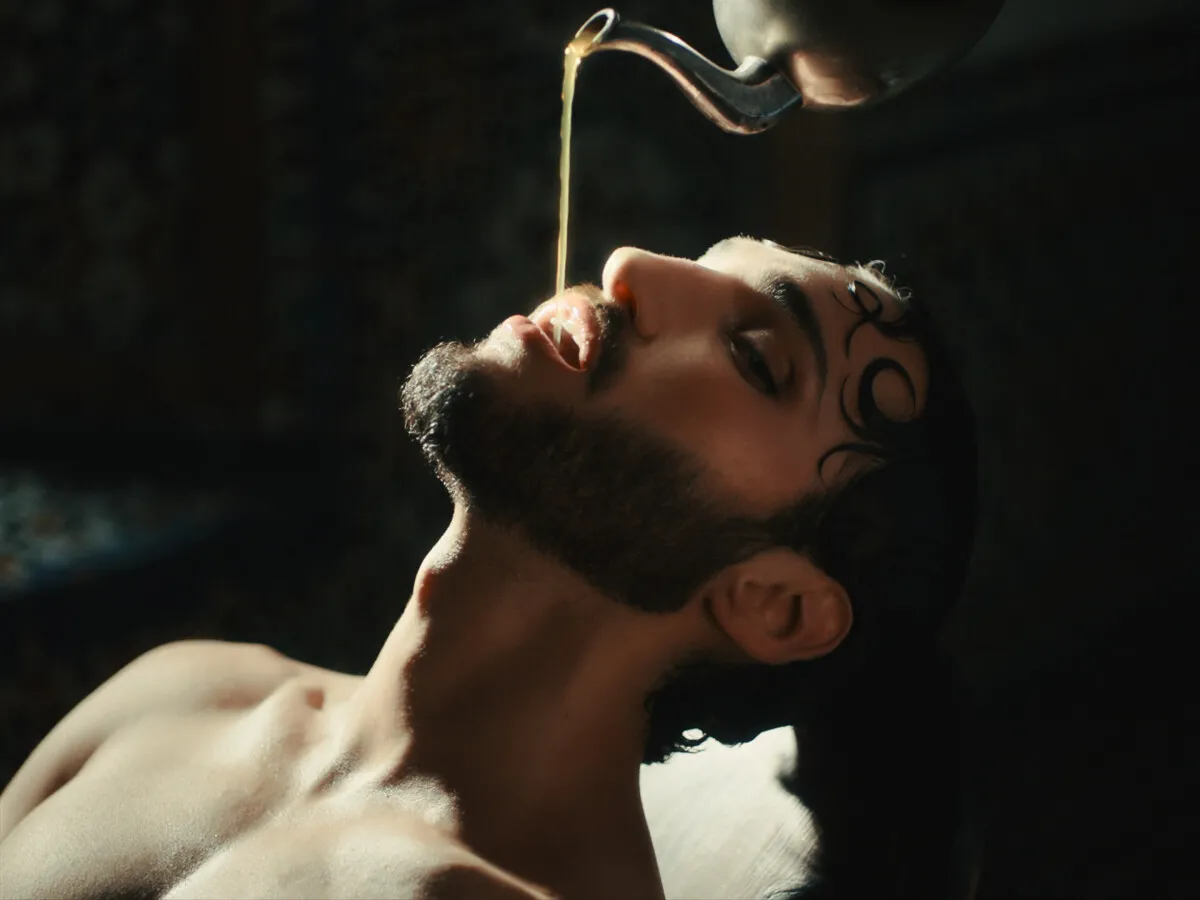
The caftan, once a unisex garment, has evolved to symbolize feminine elegance and bridal traditions in contemporary Moroccan society. Accompanied by a hauntingly layered vocal performance and minimal percussion, the visuals shift to reveal the man in a lush red room, loosely enveloped in black fabric. With a tarboush perched atop his head and a long ponytail cascading down his back, he dances with two silver teapots in hand. Returning to the courtyard, he kneels to receive hot mint tea poured into his mouth, proclaiming in English, 'You wanted me in hell.' He seamlessly transitions to French and Darija, elaborating on his journey to hell—not from condemnation, but rather to heat the tea.
These striking visuals are part of El Mehdi's groundbreaking work, 'El Film,' which boldly asserts a queer Moroccan identity. Born in Morocco and later relocating to Canada, El Mehdi's 'El Film' serves as the visual centerpiece for his debut EP, 'Salam,' which is infused with symbolism drawn from Moroccan traditions and everyday objects. Following its release, some critics dismissed the visuals as self-orientalization or self-fetishization. However, El Mehdi's meticulous approach to his art ensures that Morocco's stunning aesthetics serve as a vehicle for deeper, meaningful messages.
Reflecting on his work, El Mehdi humorously remarks, 'I’m not showcasing tea to encourage people to drink mint tea.' Instead, he refers to 'El Kass Hlou,' a song by Houcine Slaoui dating back to the 1930s. Through his research, he discovered that the original lyrics discussed a cup of alcohol, a subject that has been censored over the decades. 'It’s fascinating how this has been suppressed. A century-old song referenced topics that are now deemed incompatible with our society,' he notes. 'So I chose to reinterpret Slaoui’s version.'
El Mehdi's journey towards releasing his EP was laden with emotional intensity, yet he found profound support from his Amazigh family, a revelation that brought him to tears. In 'El Film,' his unbreakable silver platter symbolizes unity, contrasting with the fragility of the men's tea glasses. As he speaks while tea is poured into his mouth, he illustrates that cultural transmission is an active process—one that allows him to partake in culture while also expressing his true self.
El Mehdi's vulnerability is palpable throughout 'El Film' and the closing track of the EP; his disarming nudity signifies a fearless embrace of his identity. Adorning platform balgha, traditional yellow leather slippers, he asserts that it is possible to evolve while remaining connected to one’s cultural roots. He provocatively questions the notion of orientalism, asking, 'How can we reclaim autonomy over our bodies and sexualities and create nuanced representations if our expressions are continually framed by modesty, religion, or colonial narratives?' He challenges the audience to consider when they will reclaim their power, especially in a society where historical sexualization still influences perceptions of identity.
El Mehdi articulates a critical dialogue surrounding queer expression in the region, emphasizing that it is often misconstrued as a byproduct of Western influence. 'This perspective overlooks the diversity that exists within our culture,' he states, advocating for the recognition of internal representations. His lifelong dedication to art—from childhood sketches of Disney scenes to formal studies in visual arts—has culminated in a unique merging of artistic mediums. For him, a visual becomes a song, and a word inspires a video, with each project reflecting his meticulous craftsmanship.
In 'Encore,' one of the EP’s tracks, El Mehdi filmed on the rooftop of a fortress, adorned with traditional Amazigh jewelry from the Aït Atta tribe, connecting to his heritage. These pieces, which once belonged to his grandmother, symbolized a rich cultural legacy and the burdens of tradition. He poignantly shares, 'Wearing this jewelry reminded me of the weight of my ancestry, both physically and emotionally.'
As he navigates the complexities of his identity, El Mehdi embodies the struggle between feeling trapped by societal expectations and the desire for freedom. His art serves as a powerful statement, addressing the pain of feeling disconnected from his homeland while simultaneously being embraced by a global audience.
Through 'Salam,' El Mehdi introduces his narrative, revealing his journey from the fortress to the vibrant Riad of 'El Film,' claiming his place in a society that has often marginalized queer voices. The reception of his EP has stirred both support and backlash from the queer Moroccan community, prompting introspection and dialogue about the intersection of culture and identity. El Mehdi's work is a call to action—an invitation to explore the discomfort that arises when tradition meets queerness, and to understand the richness that such diversity brings to Morocco.
In conclusion, El Mehdi's artistic expression is a testament to the beauty and complexity of merging cultural heritage with queer identity. He advocates for a broader representation that celebrates diversity, urging society to embrace the multifaceted nature of Moroccan culture and the richness it can offer.
As reported by okayafrica.com.