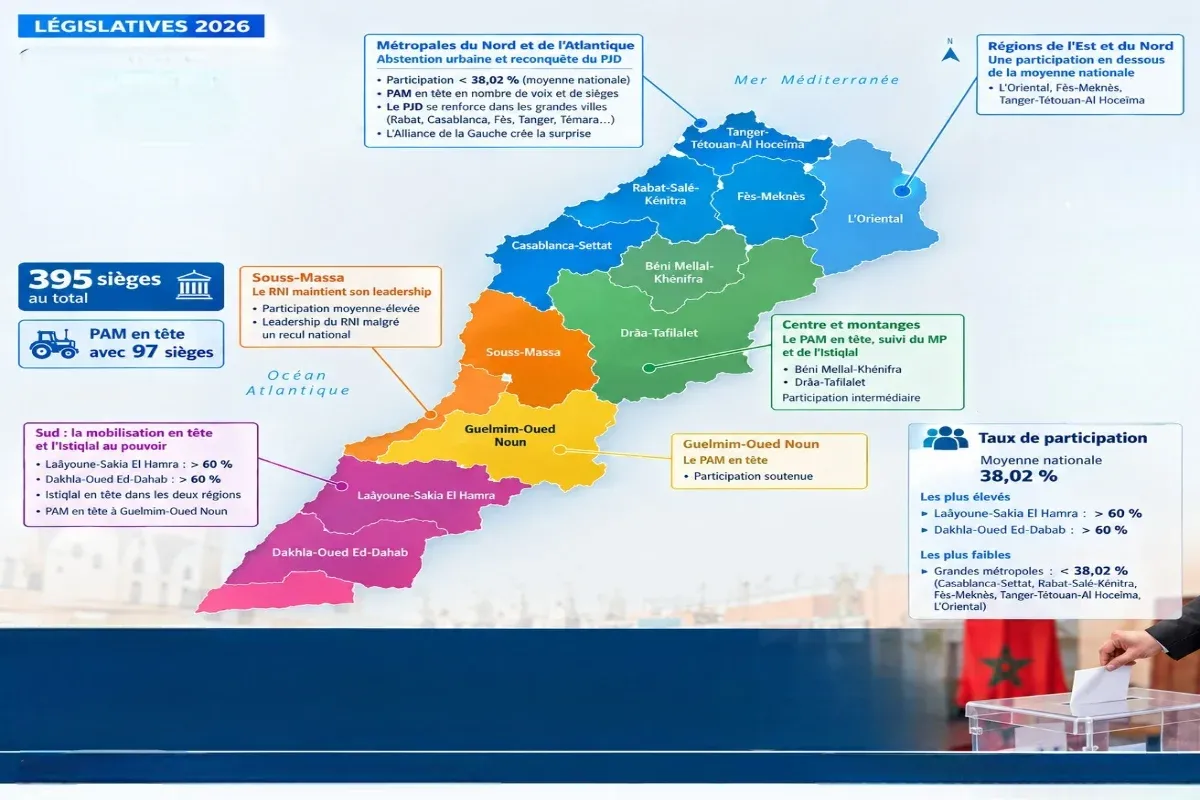

The recent legislative elections held on September 23, 2026, have unveiled a complex electoral map of Morocco, showcasing a dual territorial dynamic. While the overall distribution of the 395 parliamentary seats marks a significant victory for the Authenticity and Modernity Party (PAM), which secured 97 deputies, a deeper examination of the regional results reveals striking disparities in citizen mobilization and well-defined partisan affiliations across different areas.
Southern Regions: Leading in Mobilization with Strong Istiqlal Roots
The Saharan provinces have reaffirmed their role as a major reservoir of civic participation, with the Laâyoune-Sakia El Hamra and Dakhla-Oued Ed-Dahab regions reporting the highest voter turnout in the country, exceeding 60% on election day. Politically, the Istiqlal Party (PI) has emerged as the hegemonic force in these regions, solidifying its historical strongholds in Moroccan Sahara. In the transitional Guelmim-Oued Noun area, which also experienced robust voter turnout, PAM took the lead in securing seats.
Central and Northern Urban Areas: A Study in Contrasts
In the Souss-Massa region, characterized by a high voter turnout driven by agricultural and peri-urban areas, the National Rally of Independents (RNI) managed to maintain its regional leadership despite a national decline. Meanwhile, in the central mountainous and rural regions of Béni Mellal-Khénifra and Drâa-Tafilalet, the participation level remained moderate, allowing PAM to take the lead, closely followed by the Popular Movement (MP) and Istiqlal.
However, the starkest contrasts emerged from the populous urban centers in the North and along the Atlantic coast. In regions such as Casablanca-Settat (69 seats) and Rabat-Salé-Kénitra (49 seats), as well as Fès-Meknès and Tanger-Tétouan-Al Hoceïma, voter turnout plummeted below the national average of 38.02%. This urban disaffection did not prevent PAM from leading in overall votes and seats across these northern and central regions. Nonetheless, these large urban areas witnessed a significant political recalibration, with the Justice and Development Party (PJD) making a remarkable comeback by winning in several key cities, including Rabat, Casablanca, Temara, Fès, and Tanger, while the Left Alliance made surprising inroads in these urban centers.
This electoral geography, characterized by its two-faced nature, underscores the evolving political landscape in Morocco, which now revolves around a dual reality. On one side, the southern provinces and rural areas continue to play a stabilizing institutional role, marked by high electoral civic engagement and the dominance of traditional majority parties. On the other hand, urban metropolises reflect a growing dissatisfaction, evidenced by record abstention rates, while also serving as battlegrounds for parliamentary opposition and emerging forces.
Beyond PAM's numerical victory at the national level, the real challenge for the forthcoming legislature will lie in the ability of elected representatives to bridge this territorial and civic divide. Local governance and socio-economic redistribution in major urban centers will be critical tests for a reshaped majority, as cities have unmistakably expressed their desire to rebalance the political discourse.
As reported by fr.hespress.com.