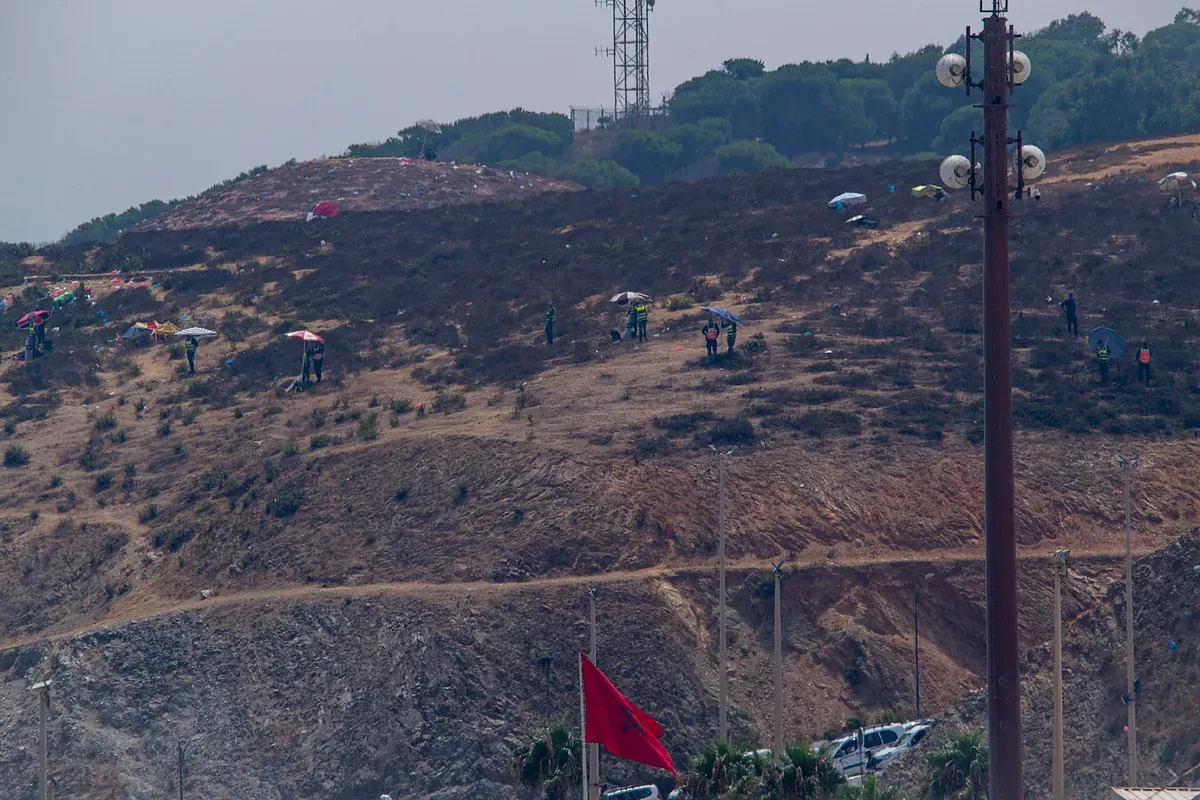

In light of escalating concerns regarding potential migrant surges, Morocco has implemented a robust security apparatus in anticipation of another attempted assault, particularly on August 15. Recent social media activity has seen a flurry of messages encouraging youth from various regions of the country to converge on Ceuta, prompting the Moroccan authorities to take decisive action. Following the overwhelming influx of approximately 80,000 individuals on July 30, which caught the government off guard, more than a thousand personnel from the military, police, gendarmerie, and auxiliary forces have been deployed. The fortified presence at the Moroccan border is visibly heightened, with concertina wire lining the beaches and military patrols observed in the hills overlooking Tarajal.
This security enhancement extends beyond the immediate border crossing to nearby towns such as Castillejos, Martil, Rincón, and Tétouan, as well as the roads leading to the Tanger area and the mountainous regions surrounding the area. Unusually high numbers of young individuals have been noticed at train and bus stations in southern Morocco and major cities like Rabat, Casablanca, and Agadir, with reports suggesting that some may have faced restrictions aimed at curbing their movement northward.
According to sources consulted by EL MUNDO, while there are currently no substantial indications of another mass surge, a prominent Spanish expert on illegal immigration warns that "we cannot afford to doubt this threat." Although consensus among experts suggests that a repeat of such a massive event is unlikely on the specified date, the expert cautions against complacency, stating, "We would face global ridicule if we allow another invasion to happen, given what we know now." This sentiment is echoed across security forces and the OSINT community, who utilize open-source information, particularly from social media, to monitor the situation at the border. Despite a surge in rumors and calls for action, the prevailing sense of alarm may paradoxically be reducing the likelihood of a large-scale incident.
One Moroccan businessman with ties to the intelligence services of both nations remarked, "I would say Saturday will be the quietest day of all." He noted that the Moroccan border is currently under military control, emphasizing that unaccompanied minors are not permitted in the area. The military's priority is to present itself as a reliable ally in the wake of the events of the past two weeks, even if their heightened response may seem somewhat performative.
The numbers surrounding this potential event are daunting. A recent Instagram user, with a modest following, posted a message indicating, "Whoever leaves Morocco on 15-08-2026, put a heart," which had garnered over 300,000 views, fueled by an algorithm favoring posts that incite such movements. Regardless of the developments tomorrow, experts are concerned that the weekend's security measures may prove superficial if not sustained over time. One OSINT specialist alerted authorities to the existence of 28 closed WhatsApp groups discussing an imminent assault, warning that if it does not occur on the 15th, it may happen on the 18th or 23rd, indicating a wider trend that has also affected Melilla.
In Ceuta, the security deployment includes rapid intervention vehicles, with new fences and concertina wire being erected along certain pathways to hinder passage. Riot control units are on standby, equipped with water cannons to manage gatherings and prevent potential clashes if a large group of migrants faces obstruction. The Moroccan Interior Ministry announced the arrest of a group suspected of inciting border crossings earlier in the week.
On the Spanish side, security has also been intensified. The maritime containment barrier, which has been established in Melilla, represents a new measure in Ceuta compared to the situation on July 30. Interior Minister Fernando Grande-Marlaska confirmed a police presence of 880 agents, an increase of 270 in just two weeks, alongside 714 Civil Guards, nearly 200 more than in July. Marlaska noted an additional deployment from the UPR (Prevention and Reaction Units), adding 45 more officers. With over 1,500 security personnel now on the ground, including military support, the overall force has surged by 50% since the influx.
As reported by elmundo.es.