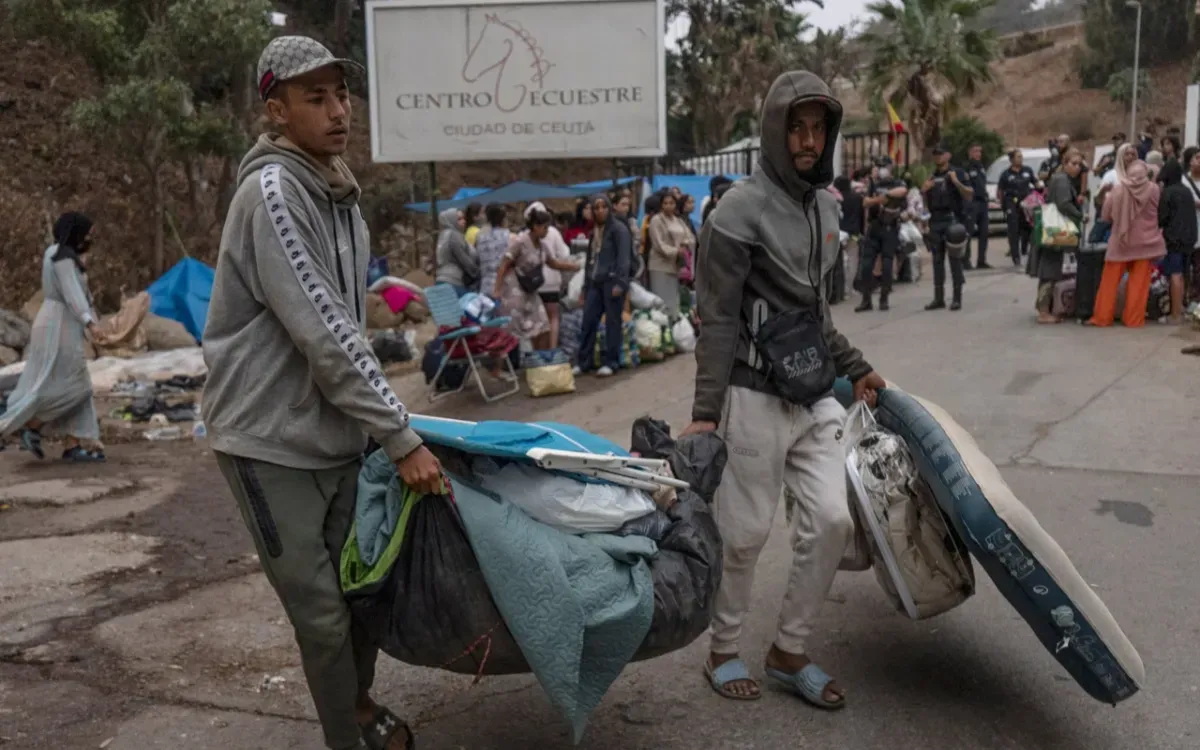
In the wake of a massive influx that overwhelmed Ceuta two weeks ago, the border is once again under heightened surveillance as of this Saturday. Morocco swiftly implemented extraordinary measures in response to social media calls for another crossing from Fnideq (Castillejos). This operation includes thousands of agents and military personnel, roadblocks on key routes, searches in surrounding forests, and the erection of new barriers at sea, all aimed at preventing a repeat of the unprecedented entry of tens of thousands of individuals that occurred on July 30th.
Meanwhile, Spain has also bolstered its border security throughout the week. Ana Redondo, the Minister of Equality, emphasized the need to avoid a repeat of such mass entries, stating, "We cannot allow another massive influx to happen." This statement comes as messages circulating on social media indicate that the border at Ceuta will be open on the 15th, coinciding with a public holiday in Spain.
Increased Security Measures from Tetouan to Fnideq
The Civil Guard is monitoring these social media calls in real-time, although it remains unclear who is behind the messages or how many individuals might respond to the invitation. The Moroccan security presence begins well before reaching the border. Since Thursday afternoon, the National Security, the Royal Gendarmerie, and Auxiliary Forces have established checkpoints in Tetouan, Rincón, and Fnideq to deter migrants from heading towards Ceuta. Along the road connecting Tangier to Fnideq, which spans approximately 80 kilometers, the number of checkpoints has significantly increased. Just eight kilometers from Ceuta, riot police were seen inspecting vehicles for individuals attempting to reach the border.
In Fnideq, dozens of empty buses, typically used for transporting migrants to cities in central and southern Morocco, have accumulated at a gas station that has been converted into an outdoor parking lot. Pressure is also mounting along the coastline, with the nearest urban beach to Ceuta remaining partially closed and secured by metal fences and vehicles from the Auxiliary Forces. Meanwhile, two large vessels from the Moroccan Royal Navy patrol the waters offshore. The land barrier has also been strengthened, with a structure of steel pillars extending five to ten meters into the sea, topped with barbed wire and metal nets to prevent migrants from swimming around the border pier. Additionally, wooded areas near the border are being patrolled in search of migrants, who, if found, are taken deeper into the country.
Contrasting Scenes at the Border
On the Spanish side, the stark contrast between the Moroccan side of the border and the relative normalcy at El Tarajal beach is evident. In these waters, where 82 bodies have been recovered, dozens of children played as the sun began to set, while just across the road, groups of young migrants gathered, aware of today's calls. The Navy has reinforced its presence with frigates Santa María and Navarra, yet the scene is markedly different from two weeks ago when civil guards and military personnel lined the shore.
Although military vehicles still frequent the streets of the autonomous city, the area they typically occupy was filled with a line of taxis bustling with journalists and cameras yesterday. Sources from the Ministry of the Interior reiterated that their primary focus remains on Ceuta while keeping a vigilant eye on Melilla, where groups of sub-Saharan migrants have been reported to be approaching the border.
In Melilla, where Rabat has also enhanced its border security measures, the Ministry led by Fernando Grande-Marlaska has deployed a group of GRS, comprising 55 Civil Guard agents, and a Police Intervention Unit (UIP), consisting of around fifty riot control officers.
As reported by lavanguardia.com.