
The European Union is currently grappling with the fallout from a significant influx of migrants attempting to enter the EU through the Spanish enclave of Ceuta. This crisis has prompted urgent discussions about the EU's collaboration with Morocco and other North African nations, raising critical questions regarding future migration policies and border security.
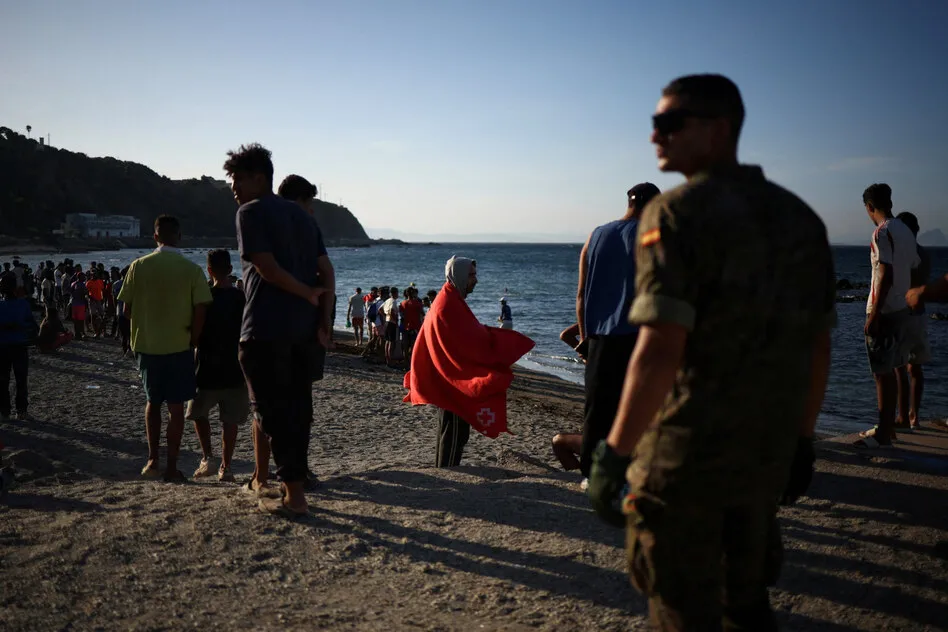
In the wake of the overwhelming number of migrants who arrived in Ceuta on Thursday, many have since returned to Morocco in the following days. Moroccan and Spanish border officials have resumed their regular duties at the crossing points, while Spanish soldiers have taken steps to fortify the border by extending the metal fence with a 500-meter floating barrier in the sea. This measure aims to make it more challenging for migrants to reach Ceuta. Tragically, at least 72 individuals have drowned in their attempts to cross the Mediterranean to Spanish territory since the surge began. The regional government of Ceuta is conducting underwater searches and estimates that the number of victims could be in the hundreds. Ceuta’s President, Juan Jesus Vivas, has publicly contradicted the Madrid government, which claims that the situation has returned to normal.
In response to the crisis, reinforcements from mainland Spain are attempting to funnel thousands of migrants, still estimated to be in the city of 83,000 residents, into a designated area. By Monday night, hundreds of young Moroccan men were transported to the border by military trucks. Among the remaining migrants are individuals from West and Central Africa who are reluctant to return to Morocco, which has so far refused to accept third-country nationals.
Many of these migrants have endured a harrowing journey, having fled conflicts in their home countries. For instance, a Senegalese migrant named Mantany Dieya shared his story of living in an informal camp near the Tunisian port city of Sfax for two years before attempting to reach Lampedusa by boat. After being intercepted and deported to Algeria, Dieya managed to make his way to Morocco with the assistance of smugglers.
The Spanish government is facing criticism from several EU member states and right-wing opposition parties over its liberal citizenship policies. Although the number of individuals swimming to Ceuta had been increasing prior to the mass influx, Prime Minister Pedro Sánchez did not respond until the crisis escalated. On Monday, EU ambassadors convened to discuss the situation, and on Tuesday, EU interior ministers are set to deliberate on potential responses to similar crises at the external borders.
This urgent meeting, requested by 22 member states, has led Sánchez to accuse them of lacking solidarity. Discussions include the possibility of deploying Frontex, the European border and coast guard agency, even against the wishes of individual member states. Additionally, Italian proposals to suspend Schengen rules have sparked outrage in Madrid.
The repercussions of this deadly surge are also being felt by the Moroccan monarchy, as the statement from the 22 EU member states indirectly addresses Rabat, asserting that "mass and uncontrolled border crossings, the instrumentalization of migration, or other hybrid threats must not create the impression that illegal entry into the European Union is possible." Many of the minors involved in the crisis reported being transported to Ceuta by bus or truck. Morocco has denied any responsibility, attributing the situation to misinformation on social media that incited people to undertake perilous journeys with the help of smugglers.
The EU interior ministers now face two pressing questions: Could a situation like the one in Ceuta occur again? And how resilient are the migration agreements with North African countries amid political crises? One thing appears certain: Sánchez's recent visit to Algeria, a rival of Morocco, has been perceived as a severe affront in Rabat.
Brussels has also established close cooperation with Tunisia and the competing governments in Eastern and Western Libya, supplying drones and patrol boats. Since then, the number of boats arriving in Lampedusa has drastically decreased. However, in light of the ongoing civil war in Sudan, an increasing number of people are fleeing northward, while tens of thousands in Libya and Tunisia await passage to Europe.
Several EU countries have reduced their support for the United Nations Refugee Agency. Tunisian and Libyan security forces are attempting to displace migrants traveling between Tangier and Agadez and the eastern Libyan city of Benghazi through deportations into the desert. Meanwhile, anger towards the ruling governments is on the rise in both countries, as well as in the Sahel region, due to ongoing economic crises. Last week, demonstrators stormed the office of Prime Minister Abdulhamid Dabaiba in Tripoli, with militias warning they would send boats to Europe if he were to be ousted.
An EU delegation last July refused to take photos with the internationally unrecognized government in Eastern Libya upon their arrival in Benghazi, leading to the Italian Interior Minister Matteo Piantedosi and EU Migration Commissioner Markus Brunner being declared personae non gratae.
In the weeks that followed, nearly 20,000 migrants arrived on the Greek islands of Crete and Gavdos, surpassing the numbers witnessed during the current Ceuta crisis. As Rome and Athens forged closer ties with Haftar, departures of boats from Eastern Libya became increasingly rare.
The looming success of the far-right AfD in the upcoming state elections illustrates the growing strength of extremist forces. Now more than ever, cohesion and solidarity are needed, especially with those who are actively working towards a robust civil society. The taz is collaborating with "Everything Begins in the Center," a campaign that supports leftist, self-managed spaces across the country and establishes a solidarity fund for their protection and preservation. An open society requires quality, accessible journalism and civic engagement. Do you agree? Join us and support our initiative.
As reported by taz.de.