
EU's Urgent Meeting on Ceuta Developments
On Tuesday, the interior ministers of the EU member states will convene in an urgent meeting to discuss the ongoing developments in Ceuta, as announced by Irish Prime Minister Micheál Martin on social media platform X. As part of their presidency duties, Ireland will lead this critical meeting of the EU Justice and Home Affairs Council, chaired by @OCallaghanJim, to address the pressing situation. The Irish government has emphasized its commitment to maintaining close communication with all member states and relevant institutions while continuously monitoring the unfolding crisis.
Both Spanish Prime Minister Pedro Sánchez and the leaders of 22 out of the 27 EU member states have called for a video conference to discuss the matter, albeit for differing reasons. While several EU members criticized the Spanish government’s handling of the situation, Sánchez accused some partners of displaying “selfish” and “illegal” reactions. He expressed concerns that their attitudes were driven by “prejudice, misinformation, ignorance, or political interests,” stating that such behavior is unacceptable for the European Union at this critical time in a letter addressed to the heads of European institutions.
Concerns Over Illegal Immigration and Border Control
The collective letter from the 22 leaders stressed that the EU must not allow “mass and uncontrolled border crossings, the instrumentalization of migration, or other hybrid threats to create the impression that illegal entry into the European Union is feasible.” They asserted that illegal entry should not lead to a legal residency status, which can be interpreted as a critique of the Spanish government's recent decisions to grant residency permits to hundreds of thousands of irregular migrants earlier this spring. German Chancellor Friedrich Merz (CDU) also signed this open letter, reinforcing the collective stance.
European Commission President Ursula von der Leyen welcomed the upcoming meeting, advocating for a process to “strengthen our European resilience.” However, she pointed out that “not a single person has reached the Spanish mainland or the rest of the EU.”
German Foreign Minister Johann Wadephul (CDU) remarked in an interview with Bild am Sonntag that securing the EU’s external borders is of utmost priority. He described the situation in Ceuta over the past few days as an absolute stress test that the EU has passed, although he acknowledged it has revealed Europe’s vulnerabilities.
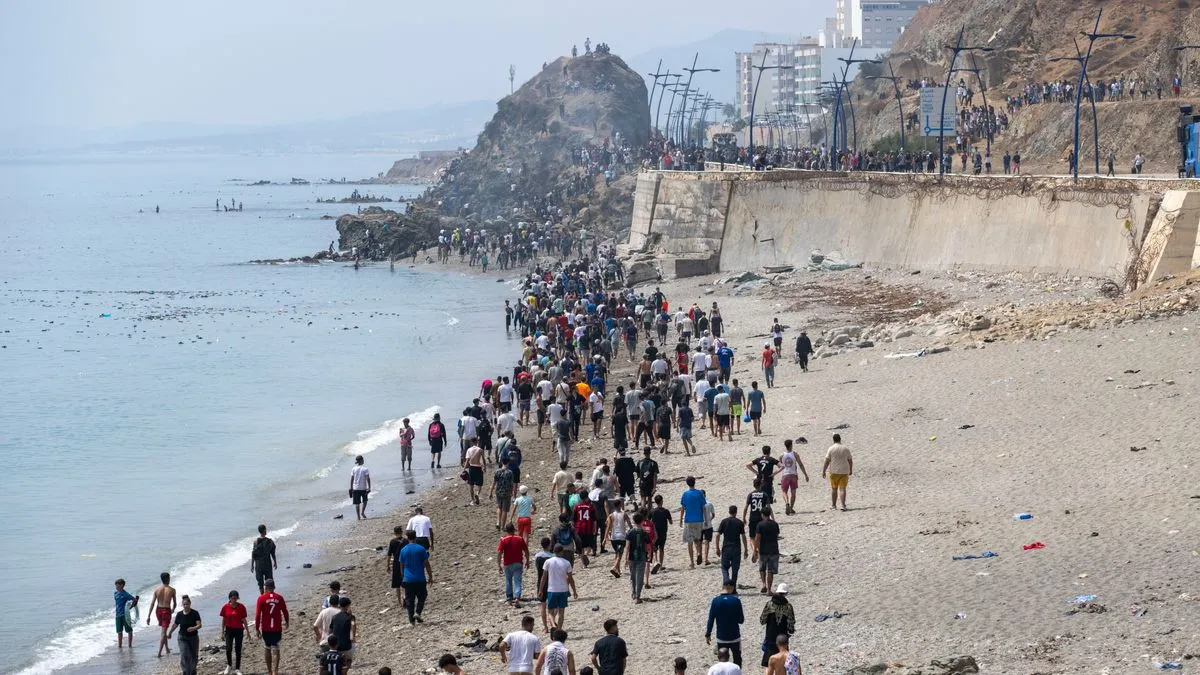
According to the Spanish government, nearly all of the estimated 50,000 to 60,000 individuals who managed to reach the Spanish exclave from Morocco within a short timeframe have voluntarily returned, as they faced limited prospects for further travel into the EU. Additionally, there was a significant lack of shelter and resources available for those who remained.
Many of those who continue to stay in Ceuta are minors, who have shared stories of violence and hope amidst the turmoil. For more insights, you can read a detailed report from the city.
As reported by spiegel.de.