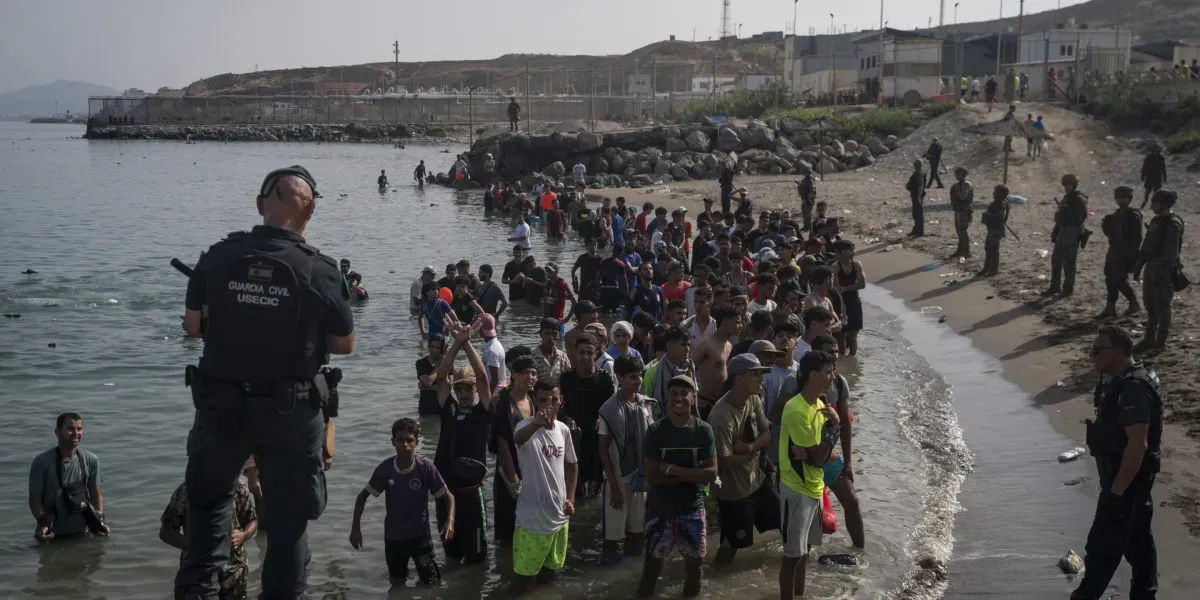

Europe finds itself once again at the center of a heated debate regarding immigration, as a recent surge of migrants crossing from Morocco to the Spanish enclave of Ceuta has ignited tensions among EU member states. On August 4, 2026, European interior ministers convened for an emergency meeting to address the crisis that saw approximately 70,000 individuals attempt to breach the heavily fortified borders of Ceuta, with many risking their lives by swimming across the treacherous Mediterranean Sea. Tragically, this perilous journey resulted in the drowning of 88 individuals within just two days. Although Spanish authorities managed to return the majority of these migrants to Morocco with the cooperation of Moroccan officials, the incident quickly became a rallying point for far-right factions across Europe, eager to leverage the situation to bolster their anti-immigration agendas.
The current episode is not unprecedented; Ceuta has long been a focal point for migrants seeking a better life in Europe. However, the scale of this latest influx has prompted urgent discussions reminiscent of the 2015 migration crisis, which previously strained the fabric of the European Union. This latest instance is not solely a consequence of misinformation or a sudden influx of individuals fleeing violence and instability. Instead, it underscores the deep-seated disagreements and lack of coordinated response among EU nations regarding immigration policy.
Understanding the Factors Behind the Migration Surge
Discontent among Moroccans, particularly in the northern regions, has been simmering for years. Many cite stark economic disparities between their communities and the nearby Spanish enclaves as significant motivators for their migration. In 2024, the GDP per capita in Morocco was a mere $4,153, starkly contrasting with $26,774 in Ceuta. This economic inequality has compelled some Moroccan women, often referred to as "mule women," to undertake hazardous journeys to transport goods for sale in Ceuta, further highlighting the desperate circumstances many face.
Under typical circumstances, thousands of migrants manage to cross into Ceuta and Melilla each year, with 2,582 individuals making the journey between January and April 2026 alone. However, the sudden spike in numbers last week has puzzled observers, prompting various theories. Spanish Prime Minister Pedro Sánchez pointed to trafficking groups that circulated false rumors about a recent Supreme Court ruling, stirring hope among migrants that they might reach Spain and subsequently Europe for better opportunities. This ruling centered around the complex legalities of asylum applications at maritime borders, echoing similar legal debates within the U.S. regarding asylum seekers at its southern border.
Despite the legal complexities, Spanish authorities have largely escorted migrants back to Morocco, allowing only select individuals from non-Moroccan nationalities to apply for asylum. This ongoing situation further complicates the relationship between Spain and Morocco, with the latter viewing the enclaves of Ceuta and Melilla as occupied territory. The historical context of this relationship reveals a pattern of cooperation and tension, particularly concerning migration policies and regional disputes.
Implications for European Immigration Policy
The events of July have illuminated the enduring impact of the 2015 migration crisis, during which over a million people arrived in Europe from Turkey and North Africa, leading to significant political and social upheaval. The EU's response at that time involved a series of contentious summits aimed at establishing a cohesive migration policy. However, many of these initiatives, such as mandatory quotas for refugee distribution, fell apart amid accusations and resistance from several member states.
In recent years, the EU's approach has shifted towards providing migration management aid, attempting to address the root causes of migration in countries like Morocco. However, this strategy has often backfired, strengthening authoritarian regimes while failing to stem the tide of migration. As a result, the recent migration surge has prompted calls from various EU leaders, including Italy's Prime Minister Giorgia Meloni, for stronger border security measures and even the suspension of Spain from the Schengen zone.
While EU leaders have promised increased funding for border security and cooperation with African governments, the underlying socio-economic issues driving migration persist. Until Europe addresses these root causes, including economic inequality and governance challenges in neighboring regions, it is likely that incidents of large-scale migration will continue to recur, creating further divisions and crises within the EU.
As reported by fortune.com.