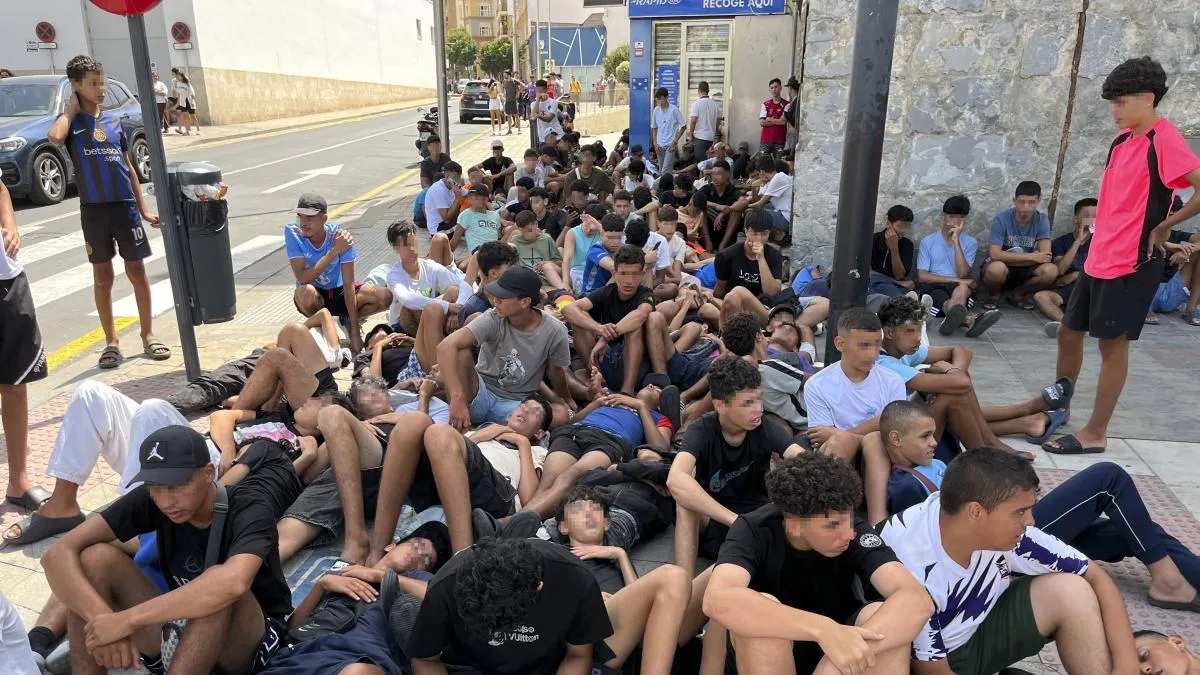

The European Commission has unequivocally stated that EU law supports the return of all migrants who crossed the fence in Ceuta at the end of July, including unaccompanied minors. This was emphasized by the Commission's spokesperson for Home Affairs, Markus Lammert, who reiterated that EU law indeed allows for such returns. He highlighted that the primary objective of the European Commission is to ensure that Moroccan authorities maintain control over the situation and guarantee the swift return of all individuals residing irregularly in the autonomous city.
During a press conference at the European Commission, Lammert stressed, “We continue to insist that the expectation is for all those who remain illegally in Ceuta to be returned.” He further clarified that this includes unaccompanied minors, pointing out that “there is a specific article in the directive regarding this matter.”
Financial Aid Request from the Spanish Government Awaited by the EU
The directive in question is a regulation approved in 2008, which is rather protective and its implementation is not automatic. It stipulates that before a return decision is made regarding an unaccompanied minor, relevant services should be provided in the child's best interest. Additionally, it specifies that prior to expelling an unaccompanied minor, a member of their family, a designated guardian, or adequate reception services in the country must be ensured. The directive aims to limit the detention of unaccompanied minors and families while establishing appropriate detention conditions.
This directive is set to be replaced soon by a stringent new returns regulation recently approved by the Council and the European Parliament, which aims to enhance the effectiveness of repatriation orders and the expulsion of migrants without asylum rights. This new regulation, which allows for the establishment of controversial migrant centers in third countries similar to those built by Italy in Albania, has yet to come into force due to pending bureaucratic processes and the need for publication in the EU's official journal, despite receiving approval from the European Parliament, facilitated by votes from the center-right and far-right parties.
The forthcoming legislation closely mirrors the existing provisions regarding unaccompanied minors. It emphasizes the pursuit of the “best interests of the child,” which must be safeguarded by a representative capable of advocating for this interest. Moreover, it specifies that minors should be returned to a family member, a designated guardian, or a suitable reception center in their country of return. Importantly, unaccompanied minors will be excluded from future return centers in third countries. Under the new regulation, immediate age assessments will be conducted, and despite facing criticism, detentions of unaccompanied minors and families with children will occur only as a last resort.
The European Commission has also indicated that it has yet to receive an official request from the Spanish Government for urgent financial assistance to address this migration crisis, even though Minister Elma Sainz mentioned in an interview with Cadena Ser that such funds had been requested. According to Lammert, “informal contacts are ongoing regarding how this could be proposed, but Spain needs to submit an official request.”
As reported by lavanguardia.com.