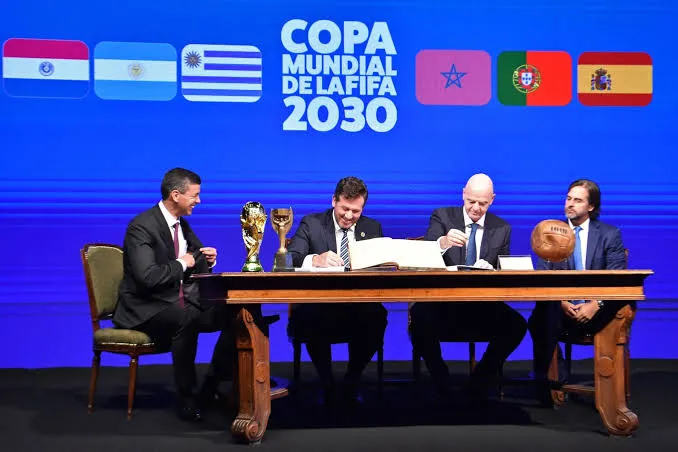

The upcoming **2030 FIFA World Cup** is set to be a historic event, marking a monumental celebration for the sport of football. Scheduled to take place from **June 8 to July 21, 2030**, this edition of the World Cup is particularly significant not only because it commemorates the centenary of the inaugural tournament held in **Uruguay** in **1930**, but also as the first World Cup to be hosted across **three continents** and **six countries**. The tournament will span **Europe, Africa, and South America**, showcasing a diverse array of cultures while connecting cities that are separated by vast distances.
The decision to host matches in these regions is deeply rooted in history. A century ago, Uruguay was the birthplace of the World Cup, and now, the FIFA has chosen to symbolically return to its origins for this special occasion. The initial matches will honor this legacy by taking place in the **Southern Cone**, with the majority of the tournament continuing across the **Atlantic Ocean**. The final is expected to be held in mid-July, with Morocco aiming to construct a new stadium to serve as the venue for this grand conclusion.
Host Countries and Opening Matches
The official host countries for the **2030 FIFA World Cup** will be **Spain**, **Portugal**, and **Morocco**. Additionally, in celebration of the centenary, opening matches will also be played in **Uruguay**, **Argentina**, and **Paraguay**. This decision by FIFA is a tribute to South America, recognizing its pivotal role in the inception of the World Cup in the 1930s.
According to the current format, which maintains the inclusion of **48 teams**, there will be a total of **104 matches** played throughout the tournament. Of these, three matches will be designated as centennial games, taking place in Uruguay, Argentina, and Paraguay. The remaining 101 matches will be distributed among the other host nations, although specific allocations have yet to be announced. Projections suggest that Spain may host the highest number of matches due to its developed infrastructure and available venues, while Portugal and Morocco are expected to accommodate fewer games.
Why is the 2030 World Cup Unique?
The **2030 FIFA World Cup** will feature a unique shared hosting arrangement between three confederations. The competing bids included a joint proposal from Morocco, Portugal, and Spain, endorsed by **CAF** and **UEFA**, as well as a bid from Uruguay, Argentina, and Paraguay, supported by **CONMEBOL**. Ultimately, FIFA opted for this collaborative approach to leverage the strengths of each region while ensuring a commemorative atmosphere for the centennial celebration. The major portion of the tournament will be held in Morocco, Portugal, and Spain, where the infrastructure and technological capabilities are already well established. The centennial commemorative match will take place in **Montevideo**, Uruguay, as part of the festivities honoring the host nation and the first World Cup champion. Argentina will host another match in recognition of its role as a finalist in that historic tournament, and Paraguay will also welcome a game in acknowledgment of its status as the host of the **South American Football Confederation**, which played a vital role in the World Cup's early history.
As reported by olympics.com.