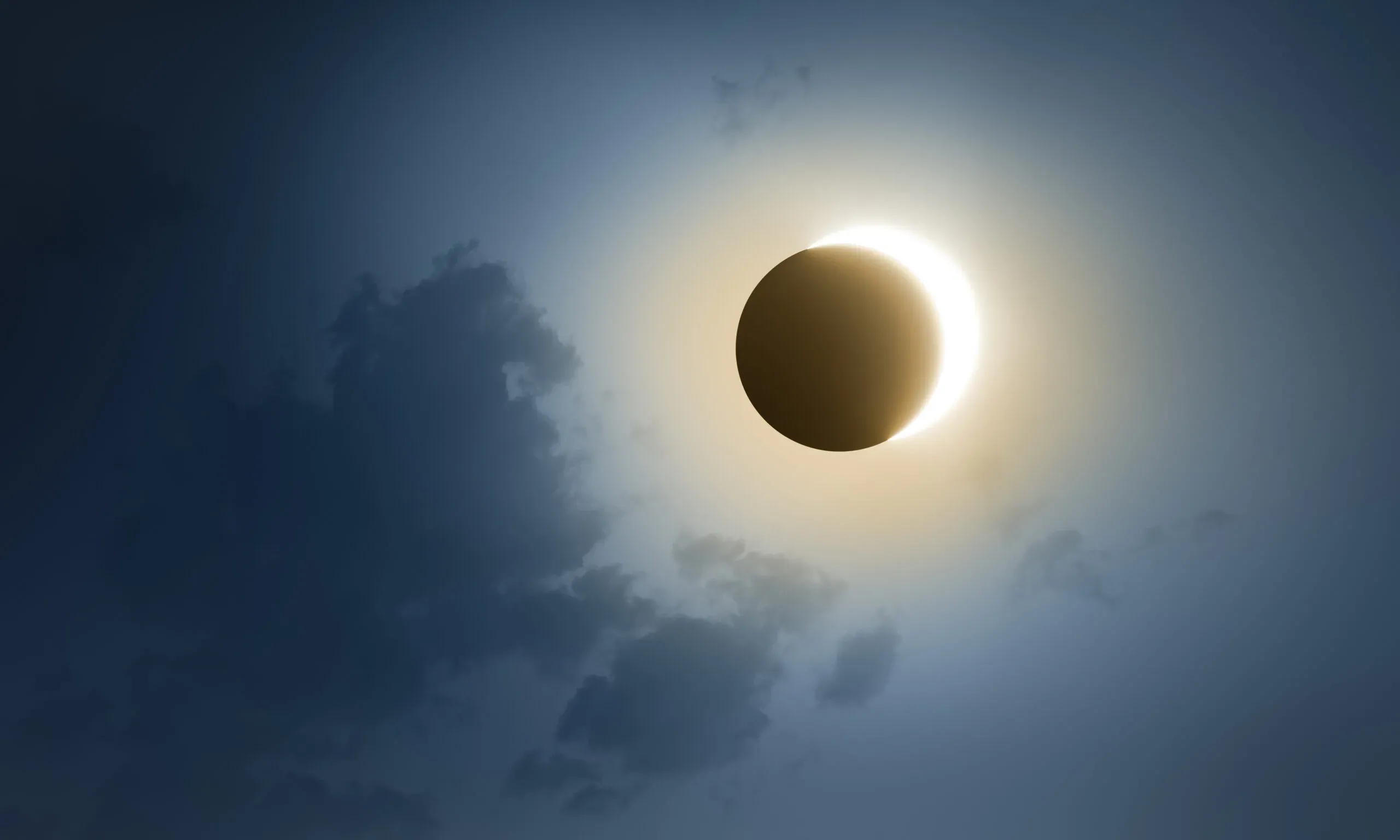

Partial Solar Eclipse to Grace Morocco on August 12
On August 12, 2023, Morocco will be treated to a breathtaking partial solar eclipse, captivating observers across the nation. While the phenomenon will be visible throughout the country, those residing in the northern regions will experience the most substantial coverage, making it a significant event for astronomy enthusiasts and casual viewers alike. This celestial event is set to commence at approximately 6:44 p.m. local time near Lakhouayyet in northern Morocco, concluding around 8:40 p.m. near Agadir. Given the late timing of the eclipse, viewers should expect the Sun to appear low on the western horizon, potentially setting while still partially obscured by the Moon.
Among the major Moroccan cities, Tangier will witness the highest degree of obscuration, with about 92% of the Sun hidden during the eclipse. The observable phases in Tangier will start at 6:44 p.m., peak at 7:40 p.m., and end at 8:31 p.m., leading to a total duration of approximately one hour and 47 minutes. In the capital city, Rabat, the eclipse will initiate at 6:47 p.m., reach its maximum at 7:43 p.m. with an impressive 88% coverage, and wrap up by 8:34 p.m. Casablanca isn’t far behind, expecting around 87% coverage, starting at 6:48 p.m., peaking at 7:43 p.m., and concluding at 8:35 p.m. Meanwhile, Fez will enjoy about 90% coverage from 6:47 p.m. until 8:33 p.m., with its peak occurring at 7:42 p.m. Marrakech will see approximately 83% coverage between 6:52 p.m. and 8:38 p.m., with the maximum at 7:46 p.m. Lastly, Agadir will experience around 79% coverage, beginning at 6:54 p.m., peaking at 7:49 p.m., and ending at the same time as the eclipse in other cities, around 8:40 p.m.
Safety Precautions and Cultural Significance
It is essential to note that Morocco will not experience a total eclipse; the Moon will completely obscure the Sun along a narrow path that traverses northern Russia, Greenland, Iceland, the North Atlantic, northern Spain, and a small section of northeastern Portugal. For those in Morocco, viewing the eclipse safely is paramount. NASA emphasizes that it is never safe to look directly at the Sun during a partial eclipse without appropriate eye protection. Observers should utilize certified eclipse glasses or handheld solar viewers that meet the ISO 12312-2 safety standard. Conventional sunglasses, smoked glass, photographic film, and homemade filters are unsafe alternatives. Additionally, individuals using cameras, binoculars, or telescopes must ensure that proper solar filters are affixed to the front of their equipment to prevent eye damage.
Given the evening timing of the eclipse, many individuals may find themselves on the road or at the beach. It is critical to remember that eclipse glasses should never be worn while driving; drivers must remain focused on the road and utilize a sun visor if the low Sun is in their line of sight. Moreover, NASA advises anyone who plans to stay outdoors for extended periods during the eclipse to apply sunscreen, wear protective clothing, and don a hat to mitigate sun exposure.
From a cultural perspective, the eclipse carries religious significance for Muslims, who traditionally observe Salat al-Kusuf during such celestial events. However, the Ministry of Endowments and Islamic Affairs has announced that this prayer will not be conducted in mosques due to the eclipse occurring after the Asr prayer. Instead, the Ministry encourages individuals to engage in supplication and seek forgiveness during this extraordinary moment.
As reported by moroccoworldnews.com.